Expectations: Thorong Peak Climbing
While planning a Thorong Peak expedition (6,144 m), climbers should feel a thrill of adventure and excitement. It is not technical climbing. However, good physical fitness, endurance, basic level of mountaineering using ice axes, crampons, and ropes are required.
“The trek offers a breathtaking backdrop of Himalayan peaks, including Annapurna I, II, III, IV, Gangapurna, Manaslu, Pisang, Nilgiri, Dhaulagiri, and the Thorong massif.”
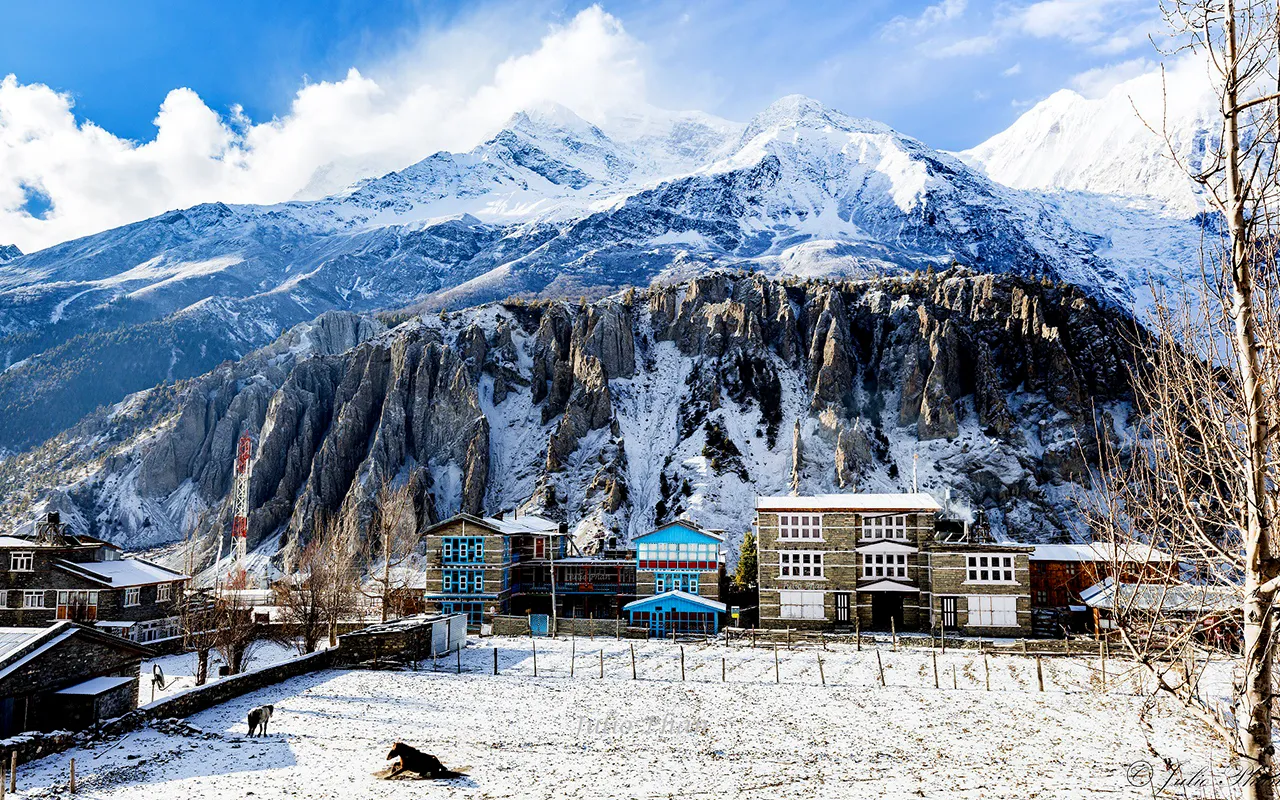
“Along the way, trekkers pass through lush forests, alpine meadows, and terraced farmlands, creating a constantly changing landscape.”. Culturally, you’ll pass through the Gurung, Manang, and Thakali communities, where you can see their ancient Buddhist monasteries and learn about their traditions & values.
You can expect comfortable and basic facilities through the tea house accommodations. “Food will be nourishing and healthy. At higher altitudes, you will stay in tented camps with limited amenities.” However, at high altitude, you have limited choice.
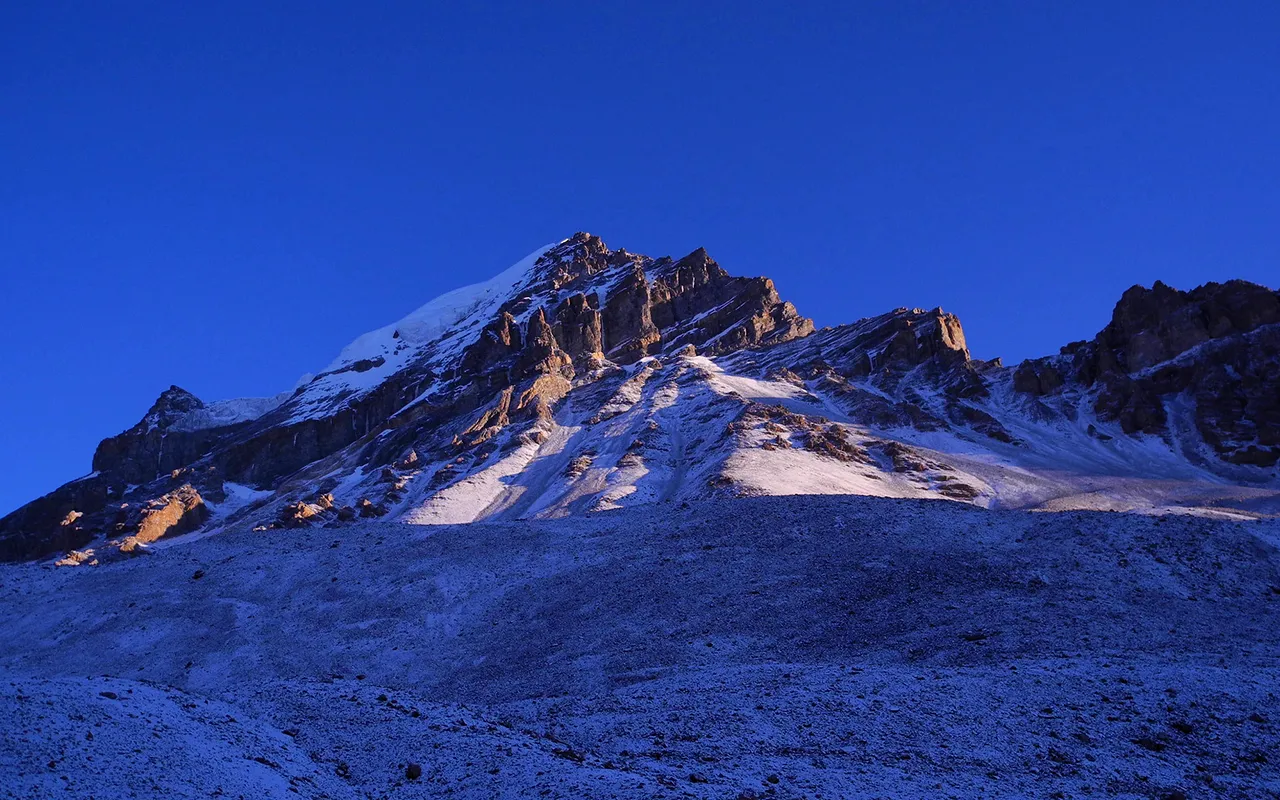
“Climbing above 6,000 meters presents challenges such as thin air, cold temperatures, and freezing nights.”
In short, Thorong Peak Climbing is full of excitement, adventurous, and thrilling mountain climbing with the majestic Himalayan vistas from the summit, but it is also physically demanding, with challenging altitudes and basic living conditions.
What is the Difficulty Level of the Thorong mountain expedition?
The Thorong Peak Climbing is generally regarded as of moderate technical difficulty, making it more suitable for those who have previous mountaineering experience.
The length, duration and altitude of the trek are challenging. You have to walk 6-7 hours per day, average 600-700 meters gain every day.
The most significant part is the high altitude. At over 6,000 meters, the oxygen level drops. As a result, trekkers might face several obstacles and symptoms like nausea, vomiting, dizziness and shortness of breath.
The trek leads us to the rugged terrains, rocky paths and slippery trails that can be more complicated.
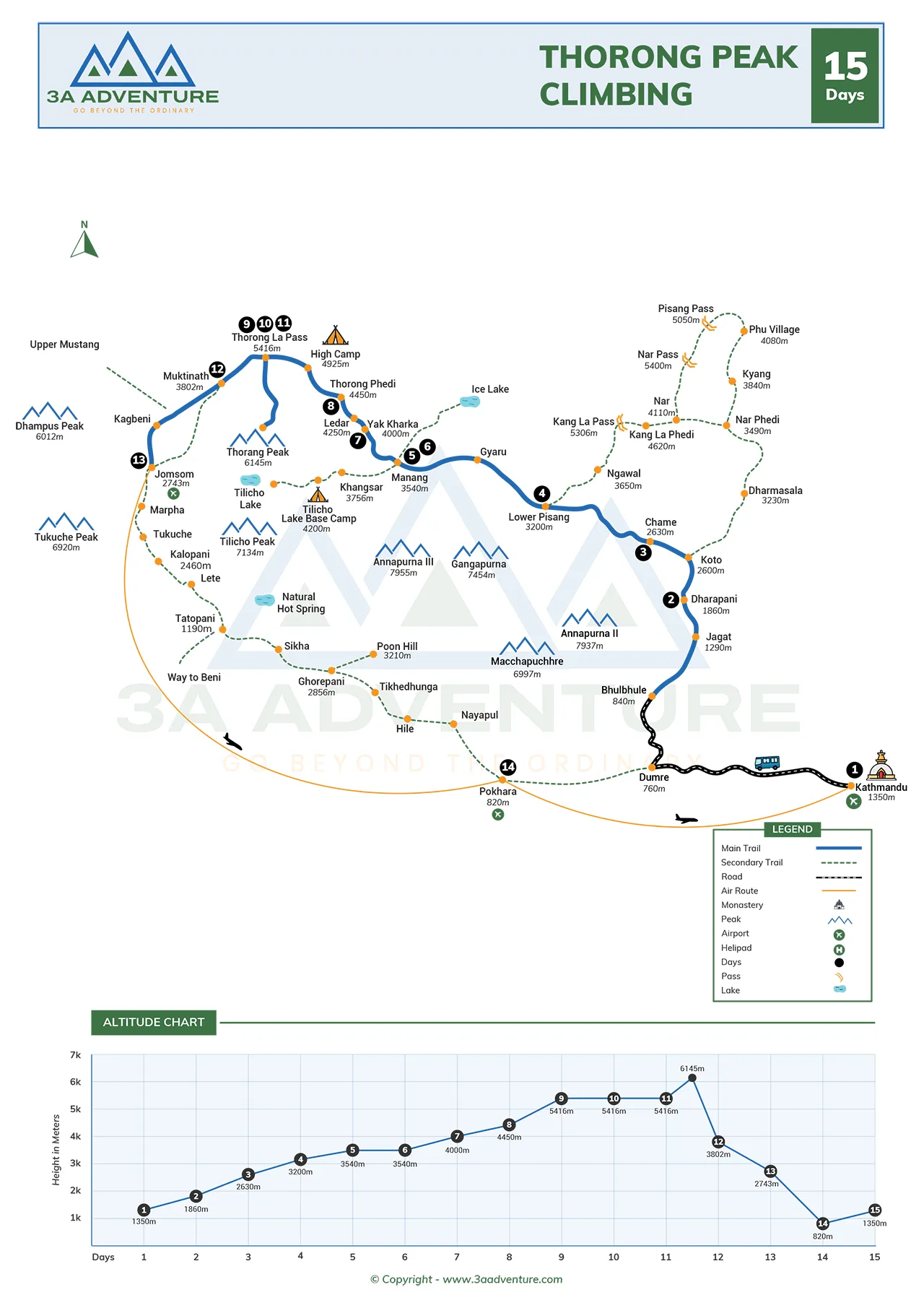
The Thorong Peak Climbing demands some technical aspects. The hikers have to use gear like crampons, ropes, and ice axes on the 12th day of the trek.
In the lower parts, the trekkers get the basic facilities of the accommodations through the tea houses. However, at the higher altitudes, tent camping is required with limited food facilities.
The weather is unpredictable and unstable even in the Himalayas, even in Spring and Autumn. The sudden storms, poor visibility, freezing temperatures, and instant snowfall create difficulty on the summit day.
Physical fitness, basic mountain training and the right gear play a significant role in enjoyable climbing.
Trek Preparations
The Thorong Peak Climbing is a 15-day-long and strenuous trek. You have to make proper trek preparations for the successful execution of this thrilling journey.
To make the trip enjoyable, you must have excellent fitness. You’d better get involved in endurance training and cardio exercises like swimming, jogging, and running at least 7-8 weeks before the trip.
The strength training – squats, lunges, and planks is equally significant for the uphill climbing.
Taking basic mountaineering training will be fruitful for you. If possible, hike at elevations above 2000-2500 meters.
Your mental health equally plays a crucial role during the journey. A practice of Yoga and meditation leads you to a peaceful and pleasant hike. Keep your mindset to live with limited facilities and less luxurious for two weeks.
Remember, your gears will be your best friend on the trek. Prepare all your equipment – ropes, footwear, crampons, ice axes, and trekking poles.
Take all the necessary documents and a copy of your travel insurance during the trek. Carry a sufficient amount of cash rupees to the ATM centre available till Dharapani.
Altitude Sickness & Preventions
Altitude Sickness is a state of body not disease. It is a condition when the hiker’s body doesn’t adjust with the oxygen at the altitudes. On the Thorong Peak Climbing, the trekkers go above 6,000 meters; as a result, the body doesn’t get sufficient oxygen. It affects anyone regardless of excellent fitness, age, and mountaineering experiences.
Nausea, vomiting, fatigue, dizziness, loss of appetite, trouble sleeping, and shortness of breath are some of the very common symptoms that hikers have to face.
If the condition becomes worse, it leads to severe high-altitude problems that include Acute Mountain Sickness (AMS), High Altitude Cerebral Oedema (HACE), and High-Altitude Pulmonary Oedema (HAPE).
To diminish the risk of altitude sickness, we have acclimatised and rested during our journey. It is necessary to adapt and adjust to the high altitude and changing environments while you are on the trek..
Here are some essential preventive measures that are helpful for trekkers.
Gradual Ascent: Manage your acclimatization and give priority to the gradual ascents. Keep steady and don’t be in a hurry while trekking.
Stay Hydrated: Stay hydrated and drink at least 3-4 liters of safe water during the journey.
Proper Nutrition– Eat healthy, nutritious and high calories foods while you are on the trek.
Alcohol & Tobacco – Avoid consuming alcohol, cigarettes, and chewing tobacco during the journey. It low down your stamina energy and strength
Medicize –Consume the Diamox, aka Acetazolamide before the high-altitude hike
Listen to your body – Never ignore any health symptoms you feel during the journey.
Oxygen Supports – Thorong Peak is a high-mountain expedition. It will be better to carry portable oxygen if possible.
Is Thorong Peak climbing possible for the beginner’s?
Thorong Peak is classified as a trekking peak in Nepal, but it is less technical than major expedition peaks. It involves high-altitude challenges, so for beginners, proper guidance and preparation are necessary.
Although it is not technical climbing, the first-time climber should prepare for 6-7 hours of daily walking and with a long summit day of 10-11 hours.
The trekker should build their stamina by engaging in cardiovascular exercises like cycling, swimming, and running. You may also walk with a 6-7 kilogram backpack. Hiring an experienced guide is very important for your comfort and safety.
Thorong expeditions demand some technical skills. Therefore, for safety, some basic mountaineering skills are required before the journey commences. As a result, you can easily use crampons, axes, and ropes while walking on the snow, ice, and rocky ridges.
The unpredictable weather is also crucial. The beginner has to adapt the environment to the changing weather. The trek can be mentally challenging for the first-time climber, so your mental resilience is equally significant.
The beginner should choose comfort months – October, November, or May, June.
Promising Seasons for the trek
The promising time for the Thoronf Peak expedition is Spring (March to May), and Autumn (Sep to Nov.).
Spring (March-May) – Spring is one of the best times for the Thorong Peak Climbing. The weather is stable; the temperature is moderate, and the long day hours. The lower hills are decorated with rhododendrons, which make the environment vibrant and magical. Additionally, you have comfortable trail conditions. It is also a promising time to learn their culture through the festival Lhosar and Buddha Jayanti (Birth of the Buddha).
Autumn (Sep-Nov) – Autumn is regarded as a promising time for the Thorong Peak Climbing. The monsoon has just ended; no chances of rain from October. The weather becomes cool & stable. You’ll get the crisp, clear view of mountains like Annapurna ranges, Manaslu, Gangapurna and Pisang Peak.
There will be a cultural vibrancy everywhere; the Nepalese are celebrating their major festivals: Dashain (worshipping goddess Durga) and Tihar (worshipping the wealth of god Laxmi).
Winter (Dec-Feb) – Winter is harsh to climb above 6,000 meters. There is a heavy snowfall, extreme cold and temperature will be in the minus degree. The trails are blocked and prone to fatal injury due to the slippery paths. Only highly experienced individuals can attempt in the winter season. It is less crowded and more peaceful compared to other seasons.
Monsoon (June-Aug) – Monsoon is the least favourable time for the Thorong Peak Expeditions. All through the 3-4 months, there are high chances of rain. As a result, landslides, floods and mudflows from the mountains.
The trails become slow and sore. The visibility is poor. One cannot enjoy the breathtaking vistas of the mountains in this region. The leeches and mosquitoes are more active this season. The medical services are limited, and the helicopter (in case of emergency) is delaying due to the bad weather.
Facilities of Accommodations
You are going to stay in a luxurious 3-star hotel when you are in Kathmandu and Pokhara. During the trek, you have to rely on the lodges, tea houses and tent camping.
Since Thorong Peak lies in the Annapurna region, you will get comfortable tea houses (lower regions) because it is the second most popular route after Everest.
In the lower regions – Dharapani, Chame, Pisang, Manang, you will get comfortable accommodation in the form of tea houses or lodges. They will provide you with twin beds, a mattress, pillows and blankets. Toilets may be shared attached. There are no room services like Kathmandu and Pokhara. There is a common dining hall.
As you move higher, you’ll get limited services compared to the lower valley. The rooms are simple, with wooden beds and thin mattresses. The facilities of electricity and Wi-Fi are available but expensive.
As it is a mountain expedition, you also have to stay in tented camps near the Thorong Peak.
Availability of Food & Meals
During the Thorong Peak Climbing, meals and food are mostly provided by the tea houses along the route of the Annapurna Circuit. In the lower regions like Dharapani, Chame, Manang and Pisang, you will have a variety of options. Once you move to a high altitude, there are limited options for foods. Here are the food menus that you may enjoy throughout the trek.
Breakfast ( the first meal) – It is the first meal of the day. It usually serves around 7-8 a.m., and it also depends on our route. You’ll have several choices and options that include: egg dishes, porridges, muesli, oatmeal, cornflakes, sel roti, puri tarkari and many more.
Lunch (the power meal) – By considering the popular Nepali saying “Dal Bhat ko Power” 24 hours hour, we’ll serve you Dal, Bhat, Tarkari aka Rice, Lentils and Vegetables. Aside from this , you may also enjoy other dishes that include: Chapatti, vegetable soup, Mo: Mo (dumplings), Spaghetti, Rice Pudding, Thupka and many more.
Dinner (the comfortable meal) – The trekker usually prefers the same Dal, Bhat, Tarkari for the dinner. Along with that, you may also enjoy the non-veg. items – chicken, mutton, and buffalo. Additionally, there are several other options that include: Tibetan bread, Fried rice, potato dishes, Noodles and Thupka.
Beverages & Drink – During the journey, you’ll have several beverages and drink options that include – Tea (milk, hot lemon, and black), Coffee, fruit, juices, and cola drink.
We are advising to the trekker’s to buy energy bars, milk and dark chocolates. It sustains your body energy while hiking to the higher altitudes.
Travel Insurance and its necessities
Travel Insurance is not only a safety measure for the traveller, but it also helps climbers and trekkers avoid several uneven circumstances. For the high-altitude trekking to Thorong Peak (6,144 m), your insurance becomes a safety weapon.
The remote and Himalayan region has limited facilities. You’re insurance covers the treatment costs in better places like Kathmandu or Pokhara.
Beyond the health-related issues, travel insurance is helpful for the trekkers in many ways.
- It reimburses all your costs if your trip is cancelled due to political unrest or any other natural disasters, such as floods or landslides.
- Protects your baggage, documents and gear during the journey
- A complete peace of mind while travelling
- Without insurance coverage, your costs can grow higher.
- Helicopter evacuations; if any emergency or severe injury/accidents
Permit and Consent for the trek
To be the part of thrilling and exciting Thorong Peak Climbing; you have to take several permits.
Annapurna Conservation Area Permit (ACAP) – The Annapurna Conservation Area Permit, aka ACAP, is a mandatory permit to trek inside the Annapurna region. It helps to maintain and regulate tourism and the overall development of the area. It costs USD 30 for the foreign trekkers and NRS 1000 for SAARC nationals.
Trekker’s Information Management System (TIMS) – It is a TIMS card that is designed for the safety and security of the trekkers. It is helpful in rescue and emergencies. It costs USD 20 for the individual trekker. The group trekkers may have a different fee structure.
NMA Climbing Permit (Thorong Peak) – This permit will be issue by NMA aka Nepal Mountaineering Association. It is classified as “Group B” trekking peak.
This permit is varies from the seasons
- Spring (March–May): USD 250 per person
- Autumn (September–November): USD 125 per person
- Winter (December–February), Monsoon (June–August): USD 70-75 per person
Trekker’s Information Management System (TIMS) – It is a TIMS card that is designed for the safety and security of the trekkers. It is helpful in rescue and emergencies. It costs USD 20 for the individual trekker. The group trekkers may have a different fee structure.
Where to obtain – You can easily obtain these permits from the Nepal Tourism Board, Kathmandu and Pokhara.
Some Additional Information’s
- Do carry your passport copy and permits during the journey
- Permits will be checked at the stopping points
- Your passport must have validity of at least six months before entering in Nepal.
- The tourist VISA will be issued at Kathmandu Airport
- You need to submit 5-6 passport-size photos.
Extra Expenses
We, the 3A Adventure, are one of the prominent trekking agencies of Nepal. After purchasing the Thorong Peak Climbing, it includes almost everything that you need during the trip.
All through the journey, if you want to take a hot shower, you have to pay around 300-500 NPR. Furthermore, you may have to pay for a gadget, mobile charging and WI-FI.
If you do not have trekking gear, you may easily buy or rent it in Kathmandu. You have to buy yourself your medical supplies like Diamox, First Aid kit, oral solutions, wet wipes or tissues.
Remember, toilet paper and personal hygiene products are very expensive in the remote areas.
The packaged foods, snacks, chocolates, alcohol and cigarettes are expensive due to the high transportation cost. You’d better buy all these things in Kathmandu at a reasonable price.
There may also be the availability of laundry services. It may be expensive.
Tipping the guide and porter is not mandatory. However, it is appreciated if you pay.
Tour Guide – 5-7 USD per day
Porter – 4-5 USD per day
The helicopter rescue is available in emergencies, but it is expensive (3000-5000 USD), and is manageable through your insurance.
Significant Points
- Carry sufficient Nepali rupees. You can easily exchange or withdraw from ATMs in Kathmandu
- Bring a power bank to reduce the cost of charging
- Ask about the prices before a hot shower, wi-fi and gadgets charging.
Transportation and Communication Facilities
Our company is always dedicated to our valuable clients and new trekkers. Throughout the Thorong Peak Climbing, all road transportation will be taken care of by us.
Upon arriving in the Kathmandu valley, our company representative will meet you at the exit gate. From there, we will move to our reserved hotel in a private or company vehicle.
The next day, we’ll take a bus from Kathmandu to Dharapani. After Dharapani; the rest of our journey on foot. Upon concluding our trekking journey at Jomsom, we’ll fly to Pokhara, then to Kathmandu in a mountain flight.
Regarding communication, we’ll provide you with a buy NCELL or NTC sim card for browsing the data. You will get a good net coverage at a lower altitude. However, there is a poor signal above 3,000 meters.
Private trek vs. Group Trek
A group trek and private trek offers different experiences to the climbers. Both have their own advantages and disadvantages.
In a private trek, you can set your own timings, flexibility, itinerary and acclimatization. A group trek is a properly managed trek where 10 to 16 members join under the same itinerary.
The private trek offers you more privacy and comfort. It is bit expensive but you get better guidance and support through your personal guide and porter. In a group trek, guides and porters are split among the trekker’s.
In a group trek, you’ll meet people of different places and countries. You socially interact with them by sharing your experiences and knowledge.
You have less flexibility while you are in group trek. Correspondingly in a private trek you have more flexibility with your family and friends
| Features |
Private trek |
Group Trek |
| Flexibility Itinerary |
Yes |
No |
| Personal guide & porter |
Yes |
No |
| Low cost |
No |
Yes |
| Privacy |
Yes |
No |
| Social Interaction |
Very low |
High |
| Good for families & couple |
Yes |
No |