Based on 27 reviews
Trip Duration
22 DaysTrip Difficulty
ModerateMax Altitude:
5,143m. / 16,873ft.Group Size
2 to 25 PeopleBest Season
Autumn, SpringMeals
Breakfast, Lunch and DinnerAccommodation
Teahouse/ Hotel/LodgeTransportation
Tourist BusKanchenjunga Trek is one of the best and most isolated trekking trips in Nepal, which takes you into the mountainous world of the eastern Himalayas and the land of the various mountain people. This adventure will take you through beautiful forests, traditional villages, river valleys, high alpine landscapes, and gives a chance to get to know the natural and cultural richness of the place. The trek explores both the northern and the southern face of the Kanchenjunga, and offers a full Himalayan trek experience.
A well-designed Kanchenjunga Trek Itinerary enables trekkers to get used to the rising altitude at a slow pace whilst venturing on some of the least-travelled trekking paths in Nepal. You will cross through settlements like Ghunsa, Kambachen, Lhonak and Cheram on your way to the magnificent base camp areas. The trek is a combination of scenic terrain, the local culture and the wildness of the mountain in one adventure.
A visit to both Kanchenjunga North Base Camp at (5,143 m / 16,873 ft) and Kanchenjunga South Base Camp at (4,610 m / 15,125 ft) is one of the key attractions of this Kanchenjunga Base Camp Trek. The places offer spectacular panoramic views of the Himalayan mountains and glaciers around them.
The trek is appropriate for physically fit hikers who want to take a longer hike in isolated mountain surroundings. The route is a great place to have a memorable trekking time, but it needs proper preparation, acclimatization, and support to avoid the busy paths of Nepal. All the logistics and other details such as permits, transport, accommodation arrangements, and professional trekking staff are taken care of by 3A Adventure, and you are left with enjoying the ride and the spectacular scenery of the Kanchenjunga region.
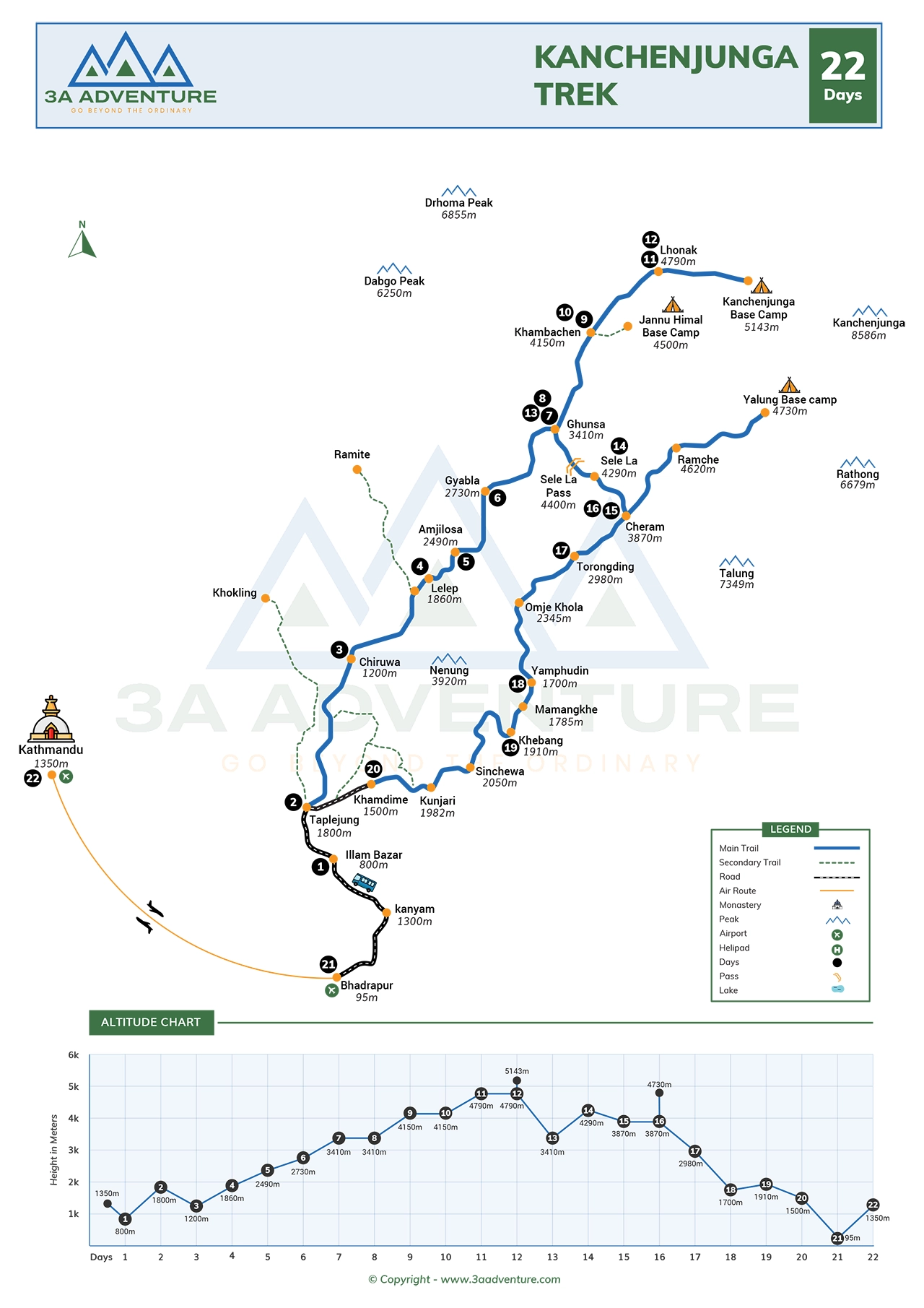
You start your Kanchenjunga trip with a Kathmandu to Bhadrapur flight. Scenic views of rivers, forests, hills, and distant mountain landscapes can be enjoyed during the flight. You will arrive by road at Illam after landing in Bhadrapur. The route is along the country roads of eastern Nepal, with tea plantations and green mountains forming a good landscape.
As the road ascends, the landscape is slowly transformed and provides a preview of the beauty of the area. When you come to Illam, you can have a rest and get ready to continue on the way. At an altitude of (1,677 m / 5,502 ft), the hill town of Illam is a tourist resort and a major resting place before proceeding to the Kanchenjunga trekking area.
Activity: 6 hours Flight and Drive
Max. Altitude: 1,677m/5,502ft. (Illam)
Meal: Breakfast, Lunch and Dinner
Accommodation: Hotel, Lodge
You will leave Illam after breakfast and proceed by road to Taplejung. It takes you through hilly terrain, agricultural villages, and wooded terrain of eastern Nepal. The road takes you further eastwards until you reach the entrance of the Kanchenjunga. The journey gives a chance to see native life and the dynamic landscape of the rural area.
When you get to Taplejung (1,820 m / 5,971 ft), you can relax into your lodgings and have a rest before starting the trekking part of the trip. The headquarters of this district is a key point of departure among trekkers towards the remote mountain trails in the Kanchenjunga region.
Activity: 5 hours Drive
Max. Altitude: 1,820m/5,971ft. (Taplejung)
Meal: Breakfast, Lunch and Dinner
Accommodation: Lodge, Teahouse
Today you will walk between Taplejung and Chirwa. This is where your walking adventure starts as you abandon road travel and use mountain trails that lead to the Kanchenjunga region. The road goes through small villages and crosses parts of the river valley. The stroll along the river is an enjoyable way to start the trek and an opportunity to enjoy the natural environment at a very slow pace.
You will pass a bridge made of wood and proceed through different terrains as you approach your destination. Chirwa is a small settlement where teahouses and a serene environment can be found, at (1,270 m / 4,167 ft). Overnight Chirwa.
Activity: 6 hours Trekking
Max. Altitude: 1,820m/5,971ft. (Chirwa)
Meal: Breakfast, Lunch and Dinner
Accommodation: Teahouse
You will trek from Chirwa to Lelep. The route leads further into the Kanchenjunga area, along the river valleys and through the natural landscapes in between. During your walk, you will have a more distant setting, and you will slowly abandon larger settlements. The trail is close to significant waterways and is a fine introduction to the landscape that defines this trekking region.
During the day, you will be able to see the serene environment and experience driving deeper into the mountains. After a few hours on the trail, you will reach Lelep (1,860 m / 6,102 ft). This is a good village to make a stop at on the way, and a good place to rest at night.
Activity: 7 hours Trekking
Max. Altitude: 1,860m/6,102ft. (Lelep)
Meal: Breakfast, Lunch and Dinner
Accommodation: Lodge, Teahouse
You will trek from Lelep and proceed to Amjilosa. The trail cuts through a number of suspension bridges and goes through waterfalls to slowly ascend higher up the valley. The current path presents a quite evident increase in altitude and is, therefore, one of the initial days when you start feeling that the mountain setting starts taking on a more significant role.
On the route, you can come across grazing animals like yaks and sheep in open spaces along the trail. The terrain gets rougher as you proceed to the further parts of the area. Then, after a gradual ascent, you will reach Amjilosa at (2,510 m / 8,235 ft). This tiny village is a place to pause and have a restful night before moving to higher places.
Activity: 5 hours Trekking
Max. Altitude: 2,510m/8,235ft. (Amjilosa)
Meal: Breakfast, Lunch and Dinner
Accommodation: Lodge, Teahouse
You will trek today from Amjilosa to Gyabla. The trail proceeds up the mountainous terrain and traverses bamboo and oak forest areas. The trail has uphill and downhill sections which make the trekking experience diverse. The environment around you slowly changes as you rise higher, and the mountain environment is more pronounced.
The woody pathway is a good day walk, and it will enable you to go on with your gradual acclimatization. In a few hours, you will arrive at Gyabla (2,730 m / 8,957 ft). This little village is enclosed by the beauty of nature and offers a good resting place before moving on further into the Kanchenjunga country.
Activity: 4 hours Trekking
Max. Altitude: 2,730m/8,957ft. (Gyabla)
Meal: Breakfast, Lunch and Dinner
Accommodation: Lodge, Teahouse
Today you are going to trek from Gyabla to Ghunsa. The trail is via mountain tracks on forested terrain and through the village of Phale. The higher up into the region, the more the settlements are affected by Tibetan culture and traditions. The path is an enjoyable walk with the gradual approach towards the elevated parts of the Kanchenjunga trek.
You will go on to Phale, and you will pass by another village on the trail, called Ghunsa, which is probably one of the most important on the trail. Ghunsa (3,595 m / 11,795 ft) is a key tourist attraction site, and a convenient base where trekkers can find all necessary facilities. When there, you can relax and look forward to the next day of acclimatization.
Activity: 4 hours Trekking
Max. Altitude: 3,595m/11,795ft. (Ghunsa)
Meal: Breakfast, Lunch and Dinner
Accommodation: Lodge, Teahouse
Today is an important acclimatization day in Ghunsa (3,595 m / 11,795 ft). Your body is required to adapt to the thinner air at higher altitudes; thus, after several days of trekking and gaining altitude, you must give your body time to adapt. Resting in this place will assist in mitigating the danger of altitude-related issues and will prepare you for the elevated parts of the trail in the future. Ghunsa is a larger village on the road and has a nice daytime rest-place.
You will be able to walk through the village, explore the local way of life, and get to know the culture and traditions of people inhabiting this mountain area. The day is made malleable, giving you time to relax, recuperate, and get ready to begin the next phase of your Kanchenjunga trek.
Activity: Acclimatization
Max. Altitude: 3,595m/11,795ft. (Ghunsa)
Meal: Breakfast, Lunch and Dinner
Accommodation: Lodge, Teahouse
Today you are going to trek from Ghunsa to Kambachen. You will leave the village behind and follow a slow trail over the mountains, further into the upper Kanchenjunga area. The path is not that long, and you can still have your body acclimate to the rising altitude, still making steady progress. The scenery is more open as you walk, the mountain setting growing more dramatic.
On your way, you will be able to see glaciers and Himalayan highlands that are the hallmark of this part of the trek. This is also a route across regions where wildlife habitats are located in the area. Several hours of walking will lead to reaching Kambachen (4,100 m / 13,451 ft), where you will sleep, and then continue increasing the altitude.
Activity: 4 hours Trekking
Max. Altitude: 4,100m/13,451ft. (Kambachen)
Meal: Breakfast, Lunch and Dinner
Accommodation: Lodge, Teahouse
It is your second day of acclimatization today and Kambachen (4,100 m / 13,451 ft). As you keep on the hike to even greater heights, it is very crucial that your body should be given time to acclimate. This rest will aid in better acclimatization, and will raise the chances of a safer and more comfortable voyage in the days ahead. The day may be spent in rest about the settlement, and admiring the quiet mountain scenery.
Kambachen is a nice place to rest before moving uphill, as it is surrounded by the spectacular Himalaya. The rest can also enable trekkers to rest after a couple of days of walking. At the end of the day, you will be more ready to explore the more challenging parts of the trek which await you.
Activity: 2 hours
Max. Altitude: 4,100m/13,451ft. (Kambachen)
Meal: Breakfast, Lunch and Dinner
Accommodation: Lodge, Teahouse
Today you are to trek from Kambachen to Lhonak. The path slowly turns into a wilder and more isolated terrain as you turn your back on the settlement. Rocky pathways increase in general, and the path proceeds to the elevated surroundings through the Kanchenjunga area. During the trek, you will be able to see the sights of the mountain and glacier scenery of the surrounding mountains which characterize this segment of the journey.
The slow climb enables you to keep on increasing the altitude at a suitable speed. A few hours later, at (4,785 m / 15,699 ft), you will reach Lhonak. This is a significant place of rest on the journey to Kanchenjunga North Base Camp and provides spectacular high-mountain scenery.
Activity: 4 hours Trekking
Max. Altitude: 4,785m/15,699ft. (Lhonak)
Meal: Breakfast, Lunch and Dinner
Accommodation: Lodge, Teahouse
It is one of the key days of the trek since today you go on a day tour to Kanchenjunga North Base Camp. You will leave Lhonak and take a trail, which, as you ascend, winds steadily through a high mountainous country, approaching the base camp region. The path is in the glacial landscape and exposes great scenes of the surrounding mountains and valleys.
The landscape grows more and more dramatic as you rise in altitude and is indicative of the remoteness of this section of the Kanchenjunga region. When you arrive at Kanchenjunga North Base Camp (5,143 m / 16,873 ft), you will be able to spend some time in the mountain environment and take photos and then start the journey back. You will spend the night at Lhonak after spending some time at the base camp.
Activity: 8 hours Trekking
Max. Altitude: 5,143m/16,873ft. (Kanchenjunga North Base Camp)
Meal: Breakfast, Lunch and Dinner
Accommodation: Lodge, Teahouse
You will trek from Lhonak to Ghunsa. Once in the northern base camp area, the trek now starts on the retrace of part of the route through the upper Kanchenjunga. The path winds down slowly through the known mountainous topography and goes back through Kambachen and proceeds to Ghunsa. Downhill walking will enable you to see the scenery at a new angle, and your body will feel relieved after having been at very high levels.
During the day you will be walking along the proven tektrek paths across remote land and mountain villages. By the end of the trek, you will arrive back in Ghunsa (3,595 m / 11,795 ft). This is a very nice village where one can have a nice rest before starting the journey to the southern side of Kanchenjunga.
Activity: 7 hours Trekking
Max. Altitude: 4,785m/15,699ft. (Ghunsa)
Meal: Breakfast, Lunch and Dinner
Accommodation: Lodge, Teahouse
Today you will trek from Ghunsa to Sele La. Beyond the village, you will take a pathway which ascends slowly through alpine scenes to an elevated region. The path goes through mountainous geography with the scenery varying as you keep gaining altitude in the day. As you ascend, the environment gets more open, and you have an opportunity to see the rough environment that defines the upper Kanchenjunga region.
This part of the trek is a significant link between the south and north paths of the trek. Several hours of constant ascending will bring you to Sele La (4,390 m / 14,403 ft). This is a significant overnighting point, as the elevation is only higher, and then you cross into the southern part of the trek.
Activity: 5 hours Trekking
Max. Altitude: 4,390m/14,403ft. (Sele La)
Meal: Breakfast, Lunch and Dinner
Accommodation: Lodge, Teahouse
You will trek today from Sele La to Cheram. It is among the tougher days of the journey because the path traverses mountain passes that are high and then drops to the destination. The pass area offers beautiful scenery of the mountainous landscapes around it, and a long descent starts.
The path is to be passed cautiously amidst diversified landscapes as one passes out of the high pass area to the low areas. After completing the descent, you will arrive in Cheram at (3,870 m / 12,697 ft). The village is a good place to relax and is the point where you will enter the southern part of the Kanchenjunga trek.
Activity: 8 hours Trekking
Max. Altitude: 4,800m/15,748ft. (Cheram)
Meal: Breakfast, Lunch and Dinner
Accommodation: Lodge, Teahouse
Another big day of the trek today is a day trip to Kanchenjunga South Base Camp. You will leave Cheram in the morning and travel by the trail towards Ramche, a great place on the path. The trip then proceeds on a break, after which the high mountain scenery leads to the base camp locale. The higher you go, the more spectacular the surroundings are, with mountainous landscapes conquering the horizon.
When you get to Kanchenjunga South Base Camp (4,610 m / 15,125 ft), you will have an opportunity to relax and enjoy the views, taking photos and admiring the special air of this distant place. You will then backtrack and head back to the base camp and then back to Cheram, where you will overnight.
Activity: 6 hours Trekking
Max. Altitude: 4,610m/15,125ft. (Kanchenjunga South Base Camp)
Meal: Breakfast, Lunch and Dinner
Accommodation: Lodge, Teahouse
You will trek today from Cheram to Torongding. The path is winding downwards as you start abandoning the elevated areas. You will go through different land formations throughout the day and will go through regions which display the natural beauty of the area. The path steadily becomes lower, and the walk becomes more comfortable after a few days in the high mountains.
Further down the path, the presence of forests becomes increasingly evident, and the environment starts to transform from an alpine mountain environment to a lower mountain one. Several hours of walking will take you to Torongding (2,080 m / 6,824 ft). This small village gives a serene place to spend the night and is a significant point of departure for backtracking.
Activity: 4 hours Trekking
Max. Altitude: 3,870m/12,697ft. (Torongding)
Meal: Breakfast, Lunch and Dinner
Accommodation: Lodge, Teahouse
Today you will trek from Torongding to Yamphuding. The track goes down the hill as you head towards the lower points. The trail is mostly covered with forests and traverses the regions where vegetation and landscapes change. The fall is more extensive today, and the walk through isolated parts of the path takes all day.
As you proceed, you will slowly get to larger settlements and more populated areas than the higher parts of the trek. After a few hours on the trail, you will reach Yamphuding (1,980 m / 6,496 ft). This bigger camp provides a very nice rest area and recuperation after a hard day of walking across the lower Kanchenjunga area.
Activity: 8 hours Trekking
Max. Altitude: 2,080m/6,824ft. (Yamphuding)
Meal: Breakfast, Lunch and Dinner
Accommodation: Lodge, Teahouse
You will begin your journey from Yamphuding to Khebang. The trail is a lower-altitude road passing through villages, farmland, and other local settlements. You will get to come across another aspect of the Kanchenjunga region, unlike the high mountain settings you visited previously in the trek. The path crosses the Kabeli Khola and then moves to Khebang.
Having a shorter walking day that is shorter, time to explore the area in a more leisurely fashion is available, watching the local life on the trail. In about four hours of walking, you will arrive at Khebang at (1,910 m / 6,266 ft). After that, you will be able to relax and spend a more peaceful afternoon before the following step of the trip.
Activity: 4 hours Trekking
Max. Altitude: 1,980m/6,496ft. (Khebang)
Meal: Breakfast, Lunch and Dinner
Accommodation: Lodge, Teahouse
Today you will trek from Khebang to Khamdime. The path goes on into the eastern Nepal lower hills and a trail of village paths and ridges. On your way through, you will go through some small villages as well as local attractions on your way to where you are going. The route incorporates some downhill areas and allows one to have a glimpse of the rural scenery that defines this area.
The walk is more relaxed today compared to the higher areas of the trek as you approach the more accessible places of the road. To the north, a few hours of walking will bring you to Khamdime at (1,500 m / 4,921 ft). This nice small town is the last trekking point before traveling to Bhadrapur by car.
Activity: 4 hours Trekking
Max. Altitude: 1,910m/6,266ft. (Khamdime)
Meal: Breakfast, Lunch and Dinner
Accommodation: Lodge, Teahouse
The day is the last overland part of your Kanchenjunga adventure as you drive from Khamdime to Bhadrapur. You will start a long journey through eastern Nepal. The path cuts across small villages, arable land, wooded land, and open fields and provides a last chance to appreciate the scenery of the area.
The road then gradually leads down to the lowlands as it progresses. The travelling today, as compared with the mountain-trails of old days, is a smooth transition to more civilized regions. You will be on the road, and after a distance of about ten hours, you will reach Bhadrapur at (91 m / 299 ft). You can use the evening to relax and get ready to fly to Kathmandu the next day.
Activity: 10 hours Drive
Max. Altitude: 1,500m/4,921ft. (Bhadrapur)
Meal: Breakfast, Lunch and Dinner
Accommodation: Lodge
Today is the last day of your Kanchenjunga Trek. Following breakfast, you will be taken to Bhadrapur Airport, and you will be set to take off to Kathmandu. When the plane is taking off, you are able to see the incredible experience you have had across eastern Nepal and the isolated Kanchenjunga. The brief flight offers aerial views of the scenery on the ground until the capital city is reached.
When you reach Kathmandu (1,400 m / 4,593 ft), your trekking experience is officially over. This completes an unforgettable trip that has carried you through varied landscapes, mountain villages, high-altitude trails, and the northern and southern base camp area of Kanchenjunga. Then you can proceed with your further travel plans or have more time in Kathmandu.
Activity: 50 minutes Flight
Max. Altitude: 1,400m/4,593ft. (Kathmandu)
Meal: Breakfast, Lunch and Dinner
Accommodation: Hotel
Note:
If you have a private group and prefer a personalized experience, we can organize a custom trip tailored to your requirements and group size, running it any day you choose.
Transportation
Food and Accommodation
Guide and Support Staff
Permits and Expenses
Medical and Gear
Others
International Visa and Flights
Food and Accommodation
Travel and Medical Insurance
Other Expenses
Kanchenjunga Trek may be done at various times of the year, although spring and autumn are usually regarded as the most appropriate seasons. The time of spring (March to May) is stable and has comfortable temperatures, and the view of the mountains is clear. During this season, the colorful rhododendron flowers also bloom on many hillsides. The other season enjoyed is autumn (September to November). The sky tends to be clear following the monsoons, and thus it offers good visibility so that trekking can be done.
Winter is colder at higher altitudes like in Kanchenjunga North Base Camp (5,143 m / 16,873 ft), and during summer it can be wet, and the trails tend to be slippery. The selection of the appropriate season can help to enhance trail conditions, visibility, and the level of comfort during the Kanchenjunga Trek Itinerary.
Kanchenjunga Trek is regarded as a difficult trekking adventure that can be taken by trekkers who are fit and have prior hiking experience. The trail includes several days of hiking in the isolated mountainous landscape, with steep climbs and descents, and hiking days. The trek goes to great heights such as the Kanchenjunga North Base Camp (5,143 m/16,873 ft) and the Kanchenjunga South Base Camp (4,610 m/15,125 ft).
Due to the elevation and duration of the trip, trekkers are expected to be in physically challenging conditions. Nonetheless, the trek does not involve technical climbing. As long as one has adequate preparation, acclimatization, and pacing, a majority of healthy trekkers are able to complete this Kanchenjunga Base Camp Trek successfully and get to enjoy the variety of landscapes and mountain scenery along the way.
One of the most significant issues on the Kanchenjunga Trek is altitude sickness since the path goes up to 5000 m and above (5,000 m / 16,404 ft). With the increase in altitude, the oxygen levels drop, and it becomes increasingly difficult to adapt to this. The symptoms might be typical, such as headache, dizziness, fatigue, loss of appetite, and difficulty sleeping. The risk should be minimized by proper acclimatization.
The Kanchenjunga Trek Itinerary involves acclimatization of the trekkers at Ghunsa (3,595 m / 11,795 ft) and Kambachen (4,100 m / 13,451 ft) so that they can adjust to the change. Ensuring that water is consumed adequately, keeping the pace steady and not too fast, and not climbing the altitude very quickly can help as well. In case of severe symptoms, the easiest way out is to rush to a lower altitude.
A successful Kanchenjunga Trek requires good preparation. The trek will take a couple of weeks of walking in remote areas of the mountains, and trekkers would therefore be advised to start training at least a few months before the trek. Endurance and strength can be improved by activities like hiking, walking, running, cycling and stair climbing. Exercise is also important in making the body adapt to the long trekking days and varying heights. It is also vital to be mentally prepared because the process is one of patience and regularity.
It can be useful to practice using a loaded backpack before the trek. It is much easier to follow a thoroughly designed Kanchenjunga Trek Itinerary when you are physically fit. Good fitness will enable trekkers to experience the adventure more easily and positively during the process.
The Kanchenjunga Trek usually has food and accommodation in the form of local teahouses and lodges on the way. Food is typically plain, fresh, and made by the local families. Typical alternatives are rice, lentils, vegetables, noodles, soups, potatoes, eggs, and seasonal meals. The menu options can be reduced as the trek goes to more remote places. Accommodation is simple, yet comfortable enough for trekkers who pass by the area.
Beds and blankets are typically found in rooms, and there are shared dining areas. In the Kanchenjunga Base Camp Trek, the facilities are more primitive at higher altitudes because of the remote location. Although it is simple, teahouses provide a friendly environment and the local welcome.
The mode of transportation in the Kanchenjunga Trek is a combination of domestic flights, transfers via personal vehicles, and trekking. The trip normally starts with a flight from Kathmandu to Bhadrapur and then a drive to Illam and Taplejung, where the trekking path begins. Travelers start the trek, and at the end of the trek, they drive back to Bhadrapur and fly back to Kathmandu. In eastern Nepal, the conditions of the roads may be subject to change based on weather conditions and location, and traveling time may be higher than anticipated in certain places.
The fastest route between Kathmandu and the eastern part is through flights. Transportation will be organized according to the Kanchenjunga Trek Itinerary and will provide a smooth transition between the days of trekking and traveling. Planning will reduce the number of delays and enable the trekkers to concentrate on the adventure.
There are communication facilities in some of the Kanchenjunga Trek, but the more remote you go into the mountain areas, the less coverage you will have. There might be mobile network service in larger settlements like Ghunsa at (3,595 m / 11,795 ft); however, the signal quality can change depending on the position and weather conditions. Some villages have Internet access, at an extra charge, but the connection speed is usually slower than in urban areas.
Trekkers should not be able to count on good communication the whole way. It is a nice thought to notify family and friends about limited connection before the trek. Having a fully charged power bank and phone can help you stay in touch with people whenever the network is accessible.
The Kanchenjunga Trek is a trek which needs special permits as the path involves a restricted area and conservation areas. Before the journey, trekkers are usually required to have a Restricted Area Permit and a conservation area entry permit. Such permits assist in controlling tourism and conservation in the area. The restricted area does not allow independent trekking, and thus trekkers are required to accompany a licensed guide and obtain permits.
The fee for the permit can change over time; that is why it is necessary to check the existing rules and requirements before reservation. Organizations like 3A Adventure will be able to help in acquiring the required permits and documentation. It is also necessary to carry copies of a permit during the trek, since there are checkpoints on the road.
A majority of foreigners planning to go to Nepal are required to obtain a tourist visa, which they present to the country before starting the Kanchenjunga Trek. Nepal has visa-on-arrival services to citizens of most countries at international ports of entry such as Kathmandu Airport. Travelers ought to make sure that their passport is still in place at the time of their intended travel, at least six months in advance.
The visa charges are based on the number of days to stay, and longer trekking tours can take a longer visa period. One can always look into the current immigration requirements prior to travelling. It can also be useful to have printed copies of important documents related to traveling. After preparing visa requirements, trekkers can concentrate on preparing the adventure and adhering to their scheduled Kanchenjunga Trek Itinerary.
One of the most important things when joining the Kanchenjunga Base Camp Trek is travel insurance. Since the trek will go to high altitudes like 5,143 m / 16,873 ft, high altitude trekking and emergency evacuation insurance will be needed. Remote mountain areas might have minimal access to health care, and helicopter evacuation coverage can be especially essential.
Protecting against medical bills, interruptions of the trip, lost baggage, and unexpected delays in the trip should also be a good policy. Trekking people ought to examine the policy terms and ensure that the highest altitude is covered before they buy insurance. It is a good idea to carry a copy of the insurance certificate with the trek. The appropriate insurance gives assurance of safety and finances during the trip.
Although a trekking package covers many services, some personal costs are expected to be incurred by the trekkers in the Kanchenjunga Trek. Some of the common additional expenses might be hot showers, charging of electronic devices, internet, bottled beverages, snacks, laundry, and personal purchases. Guide and support staff tips are also budgeted separately. The other costs can be different according to personal tastes and expenditures.
It serves to have enough cash since there are not many banking facilities and a card payment system in remote trekking regions. Given the general trend of higher prices at higher altitudes, it is advisable to budget a little extra. By having these extra expenses in mind, one may not be inconvenienced on the trek.
Kanchenjunga Trek can be done in either a personal or a group trek. A personalized trek is more flexible, and the trekkers are free to design their schedule, hiking speed, and travel months to suit their preferences. Group trips have an established itinerary and enable the participants to enjoy the experience with other travellers. Numerous trekkers like the social nature and cost-sharing opportunities of group departures.
The major highlights are shared between the two options, such as a visit to the Kanchenjunga North Base Camp and Kanchenjunga South Base Camp. The most appropriate option varies according to individual style of traveling, budget, and the desired degree of flexibility. Travelling alone or in a group, the experience of trekking all in all is rewarding and memorable.
General
Kanchenjunga Trek is a secluded trekking path in eastern Nepal which explores both north and south base camp areas of Kanchenjunga.
The itineraries of most of the routes require 20 to 24 days, which varies according to the route and acclimatization program.
The highest point lies in Kanchenjunga North Base Camp (5,143 m / 16,873 ft).
Preparation & Fitness
Prior trekking experience is good, though physically fit amateurs with good preparation can also accomplish the trek.
You need to be in good shape to be able to walk several hours a day on mountain trails during a few days.
Training should be started at least six to eight weeks before your departure date.
Insurance & Visa
Yes, high-altitude trekking and emergency evacuation travel insurance is highly advised.
The majority of foreigners need a tourist visa to enter Nepal.
Guides & Support Staff
Yes, there must be a licensed guide since the route is a restricted area.
Yes, there are porters and they can assist you in carrying your own trekking gear.
Accommodation and Facilities
The only type of accommodation available along the route is local teahouses and lodges.
Most villages have electricity, but to charge a phone, one might need to pay extra.
Weather & Seasons
The most favorable seasons are usually spring and fall, as the weather is stable and the mountains can be seen more clearly.
Health & Safety
Definitely, trekkers can experience altitude sickness as the path is above 5,000 m / 16,404 ft.
Report to your guide and do as he says, possibly taking a rest or going down to a lower level.
Booking & Payment
It is advisable to book several months prior to the trek during the high seasons.
Transportation & Flight
The majority of itineraries involve a Kathmandu to Bhadrapur flight and then a ride to the trekking starting point.