Weather and Best Season for Everest Base Camp Trek
The Everest Base Camp trek largely occurs inside the Sagarmatha National Park, rich in diverse weather patterns ranging from temperate to sub-temperate and alpine.
The lower Khumbu villages below 3500 m enjoy the temperate climate largely shaped by the monsoon rains, while the upper Himalayan region is consistently cold with alpine weather.
Especially in winter appearing from December to February, heavy snow and winds can make trekking nearly impossible. The navigation through the terrain can be demanding as trails will be obscured, and visibility of mountains and signposts often diminishes.
When summer arrives from June to August, the Khumbu Valley goes through heavy rain, increasing the threat of flooding and landslides.
Thus, considering these factors, the best Everest Base Camp trek time will be in spring and autumn, specifically between April and May and October and November.
The Everest Base Camp trek is possible in winter and summer as well, but spring and autumn seasons offer the hikers the best consistent weather and facilities. Tea houses will always be open, experienced porters and guides will be readily open for trek.
12 Days Everest Base Camp Trek Difficulty Level
Our 12 days Everest Base Camp trek has a difficulty rating of level II category. It means the overall trekking adventure poses a medium challenge for those enthusiastic about trekking.
The walking route is also not excessively demanding and non-technical, so anyone possessing an average fitness level can reach the Everest Base Camp with ease.
The most common challenge that every trekker succumbs to is altitude sickness, but we have arranged acclimatization days to effectively manage this.
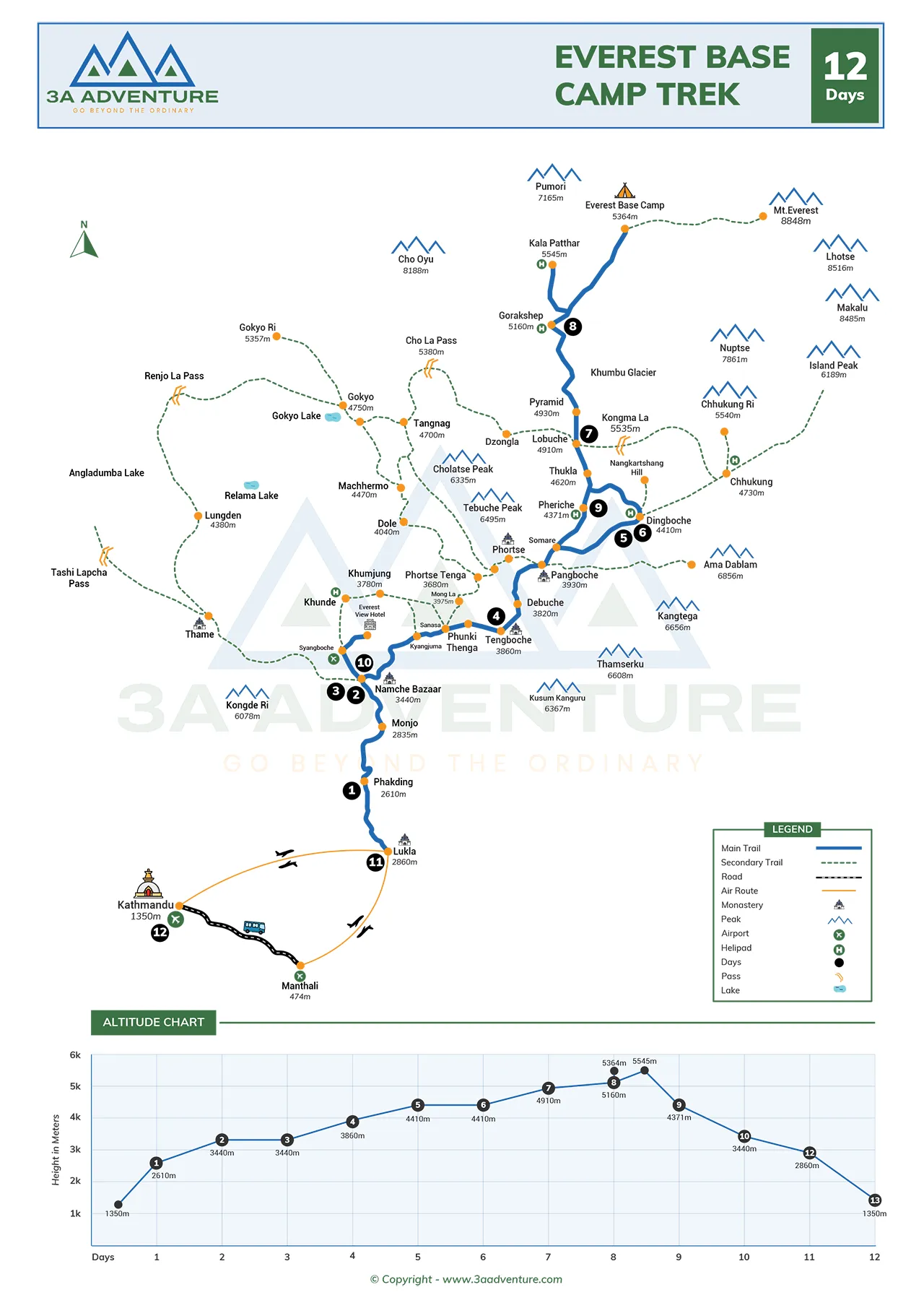
The total hiking route length is also 130 km, commencing and ending in Lukla. The ultimate elevation of the entire Everest Base Camp trek route is 5644 m, while the maximum sleeping will occur at 5,185 m in Gorakshep.
Additionally, almost the entire trail is lined with excellent tea houses and facilities, with signposts at every bend. It doesn’t mean that you should underestimate the challenge of the Everest Base Camp trek, but its moderate nature makes it a fantastic first journey for new hikers eager for the adventure it provides.
Altitude Sickness/Acute Mountain Sickness/AMS
The Everest Base Camp trek is undeniably a high-altitude Himalayan trekking action leading you up above 3000 m most days. Thus, altitude sickness or the AMS can be the biggest problem for you in our EBC trek.
You can prepare for the AMS by acclimating yourself before the actual EBC trek sets in. However, it is such a condition that can impact anyone, despite their athletic shape.
Once after crossing the threshold of 3000 m at Namche, you may start to experience a headache and dizziness. You may also have trouble sleeping and a tendency to vomit.
You can take Diamox to reduce these early signs of AMS, but only after you discuss it with your doctor. After all, it is a diuretic drug that needs certain precautions.
More than medication, drinking enough water will help you not only fight the AMS but also prevent it. So, bring a refillable water bottle and you can get the boiled water at every tea house on the route.
Besides, our Sherpa guide are well-trained regarding AMS management, so you need not worry. After constant monitoring, he may descend you or pause your hike for one or two days.
In severity, a helicopter rescue will be managed immediately, and we will also contact your insurer for prompt action.
Preparation and Fitness
You don’t have to be the fittest and most athletic person to engage in the Everest Base Camp trek. However, if you have been a couch potato, this adventure can be quite challenging for you unless you prepare yourself in advance.
Therefore, we suggest that you start exercising in the months leading up to the EBC trek. You can go running a few times a week or take long walks, preferably with a 15 kg backpack.
It is also wise to wear the shoes you intend to use during the trek while training. You can also carry out additional activities such as cycling, jogging, biking, or swimming.
Practice these activities with frequent breaks, which will help condition your body for the demands of extended walks. To make your legs get used to the frequent ascent and descents on the trek, stair climbing will be the most recommended exercise for you.
Likewise, sports such as volleyball, basketball, football, treadmill run, planks, squats, pull-ups, and push-ups will also build up your cardiovascular condition.
Food and Accommodation
Each night on the Everest Base Camp trek, you will snuggle into the warm and homely tea houses of the locals in the planned overnight villages. Our guide will get you a double room in the newer tea houses that have greatly enhanced their comfort for guests.
These tea houses now offer attached toilets, showers, and WiFi with charging utilities as well. However, hot showers, WiFi, and charging will be at a small extra fee.
Till Dingboche village, you can even get a single room if you like to. Beyond this village, you will have to settle for the humble setting at Lobuche and Gorakshep.
3A Adventure will also look after your food arrangements on the Everest Base Camp trek. Three main courses in breakfast, lunch, and dinner will be served at your table. The drinks and beverages will, however, be left to your own.
Dal Vat will be omnipresent in every tea house menu with the choices from Momo, pasta, thukpa, Tsampa, fried chowmein, chapati, vegetables, eggs, and porridge. Bakery items will also be available till Dingboche.
Transportation
3A Adventure will be responsible for organizing your transportation during the Everest Base Camp trek. A private 4WD pick-up and drop-off vehicle with driver and guide will be available for your airport and hotel transfers and for the Manthali transfer from Kathmandu. The flights back and forth between Kathmandu/Ramechhap and Lukla will also be looked after.
Communication
The local mobile network providers of NTC and Ncell work well almost all the time during the Everest Base Camp trek. Therefore, instead of activating international roaming on your current network, it is cheaper to get either the eSIM or the physical SIM from these Nepali networks for your cellular communication throughout the trek.
These providers also supply 4G/LTE service with a range of affordable data packages so you can stay online even if there is a lack of WiFi signal on the route.
For the WiFi usage, you can buy a 10 GB prepaid WiFi card from Everest Link or AirLink in Lukla or Namche Bazaar, which will remain valid for a month.
On some sections of the route of the EBC trek, you may even get free WiFi. Likewise, almost all tea houses are now able to offer you WiFi, though there will be a small fee.
Permit
For our Everest Base Camp trek, we need to have two key mandatory permits:
- The local area permit for the Khumbu Municipality at 2000 NPR for each hiker
- The permit for getting into the Everest/Sagarmatha National Park at 3000 NPR for each hiker
Remember, the TIMS card will no longer be required for the EBC trek. Our guide will get these permits once you are at Lukla and Monjo villages. The fees have already been incorporated into our total Everest Base Camp trek cost.
Visa
Certainly, you will need to get a tourist visa before entering the border of Nepal. However, there is no requirement for you to go through the procedures in the Embassy before you leave your country.
The convenient On Arrival Tourist Visa system has now enabled travelers getting into Nepal to acquire the Nepal tourist visa after landing at TIA or any land border.
Moreover, you can complete the applying process online on the Nepal Immigration Site and make the payment for the Visa once you are at TIA or any Nepal land border.
However, remember to bring the printed application form with your individual barcode. The payment for the Nepal tourist visa will be 30 US Dollars for 15 days, 50 US Dollars for one month, and 125 US Dollars for three months.
For the application to the Nepal Immigration Department for the Visa, you will need:
- A passport with two or more empty pages and a validity period of a minimum 6 months after you leave Nepal
- Passport-sized photographs (most recent)
Travel Insurance
Having international travel insurance that includes helicopter rescue and evacuation is a compulsory requirement for our Everest Base Camp trek. Without the correct insurance policy, we will not be able to procure the essential permits needed for the EBC trek.
For our 12 days Everest Base Camp trek, please get the insurance policy that covers helicopter transportation, rescue, and evacuation up to an altitude of 5700 meters.
If you also include medical and accidental coverage, along with protection for luggage loss, trip extension, or trip cancellation, you will have additional protection during the Everest Base Camp trek.
This will safeguard you from any unimaginable and unfortunate situations, such as natural calamities, injuries, accidents, or medical conditions, including AMS.
Extra Expenses
3A Adventure will manage all your travel logistics for the Everest Base Camp trek. So you will only need to reach into your wallet for personal expenses that are not part of our included services.
This includes your personal travel insurance, international flights to and from Nepal, accommodation and meals in Kathmandu, the Nepal tourist visa fee, WiFi, hot showers, hot water, beverage costs, fees for charging your devices on the way, and of course, personal shopping expenses like snacks, extra porter arrangements, and tips for porters and guide.
Other expenses that will not be covered in our Everest Base Camp trek consist of excess baggage charges, which are limited to 9 kg per hiker on the trek, and any additional costs for extra stays due to weather conditions, natural events such as landslides or avalanches, etc.
Private EBC Trek vs Group EBC Trek
A group EBC trek means you will be traveling with individuals who share your mindset, all heading to the same destination, sharing not only the route and experience but also the overall cost of the Everest Base Camp trek.
When you journey in a group, every expense related to the Everest Base Camp trek will be divided equally among the group members, thus easing your financial load.
Generally, our group will be small, usually comprising 5 to 6 members. Traveling in this manner will make you confident about the route and the potential challenges of snow and altitude.
Additionally, if the group is large, an assistant guide will be provided to support you if you can’t keep up with others.
However, when traveling in a group, you will have to coordinate your arrival dates and travel plans with people you may not know at all. This will limit your flexibility, and you will also have to adjust your daily routines adjusting the preferences of each group member.
On the other hand, in a private EBC trek, you will be able to make your own Everest Base Camp trek itinerary. You will have enhanced flexibility that will allow you to travel in your own way without the concern of adjusting to a group.
However, you will have the support of a guide, and it’s essential for you to establish a level of trust. This arrangement thus grants you complete freedom to do as you please, whenever you wish.
By discussing with your guide and the company, you can choose the best route and explore various options. Additionally, you will be able to meet new people on the trail and in the lodges as well.
However, in a private EBC trek, you will be responsible for covering the total expenses, which can make this a more expensive choice compared to group travel.