Weather and Best Season
Tsum Valley Trek may be done at various periods of the year, but spring and autumn are considered to be the most suitable periods. The months of March to May are springtime with mild temperatures, woodland forests of rhododendrons, and clear mountain views. The season of autumn, between September and November, is quite stable, with dry trails and very good visibility in the valley.
In winter, it is colder in elevated regions around Mu Gompa (3,700 m / 12,139 ft), where the temperatures are likely to drop considerably. The monsoon season of summer can cause rainfall that can cause changes in road conditions and trail conditions in lower parts of the route.
The right season will enhance your trekking experience. Most trekkers who visit this remote Himalayan region find that there is more stability in the weather in the valley in spring and autumn, and thus these are the months when most trekkers will find it appropriate to visit the area.
Difficulty Level
The Tsum Valley trek is regarded as a moderate trek that can be taken by individuals who have a fairly good fitness level. The route incorporates daily walks around forests, villages, river valleys, and mountain walks. Although the path has some uphill and downhill parts, no technical climbing skills are necessary.
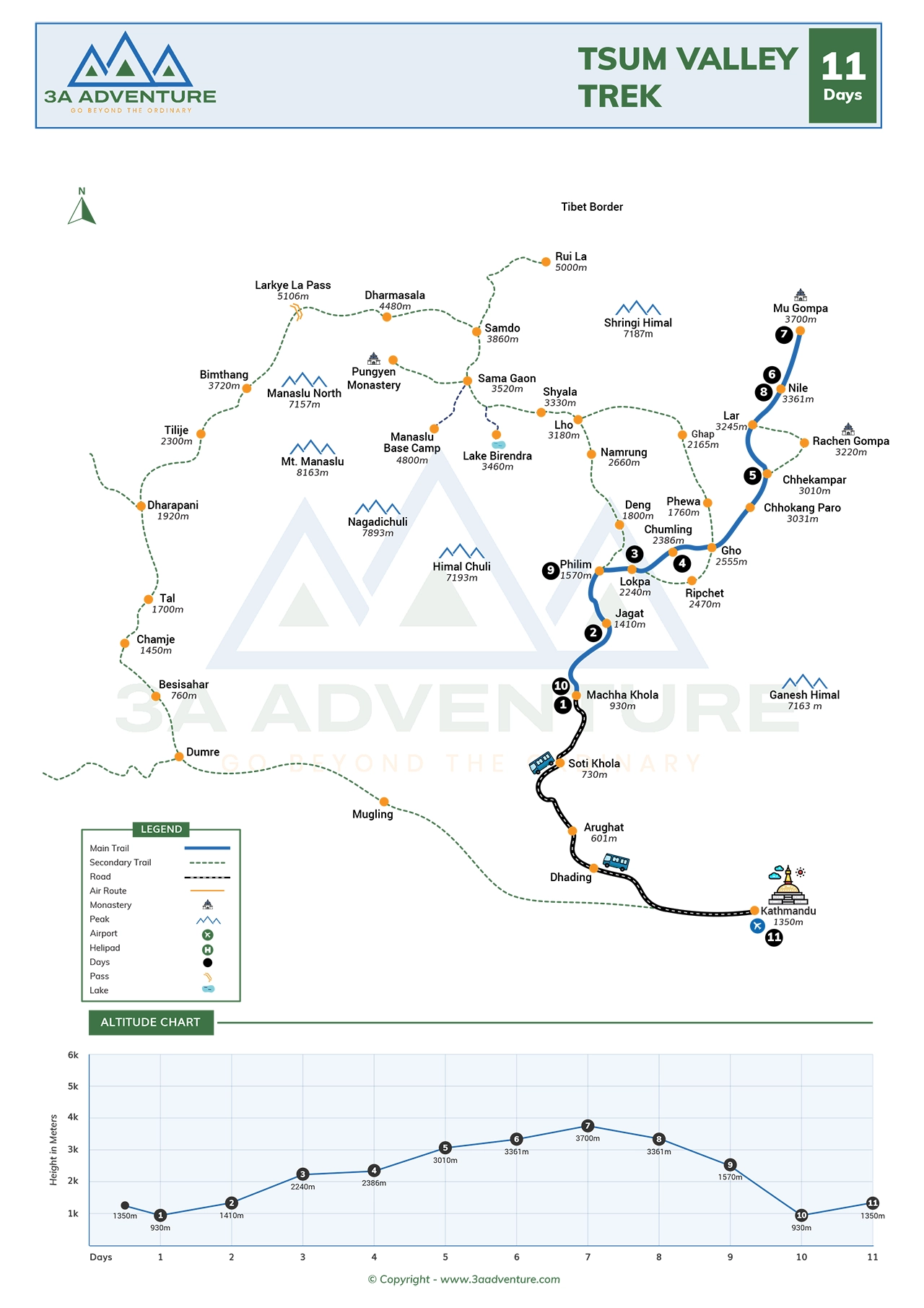
The highest point of the trek is Mu Gompa (3,700 m / 12,139 ft). The increase in altitude is gradual, and thus when using the right itinerary, most of the trekkers can easily adapt. The average number of hours walking is five to seven hours a day based on the route and speed.
Prior experience with trekking may be beneficial but is not a necessity. With proper preparation, regular walks, and proper rest intervals, most of the travelers take the trek comfortably as they observe the natural and cultural sites along the way.
Altitude Sickness
Even though the Tsum Valley Trek does not have extreme heights as most of the high Himalayan treks, the trekkers should be aware of altitude sickness. Mu Gompa (3,700 m / 12,139 ft) is the highest point overnight, and is where some people might have slight symptoms as the body adapts to the thinner air.
The most common ones may be headache, fatigue, loss of appetite, dizziness, or trouble sleeping. A gradual itinerary is useful in minimizing the risks of developing altitude-related problems. It is also necessary to drink enough water, keep the pace constant and not strain the body with unnecessary movements.
In case of worsening of the symptoms, the best option is to go down to a lower altitude. With adequate awareness and reasonable trekking practices, most travelers have a safe experience without any critical problems with altitude.
Preparation and Fitness
The correct preparation is significant in ensuring that the Tsum Valley Trek is enjoyable and comfortable. While the trek is not extremely demanding, several days of walking on mountain trails require good stamina and endurance. Fitness preparation can enhance the experience.
It is helpful to prepare by doing regular exercise like hiking, jogging, cycling, swimming or long walks. Daily ascents and descents can be assisted by strengthening leg muscles and enhancing cardiovascular fitness. It is usually helpful to do some training during a few weeks before the trip.
Mental training is also necessary since trekking in mountainous areas will entail basic infrastructure and unpredictable weather. The Tsum Valley Trek package is a well-planned trek that enables the trekkers to concentrate on enjoying the trek as the guides and support teams do the logistics.
Food and Accommodation
The Tsum Valley Trek includes food and accommodation in local tea houses found on the trail. These lodges have simple yet comfortable amenities that enable trekkers to relax after a day of walking.
Food is typically diverse, with Nepali and simple international food. Common substitutes tend to be rice, lentils, vegetables, noodles, soups, potatoes, eggs, and fried rice. Most of the villages along the route sell hot drinks.
Accommodation is usually provided in twin-sharing rooms and with simple bedding. The trail gets easier in settlements and higher, leading to easier facilities. Although luxury services cannot be offered, the hospitality of the local communities is a warm welcome. The tea house stays also enable the visitors to enjoy day-to-day living and culture of the remote villages of the valley.
Transportation
The Tsum Valley Trek involves transportation starting with a drive from Kathmandu to Machha Khola and ending with the drive to Kathmandu after the trek. The road trip traverses hills, river valleys, country villages, and mountainous terrain until it gets to the trailhead.
Depending on their budget and preference, travelers have options of taking public transport or using their own vehicles. The comfort and flexibility of the long drive are usually better with the use of private vehicles. Mass transit is still cheaper for individuals who want to travel at a lower cost.
The conditions of the path differ during the journey, especially in remote areas near the trekking area. A private vehicle is part of the Tsum Valley Trek package preferred by many trekkers since the starting point of the adventure will be more comfortable and easier.
Communication
There are numerous communication facilities at the Tsum Valley Trek in most villages, though the services may be constrained in the more remote villages. Some settlements have mobile network coverage, and depending on the location and weather, the strength of the signal can fluctuate.
The tea houses have Internet access, which is typically charged on a per-use basis. Speed might also be less than what the travelers are used to in cities. The further the trek goes into the valley, the less reliable the connection will be.
A lot of trekkers are glad that they have a chance to forget about everyday life and relax in the mountains. They should tell members of the family prior to the trek that communication will sometimes be restricted. It is advisable to have a fully charged phone and power bank to ensure that one is connected whenever there is network coverage.
Permit
The Tsum Valley Trek is a special permit area as the valley is in a restricted region of Nepal. The trekkers should acquire the required permits prior to entering the region. The documents which are usually required are the Tsum Valley Restricted Area Permit and the Manaslu Conservation Area Permit.
The permit requirements and fees may vary, and it is always good to ensure you have the most up-to-date requirements before making your trip. No independent trekking is allowed in the restricted zone, and the trekkers must be accompanied by a licensed guide and have the necessary permits.
A significant number of tourists prefer to book permits with a trekking agency to make it easier. By booking with 3A Adventure, you can handle the permit application process before the start of your trek, and instead of using your time to sort out the administrative process, you can concentrate on the trek.
Visa
Any foreigner, with the exception of those from countries that have special agreements, requires a valid Nepal visa to commence the Tsum Valley Trek. The majority of tourists are issued with a tourist visa upon arrival at Kathmandu Airport or a Nepalese embassy in their country of origin.
The traveller must make sure that his/her passport is valid at least half a year before travelling. The visa validity should also be sufficient to include the whole trekking itinerary and any extra days that you wish to stay in Nepal.
The visa charges are different based on the length of stay. As regulations could be modified, it is advisable to review the most current information before travel. The right traveling documents will be prepared in advance to prevent delays and enable a better kick-off to your trekking adventure.
Travel Insurance
Travel insurance is highly advisable for anyone intending to go to the Tsum Valley Trek. Despite the fact that the path is rated moderate, trekking in the distant mountainous regions is always accompanied by some threats connected to weather, health, and transportation.
An appropriate insurance plan must cover emergency medical care, hospitalization, and helicopter evacuation in case of necessity. Remote trekking areas have few medical facilities; hence, emergency evacuation coverage is very essential.
The policy that is taken should cover the activities of the trek so that it is a good insurance cover that covers such activities before buying. The highest altitude during the trek (Mu Gompa at 3,700 m / 12,139 ft) should also be covered. Making the right insurance also gives one extra confidence, and the trekkers can concentrate more on the journey without worrying about the insurance.
Extra Expenses
Although a trekking package contains many services, the traveler must have funds to spend on their trip. These other costs may be different, according to the preferences and spending habits of individuals.
Popular additional costs can be hot showers, internet, charging batteries, bottled beverages, snacks, laundry, and personal purchases that can be made on the trail. Guides and support staff tips are also typically thought of as personal expenses, and are usually provided at the conclusion of the trek.
The package price may not cover travel insurance, visa charges, and some purchases of personal equipment. Knowing these potential costs prior to traveling will enable you to have a realistic budget. Being aware of the anticipated cost of the Tsum Valley Trek will enable one to plan better on how to spend the money during the trip.
Private and Group Trek
The Tsum Valley Trek may be done in a group or a private trek. Each of these options has its various benefits based on your style of travel, schedule, and budget.
A personal expenses offers more freedom and flexibility and enables the itinerary to be at a pace that fits your personal style. Families, couples, and small groups of people tend to choose this option in order to be more private and have a personalized experience.
Group treks unite travelers of various backgrounds who have the same itinerary. This alternative can prove to be cheaper and also offers chances of encountering new individuals along the way. Tsum Valley Trek costs are usually cheaper when in a group due to the shared cost of transportation and operation cost with the members. The two options offer the same scenic views, villages, monasteries, and cultural activities.