Based on 27 reviews
Trip Duration
12 DaysTrip Difficulty
ModerateMax Altitude:
4,955m. / 16,257ft.Group Size
2 to 25 PeopleBest Season
Spring, AutumnMeals
Breakfast, Lunch and DinnerAccommodation
Teahouse/ Hotel/ CampTransportation
Tourist BusJomolhari Trek in Bhutan is a fulfilling camping journey that will lead you through some of the quietest and serene valleys, forests, traditional villages and high mountain scenery before arriving at the beautiful terrain beneath the mountain of Jomolhari. The trip is a blend of cultural touring and remote Himalaya trekking adventure and it would be ideal for people who wish to experience the Bhutanese culture and the nature of the country. The trip will include sightseeing of popular places like Paro Dzong, Ta Dzong National Museum, Kyichu Lhakhang and the well-known Tiger Nest Monastery before you start the trek.
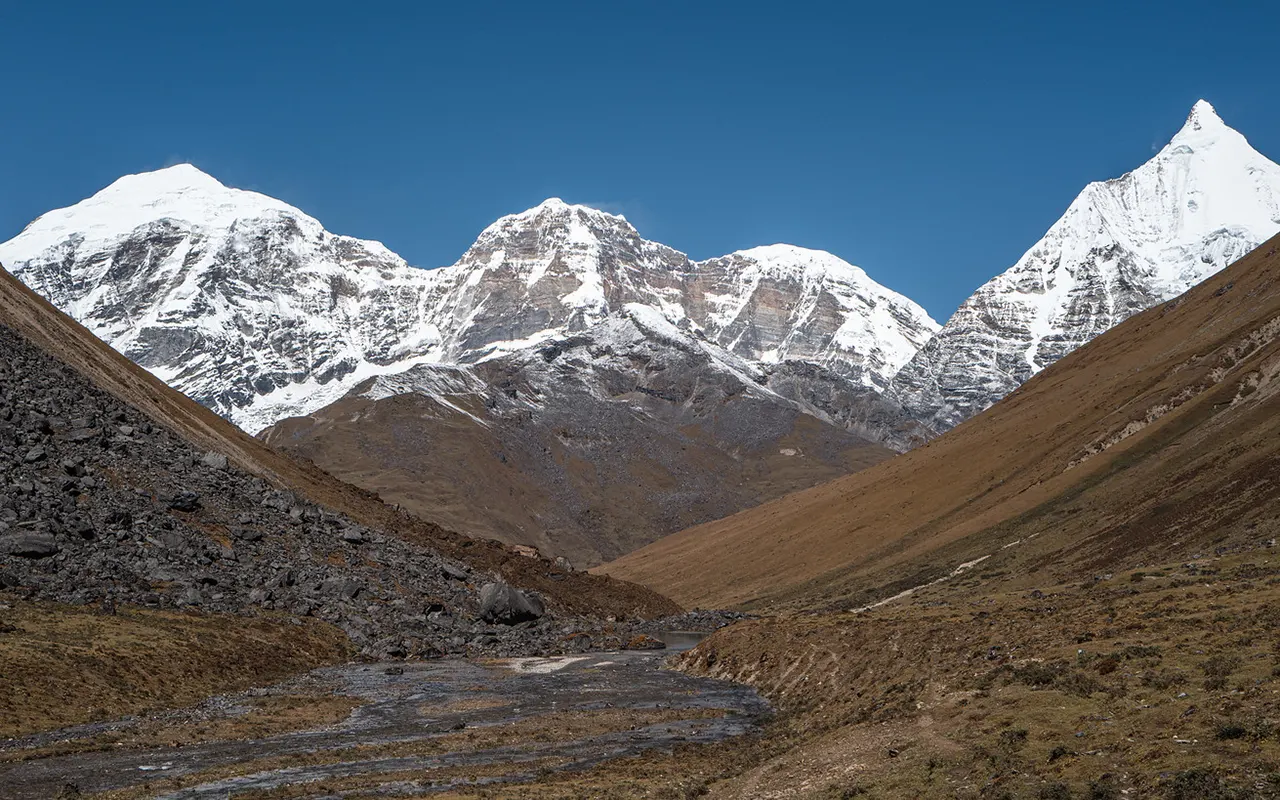
It leads slowly along the Paro Chhu River through bamboo, pine, oak and rhododendron forests and into the secure environment of the Jigme Dorji National Park. The landscape becomes less green as you ascend into a wide alpine meadow, glacier-fed rivers, and a rugged mountain landscape. An organized acclimatization day at Jomolhari Base Camp assists in getting your body acclimatized before going over the high passes of Nyile La and Yale La.
12 Days Jomolhari Trek in Bhutan is accommodative of well-fitted trekkers who like to walk in remote mountain settings. The walks will be between moderate and challenging daily, although the itinerary will give sufficient time to explore the environment whilst acclimatising to the altitude. You will walk through the yak grazing grounds, mountainous streams, old monasteries, and peaceful campsites that will enable you to get a glimpse of the serene wilderness Bhutan has to offer.
Best time for Jomolhari Trek in Bhutan is usually undertaken in the spring and autumn when the weather is usually clear and mountain visibility is at its best. The seasons are also pleasant to trek in and offer scenic beauty of nature on the way.
During the trip, 3A Adventure takes care of the travel organization by hiring the services of seasoned local guides, camping team, transportation and logistics, so that you can devote all the moments of this unforgettable Himalayan experience.
Your travel will start with you landing at Paro International Airport, where your local guide will receive you and take you to your hotel. Once you have registered, you will be free to rest and enjoy your flight and then begin your initial activities in Bhutan. In the afternoon, a briefing on the trekking route, daily timetable and what to expect during the adventure will be provided by your guide.
Following the briefing, you will see the Ta Dzong National Museum. It is situated in an old watch tower that overlooks Paro. The museum exhibits traditional paintings, fabrics, thangkas, weapons and antique household objects. A quick stroll outside the museum leads to the Paro Dzong or Rinpung Dzong, where you can observe its marvelous structures. Eating local food at Ka Ja Throm Market, and enjoying the vibrant ambiance in the evening would be the best time before going back to your hotel to spend the night.
Activity: 3 to 4 hours Airport transfer and sightseeing
Max. Altitude: 2,200m/7,218ft. (Paro)
Meal: Breakfast, Lunch and Dinner
Accommodation: Hotel
Then, you will drive a short distance to the trailhead of the trek you will have today to Taktsang Monastery or Tiger Nest Monastery. The route ascends gradually up a quiet forest in the hillside over Paro Valley. In approximately two hours of hiking up the mountain, you will come to a refreshment station where you can have a short rest before proceeding further up the mountain.
The last part is the path to the monastery, which is depicted by a long staircase to the monastery, which is constructed on the cliff approximately 1,000 metres above the valley.
You may visit prayer rooms equipped with statues, thangkas and other religious items inside. You will also be able to see the holy cave where Guru Rinpoche is supposed to have meditated. Having viewed the monastery, you will take the same path and have lunch and visit Kyichu Lhakhang Monastery. You will go back to Paro in the evening and sleep until the trekking part.
Activity: 3 to 4 hours Hike and sightseeing
Max. Altitude: 3,100m/10,171ft. (Taktsang Monastery ()
Meal: Breakfast, Lunch and Dinner
Accommodation: Lodge, Teahouse
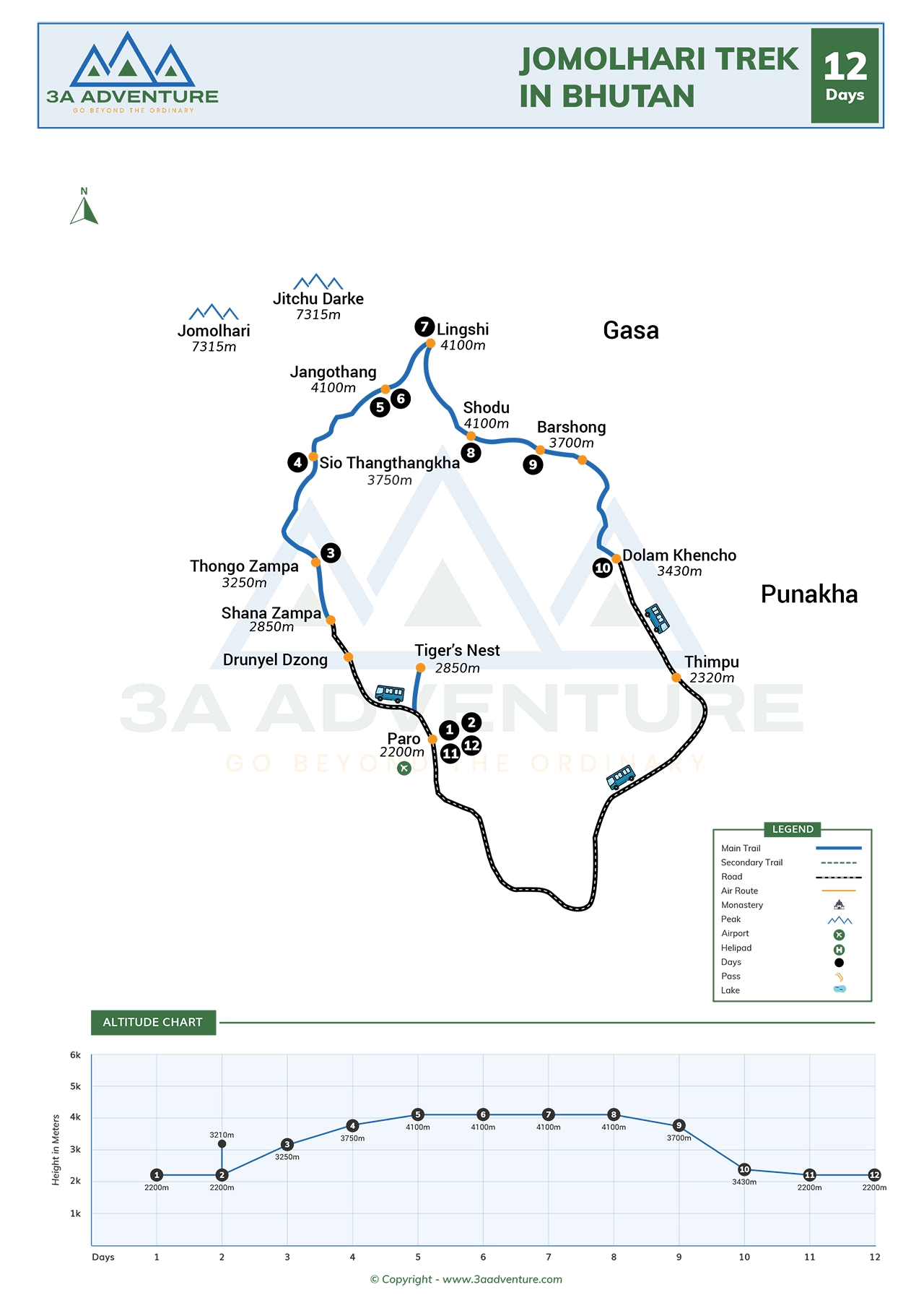
Today you start your trek to Thongo Zampa. You will then be driven after breakfast to Drukgyel Dzong and then take an off-road that follows the Paro Chhu River. Going through fields and small villages, you will have a far-off view of Jomolhari on the way to the army checkpoint at Gunitsawa, where your trekking permit will be inspected.
The trail starts with a peaceful stroll along the river through bamboo, oak, rhododendron and ferns, all of Shana. You will pass by the remains of the old Shana Bridge, and then follow a quiet trail through the woods. A junction leading towards Tibet through Tremo La Pass is left behind as you continue along your route. The trail then ascends steadily, then falls to a big bridge at Thongo Zampa. On crossing the bridge, you will reach your campsite where you will spend your initial night on the trek.
Activity: 5 to 6 hours Drive and trek
Max. Altitude: 3,250m/10,663ft. (Thongo Zampa)
Meal: Breakfast, Lunch and Dinner
Accommodation: Lodge, Teahouse
You will start your trek towards Soi Thangthangkha. The path traverses beautiful woods with moss, larch, pine and maple trees, which make the current walk tranquil. You will be spending the day within Jigme Dorji Wangchuck National Park as you trace the Paro Chhu River.
When the river bends northwards, you will go past the Buddhist stupa of Seyende Zam and then proceed on a gradual ascent. The trail is slowly rising in altitude and has periodical sight of the Jomolhari in the background. On passing another army camp, you will arrive at the broad open space of Soi Thangthangkha. Framed by mountains and open grasslands, this campsite offers a good resting spot to rest and get ready for the higher parts of the trek that await on the way.
Activity: 4 to 5 hours Trek
Max. Altitude: 3,700m/12,139ft. (Soi Thangthangkha)
Meal: Breakfast, Lunch and Dinner
Accommodation: Lodge, Teahouse
You are now heading higher into the alpine world and going to the Jomolhari Base Camp, also referred to as Jongothang. The path wends slowly up the open country, and past the little hamlet of Tegethang, where the people tend herds of big yaks. The higher you go, the more open the scenery is, and the mountains around seem much nearer.
A little further down the road you will find the ruins of an ancient fortress, and a stupa close by. Here the path leads over to the wide camping ground of Jongothang. This is a gorgeous campsite, located beneath the grandiose slopes of Jomolhari and Jichu Drake can also be seen around. Upon arriving at the camp, you will be able to rest, admire the mountainous environment and get ready for the acclimatization day before crossing over the high mountain passes in the trek later.
Activity: 5 to 6 hours Trek
Max. Altitude: 4,100m/13,451ft. (Jomolhari Base Camp)
Meal: Breakfast, Lunch and Dinner
Accommodation: Lodge, Teahouse
The day off today is to allow your body some time to become accustomed to the elevation of the higher terrain before you proceed to the trek. You can also have a relaxing day in the campsite where you can admire the beautiful mountain environment, read a book or perform some personal chores like laundry.
In case you want to have a more active day, you may also join a short hike to the beautiful Tsho Phu lakes where you will be able to see more closely Jichu Drake and Jomolhari. Alternatively, you can walk to a spot where you can see the mountains well, at approximately (4,400 m / 14,436 ft), and this would not only keep your body acclimatized, but also offer a good mountain view. Upon arriving home to camp, you will be able to rest and get ready to take on the difficult mountain pass crossing that will begin the next day.
Activity: 3 to 4 hours Acclimatization hike
Max. Altitude: 4,400m/14,436ft. (Jomolhari Base Camp)
Meal: Breakfast, Lunch and Dinner
Accommodation: Lodge, Teahouse
You will leave Jongothang after breakfast and proceed to the first big mountain pass on the trek. The trail becomes more open and rockier as you leave the valley behind. Beyond a bridge, there is a gradual ascending path which takes you above the valley in a region where blue sheep are commonly met. The last ascent to Nyile La is steep in some areas and the compensating mountain scenery is worth the effort.
The summit of Nyile La (4,850 m / 15,912 ft) is a place to see Tserim Kang, Jichu Drake and Gangchen Ta as well as the Tibetan border. It then trails downward through open mountain slopes at a gradually decreasing rate to a viewpoint which looks over Lingshi Dzong. You keep going down until you reach the small village of Lingshi, where there is a school, a small hospital and Gyo Gompa. You are camping by the river tonight, in this quiet village.
Activity: 6 to 7 hours Trek
Max. Altitude: 4,850m/15,912ft. ()
Meal: Breakfast, Lunch and Dinner
Accommodation: Camp
This is the most difficult and the longest day of the trek. You will begin in the early morning and take a path which ascends gradually along a ridge lined with forest, to a little stupa. Thence, the path goes over the Chabeyt Chang Chu or the Blue River and ascends to a mountain valley becoming remote.
Beyond the river, the path ascends further, through rocks and big boulders around Jimenaming, and then to Yale La (4,955 m / 16,257 ft) which is the summit of the current day walk. You can also have spectacular views of Lingshi and Basingthang Peaks at the pass. Then the trail turns down, along the Jaradingthang Chhu and Thimphu Chhu rivers. Going round one more little stupa, you go eastwards until you come to the campsite at Shodu, where you will sleep, pleased with all you have accomplished in the high mountains.
Activity: 8 to 9 hours Trek
Max. Altitude: 4,955m/16,257ft. (Shodu)
Meal: Breakfast, Lunch and Dinner
Accommodation: Camp
The trail today opens with a slow descent out of Shodu this morning. On the way, you will go through a deserted army camp and then enter into a valley with limestone cliffs and natural caves. The local tradition tells that these caves were used by Shabdrung Ngawang Namgyal in the past when he meditated. This scenic route goes on through beautiful landscapes with waterfalls to add to the landscape.
Later in the day you will cross over the main river and proceed on a trail that ascends gently over a distance of some 130 metres. The road then leads to the ruins of Borsang Dzong where you may have a brief rest. As the ground beneath the former fortress may be muddy, you will go a little further to get a better camping place. Upon arrival, you will have time to relax and have another tranquil night in the midst of the mountains.
Activity: 4 to 5 hours Trek
Max. Altitude: 3,700m/12,139ft. (Borsang)
Meal: Breakfast, Lunch and Dinner
Accommodation: Lodge, Teahouse
The route today starts with a steep downslope trail to the Thimphu Chhu River. The path passes a sequence of both long and short ascents and descents through the valley to a cross in the path. When you go to Dolam Khencho, it is in the right-hand direction and you are experiencing the changing mountainous landscape.
At Dolam Khencho, the path ascends again to a high viewpoint and then down a sharp cliff path to Dodena. This will be the culmination of your trekking experience in the Jigme Dorji National Park. Your own car will be here to receive you in Thimphu. In a few days of camping, you will be able to have a comfortable drive to the capital city, where there will be a hot shower and a comfortable bed that will give you a relaxing evening.
Activity: 3 to 4 hours trek and 45 minutes drive
Max. Altitude: 3,720m/12,205ft. (Thimphu)
Meal: Breakfast, Lunch and Dinner
Accommodation: Lodge, Teahouse
The morning will be devoted to sightseeing in Thimphu, which has some of the most significant sites of the city. You visit the Textile and Folk Heritage Museum, the National Memorial Chorten, Takin Mini Zoo, Arts and Crafts School, Handicrafts Emporium, the National Library, Traditional Paper Factory, Zilukha Nunnery, the Traditional Medicine Institute and Traditional Medicine Institute, and Tashichho Dzong.
Having made the tour of the city, you will start the comfortable journey back to Paro. Along the way, you will stop at Chunzom, where the Paro and Thimphu rivers meet. Here there are three chortens constructed in Bhutanese, Tibetan and Nepalese architectural designs. As you go along the Paro River, you will pass Tachogang Monastery and Shaba Village and proceed to Paro. The rest of the day is at your leisure to rest before you leave.
Activity: 2 hours drive and 3 to 4 hours sightseeing
Max. Altitude: 2,334m/7,657ft. (Paro)
Meal: Breakfast, Lunch and Dinner
Accommodation: Hotel, Lodge
The end of your journey is today. You will be shuttled to the Paro International Airport to continue your flight depending on the time of the flight you have. On the way out of Bhutan, you can reflect on the days of your wonderful experience of visiting the quiet valleys, historic monasteries, high mountain passes and the beautiful landscapes of the country. You will then board your plane to your next destination after the airport formalities with lots of great memories of the Jomolhari trek.
Activity: 20 minutes
Max. Altitude: 2,200m/7,218ft. (Paro)
Meal: Breakfast
Note:
If you have a private group and prefer a personalized experience, we can organize a custom trip tailored to your requirements and group size, running it any day you choose.
Transportation
Food and Accommodation
Guide and Support staff.
Permits and Expenses
Medical and Gear
Others
International Flights and Visa.
Food and Accommodation
Travel and Medical Insurance.
Other Expenses
Jomolhari Trek in Bhutan may be done at various times of the year, but spring between March and May and autumn between September and November are generally regarded as the most suitable season of Jomolhari Trek in Bhutan. The weather in these months is more or less stable and there are clear skies and pleasant weather during the day, which is quite suitable for trekking. The trail is covered with colourful rhododendron in spring and has great mountain views in autumn following the monsoon.
It is considerably colder in winter at higher altitudes, although even experienced trekkers will be able to make it through. It is likely to be muddy and slippery in summer because of the frequent rainfall. Temperatures may fall far below the freezing point at night since the hike goes as high as (4,955 m / 16,257 ft). 3A Adventure will be able to assist you in selecting the most appropriate departure according to the season and weather conditions.
Jomolhari Trek in Bhutan is a moderate to difficult camping trek, which needs proper physical fitness and willpower. The number of walks is four to nine daily, along mountain paths, forests, river valleys, and high passes. The route crosses Nyile La (4,850 m / 15,912 ft) and Yale La (4,955 m / 16,257 ft), where the thinner air makes trekking more demanding. It has several long ascents and descents and no technical climbing is required.
Past knowledge of trekking will be beneficial but not mandatory, provided you do prior preparations prior to the trip. It will be easier to walk slowly and in step with instructions given by your guide. To aid the trekkers in having an enjoyable adventure, 3A Adventure will schedule the itinerary with adequate acclimatization.
One of the things that should be taken into consideration in the Jomolhari Trek in Bhutan is altitude sickness since most of the path is elevated (above 3,500 m / 11,483 ft). The higher the altitude of climb, the Jomolhari Base Camp (4,100 m / 13,451 ft) and Yale La (4,955 m / 16,257 ft), the longer your body requires time to adapt. Headaches, fatigue, dizziness, sickness or anorexia can be experienced by some trekkers.
The itinerary will have an acclimatization day to minimize these risks prior to crossing the highest passes. Simple methods of helping your body adapt are to drink enough water, eat well, avoid alcohol and walk slowly. Your guide will also periodically monitor your health and intervene in case any of the symptoms are severe during the trek.
The 12-day Jomolhari Trek in Bhutan will be more enjoyable and comfortable when properly prepared. You should start training about a few weeks before your trip by walking, hiking, biking, jogging, or climbing stairs to enhance your endurance. Leg and core muscle strength training is also useful, as you will be walking many hours a day with a small daypack.
Trekking shoes must be worn out to prevent blisters by wearing comfortable trekking shoes. Changing weather in the mountains requires warm clothing, a quality sleeping bag and waterproof gear. 3A Adventure offers a packing list and travel information before departure that are detailed so that you can pack and be ready to go on the adventure.
In the Jomolhari Trek in Bhutan, you will be staying in Hotels in Paro and Thimphu, with the trekking part being assisted by fully equipped camps. The journey is prepared with comfortable tents, dining tents, kitchen tents and other camping equipment. The trekking staff prepares fresh meals daily and typically consists of a mix of rice, vegetables, soups, noodles, eggs, meat dishes and hot drinks.
Vegetarian dishes may be pre-ordered as well. Water is only served after it has been treated and it is advisable to carry a reusable water bottle. 3A Adventure has been known to employ professional camping staff to take care of clean meals, comfortable camps and solid support in the trek.
The Jomolhari Trek in Bhutan has well-organized transportation throughout the trip, both when you arrive and when you leave. All road transportation, which is included in the itinerary such as airport transfers, is taken by a private vehicle. The first step will be to transfer to your hotel at Paro International Airport. Your trip will be by car as well; before the trek begins, you will be driven to Drukgyel Dzong, which will be the starting point of your trek at Shana.
Upon the completion of the trek in Dodena, a personal vehicle will be used to transfer you to Thimphu, after which the following day you will be comfortably driven back to Paro. The roads are usually in good condition, though some areas along the trekking path are in bad condition.
The mobile network and Internet connectivity in the cities of Paro and Thimphu are usually good and communication is possible. During the Jomolhari Trek, the mobile signals are weak and inaccessible in most of the remote mountain regions. Once they have started the camping trek, there is usually no Internet connection, which is why it is a good idea not to start the trek without notifying family and friends.
This slowness of connection also allows you to take pleasure in the serene mountain atmosphere free of distractions. The trekking guide will be with the group during the trek and can help when there is a need to communicate. It is advisable to carry a fully charged power bank since there are no charging facilities in the campsites throughout the trek.
Everyone intending to participate in the Jomolhari Trek in Bhutan has to acquire the necessary trekking permits prior to the trek. Besides a Bhutan travel permit, you will require a trekking permit since the route traverses a sacred land, such as Jigme Dorji National Park. These permits are pre-arranged and verified at military checkpoints on the way, such as Gunitsawa.
Visitors do not have to obtain the permits themselves, but tend to do so via a licensed Bhutanese tour operator. By going on a trip booked with 3A Adventure, the relevant permit arrangements are made before your arrival, and you can enjoy the trek and not worry about the paperwork on your trip.
The majority of foreigners need a visa to get into Bhutan. The visa is granted upon confirmation of your tour with a legitimate Bhutanese tour operator. You will be required to give a copy of your passport and the necessary personal information before traveling in order to have the visa application processed. Your passport must have at least six months to your travel date.
When your visa is granted, you will be given a visa clearance letter before travel and a visa will be given to you on arrival in Bhutan. 3A Adventure can help you with the needed travel papers and organize the visa procedure with the company’s local partners to simplify and make your travel easy and convenient.
Anyone who is going to participate in the 12-day Jomolhari Trek in Bhutan is highly encouraged to have travel insurance. As the route goes as high as 4,955 m / 16,257 ft, you should have high altitude trekking covered in your insurance policy. In addition, selecting a policy that includes medical care, emergency evacuation, trip-cancellation, flight-delays, lost luggage and personal accidents is also recommended.
The weather in the mountains is unpredictable and anything might happen when undertaking remote trekking trips. Adequate insurance will offer financial security and comfort during the adventure. Before your journey, you should scrutinize your policy and ascertain that it covers all the undertakings and heights of the trek.
Even though you have a lot of services covered in your package, you ought to consider spending some of your personal expenses when engaging in the Jomolhari Trek in Bhutan. These can involve beverages other than the ones provided in the meal, snacks, personal shopping, laundry, tips to the trekking staff, any personal gear that you wish to purchase or rent before the trek. Other costs include souvenirs that are bought at Paro or Thimphu.
Some local currency is handy to make small purchases since you will not be able to use a card payment in remote trekking locations. It would be a good idea to plan a sensible personal budget prior to taking your trip so that you will not have to spend your time worrying about the unforeseen expenses that you might meet during your trip.
Jomolhari Trek in Bhutan can be organized as a personal trek or a group departure, according to your choice of travel. A personalized tour is more flexible, as you can select your own travel dates and have an even more personalized experience with your own guide and support team.
Group treks have predetermined dates to leave and enable you to share the adventure with other trekkers and the adventure becomes more social and usually the price is also lower. The destinations of both options are the same and feature the same trekking services.
General
The regular program is of 12 days, comprising sightseeing, trekking and an acclimatization day.
It is advisable to book at least two to three months before the date you want to go on the trek, as the trekking seasons are usually busy.
Preparation & Fitness
Experience of trekking is not necessary but desirable. It is more important to be well-fit and exercise before the trip.
You must be able to walk with some degree of comfort over rough mountain paths, with long, slow ascents and descents.
Insurance & Visa
Yes. High altitude trekking, emergency medical treatment and evacuation should be covered in your insurance.
The majority of international visitors need a Bhutan visa that is organized by an authorized tour operator and is to be acquired in advance.
Guides & Support Staff
Yes. The group is accompanied by a licensed local guide throughout the journey.
The camping gear and your primary luggage are carried by a special trekking support staff and you are only required to bear a daypack.
Accommodation and Facilities
Hotels are offered at Paro and Thimphu and the trekking part is accompanied by fully supported camping.
At campsites, there are simple toilet facilities, but the level is much lower than in towns.
Weather & Seasons
Yes. It can be done during winter, though the cold and the occasional snow make the journey more difficult.
There can be snow at higher altitudes in late autumn, winter and early spring.
Health & Safety
Your guide will check on your health and in case of need, he or she will make you go to a lower altitude to be safe.
Yes. The consumption of water is done after it is treated and it is advisable to carry a reusable water bottle.
Booking & Payment
You are confirmed when you have gone through the necessary reservation process and have paid the agreed deposit.
Transportation & Flight
Yes. The itinerary includes airport transfer and all related transportation.