Weather Month to Month and Best Season
The trekking route to Mera Peak passes through different climatic zones which range from the lower Himalayan region of the warmer hills to the high Himalayan region with cold alpine weather above 5,000m. The season greatly influences the trekking and climbing conditions because the weather turns rapidly at high altitudes.
| Month |
Weather and Trail Conditions |
Suitability |
| January |
Very cold, especially above Khare. Snow and icy conditions are possible. |
Difficult |
| February |
Cold with short days and possible heavy snow at higher elevations. |
Difficult |
| March |
Temperatures gradually improve, with generally better mountain visibility. |
Good |
| April |
Stable spring weather and good climbing conditions at higher elevations. |
Excellent |
| May |
Generally favorable early in the month, with increasing pre-monsoon cloud later. |
Very Good |
| June |
Monsoon rain begins, with wet lower trails and less reliable mountain views. |
Not recommended |
| July |
Frequent rain, clouds and slippery trails. High mountain weather can be unstable. |
Not recommended |
| August |
Continued monsoon conditions and limited visibility. |
Not recommended |
| September |
Rain usually decreases toward the end of the month, but conditions can remain changeable. |
Fair to Good |
| October |
Dry weather, clear skies and good visibility make this a strong month for climbing. |
Excellent |
| November |
Usually dry and clear, although temperatures become colder at higher elevations. |
Very Good |
| December |
Cold conditions and possible snow make the higher sections more demanding. |
Difficult |
For Mera Peak climbing via Pangom, the strongest periods are generally spring and autumn, April, May, October and November. Mountaineering is generally best during the spring and autumn periods, while conditions become colder and more difficult in winter.
Difficulty Level
The trek and climb to Mera Peak from Pangom is tough. The problem is the long approach, the change of altitude and the last one over 6000 m. Previous high-altitude trekking experience is useful, but with good preparation, the route can be tackled by fit and well-prepared climbers.
The Pangom method entails a number of long walking days before arriving at the higher Hinku Valley. After passing Khare (5,045 m / 16,552 ft), the nature of the trek shifts from trekking to technical mountain preparation.
The summit section requires the use of climbing equipment such as crampons, an ice axe, a harness and a helmet. Mera Peak is officially classified as a trekking peak, but the Nepal Tourism Board recommends that this peak is not to be taken lightly, as it requires climbing skills.
Altitude Sickness
Due to the gradual climb from Kathmandu to the summit of Pangom Mera Peak at above 6000m, altitude sickness is a serious issue to be considered during the Pangom Mera Peak Trek. Some symptoms are headache, dizziness, nausea, tiredness, loss of interest in eating and trouble sleeping.
The journey has acclimatization days in Thangnak and Khare to allow your body to adapt. These rest days are crucial and not meant for “optional” sightseeing days.
Move slowly, drink plenty of water and do not drink alcohol at high elevations. Let your guide know right away if you notice any unusual or worsening symptoms. When symptoms are severe, descending can be the most critical action when becoming ill from altitude, so always consider going down when it means it’s going to get worse.
Preparation and Fitness
Pangom is a good route for the ascent to Mera Peak and it is essential to be in good physical condition before attempting it. Walking for a few hours a day, with some hilly terrain, for a few days in a row should be comfortable.
Begin to prepare weeks in advance of the trip. Ways to improve endurance are to walk, hike, climb stairs and ride a bike regularly or to do strength training exercises.
Useful preparation includes:
- Hikes on uneven surfaces
- Climbing stairs or walking uphill
- Cardiovascular training
- Leg and core strengthening
- Wearing any light backpack while training
- Practicing regular hydration
- Getting used to walking for several hours
Typically performing this training is performed before setting out on your trip. This training occurs before the trip with the trekking footwear.
As technical climbing experience is a plus, but not necessary, climbing training is available during the expedition. But it’s a long drive up to the summit and high elevation, so you should be fit for the day.
Food and Accommodation
The food available on the Pangom Mera Peak trek is primarily eaten in the local teahouses and lodges along the trek. Usually, they serve familiar dishes like dal bhat, noodles, rice, pasta, soup, potatoes, eggs, bread and vegetables. Tea and coffee are also available.
Closer to the summits, choices of foodstuffs are reduced as supplies are brought in from great distances. It’s important to eat regular meals to keep up energy on the journey.
Typically, simple teahouses and lodges provide simple rooms and communal facilities. The Mera High Camp section is a special one where you are going to have overnight and high camp camping support at about 5780 m/18963 ft. 3A Adventure arranges the necessary trekking accommodation and high camp camping support following the itinerary.
Transportation
The majority of transportation is provided by 3A Adventure. This program includes domestic flights to/from Lukla and an airport transfer to Kathmandu.
Normal operating time for the flight to Lukla is about 30–40 minutes. In the peak season of trekking, flights may depart from Ramechhap instead of Kathmandu, depending on the airline schedules and airport availability.
A private vehicle (with driver) can be arranged for road sections in Kathmandu as per the itinerary. Your team will also arrange the airport transfers so you don’t have to arrange your local transportation.
Weather plays a key role in mountain flights, so schedules may change. Practical arrangements will be made with your guide and agency staff should flight times change.
Communication
The elevation of the Mera Peak route provides coverage for mobile communications in part, but becomes weaker as you head deeper into the mountains. Though it may not be a guaranteed signal throughout the trail, Ncell and Nepal Telecom services are available in some lower settlements.
Communication options include:
- One can get local SIM cards in Kathmandu.
- One of the mobile networks available in areas with coverage.
- WiFi at some lodges
- In the selected settlements, paid internet services are available.
- The trekking team is on duty to communicate during an emergency.
- Having essential data is accessible without the internet or power.
As altitude increases, the reliability of the internet decreases. The communication options become less available and should not be used to get continuous Internet access at or above Khare.
Permit
Permits are arranged as part of the organized climbing trip by 3A Adventure. Mera Peak is classified as a Group B trekking peak by the Trekking Agencies Association of Nepal and permits are required to climb the peak.
Trekking permits are also needed for the Everest region. Mera Peak trek is one trek in Nepal that is specifically mentioned by the Nepal Tourism Board that requires a licensed guide and an agency-issued TIMS card.
Enforcement of the appropriate national park and local area permits is also dealt with as necessary for the route. Your agency will fill out the paperwork before you go into the trekking area, so you are not required to do so on your own.
Visa
Nepal tourist visa is required for the majority of foreign travellers. A visa can usually be issued upon arrival at Tribhuvan International Airport or via a diplomatic mission in Nepal.
It is important that your passport has an adequate validity for your trip and that you have the necessary passport information and photographs or digital information that may be required during the visa application process.
The Nepal tourist visa is not covered in the trekking package; you will have to pay for your tourist visa. Please note that entry requirements and fees may vary, so please check before travelling for your nationality.
Travel Insurance
This Mera Peak climbing program requires travel insurance. Your policy needs to be a high altitude trekking and peak climbing policy as well as an ordinary trekking or low altitude trekking one.
Make sure the policy provides suitable coverage for emergency medical treatment and evacuation. Adequate rescue coverage is especially important in the Himalayas as the helicopter evacuation can be very costly.
The highest point you’ll reach on this trip is about 6,461 m / 21,198 ft, so this should be covered by your insurance as well. Read the insurance policy terms thoroughly before you buy it and have the insurance company’s emergency contact information on hand during the hike.
Extra Expenses
The package includes the principal services included in your trip, but you should bring some extra cash for personal needs while you are traveling. This depends upon your habits and the use of extras.
Additional costs may be:
- Snacks and chocolate
- Water from a bottle or boiled water
- No soft drinks or juice
- Hot showers
- WiFi and internet
- Personal telephone calls
- Charging services
- Additional space due to delays
- There are several other meals available in Kathmandu.
- Sightseeing entrance fees
- Personal medication
- Guides, climbing staff and porters: tips and tricks!
Although not mandatory, tips are usually given at the end of a successful trek and are expected in Nepal.
Private and Group Trek
Depending on your type of travel, flexibility and budget, you can opt for a private journey or a group arrangement. Both are similar and have a main route, but different experience.
| Feature |
Private Trek |
Group Trek |
| Group size |
Your own group |
Shared with other trekkers |
| Departure |
Flexible |
Fixed or scheduled |
| Pace |
Adjusted to your group |
Based on the group |
| Guide |
Dedicated guide and climbing team |
Shared guide and climbing team |
| Accommodation |
Arranged for your group |
Arranged for the group |
| Communication |
Direct with your guide |
Through the group guide |
| Cost |
Usually higher per person |
Usually more economical |
| Best for |
Families, friends and private groups |
Solo travelers and budget-conscious trekkers |
Private Mera Peak climbing via Pangom trip will allow you to set your own pace, rest and daily schedule. If you want to travel with other climbers and share the cost of running the trip, then a group trip is a good option.
In both cases, 3A Adventure arranges the climbing guide, the necessary equipment and organizes the rest of the logistics based on the chosen package.
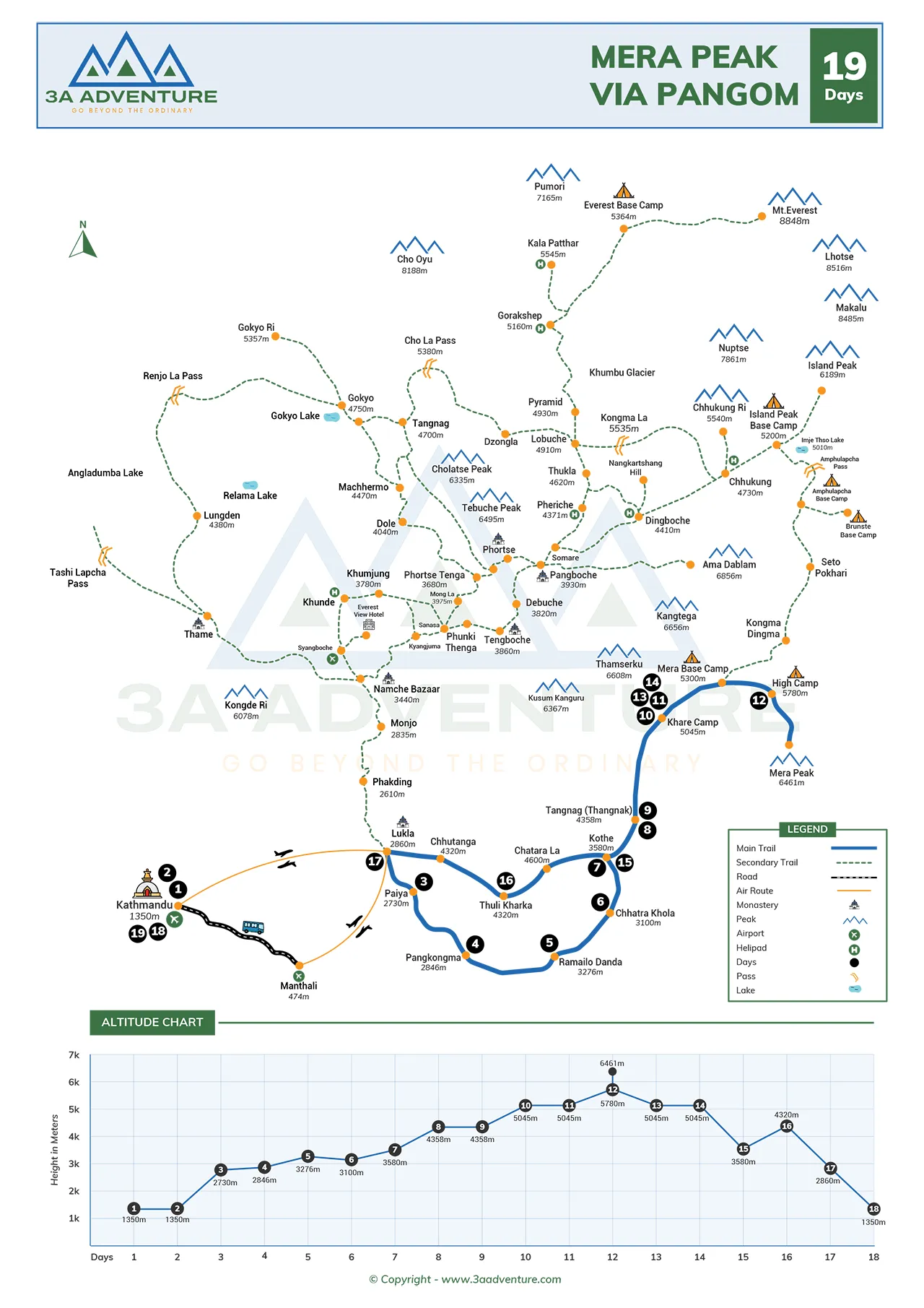
What You Will Experience on the Mera Peak Journey
| Trek Section |
Main Experience |
| Lukla to Paiya |
Mountain flight followed by forest trails |
| Paiya to Pangomma |
Forests, hillsides and remote settlements |
| Pangomma to Ramailo Danda |
Ridge walking and gradual altitude gain |
| Ramailo Danda to Chhatra Khola |
Forest trails with climbs and descents |
| Chhatra Khola to Kothe |
Hinku Valley approach |
| Kothe to Thangnak |
Higher altitude and changing mountain scenery |
| Thangnak to Khare |
Alpine terrain and increasing altitude |
| Khare |
Acclimatization and climbing training |
| Khare to High Camp |
Snow, glacier terrain and tented overnight |
| High Camp to Summit |
Early morning peak climbing |
| Summit to Lukla |
Descent through Khare, Kothe and Thuli Kharka |
You will be traversing different types of mountain terrain on your climb to Mera Peak from Pangom. The trip begins in forests and villages in the lower part and slowly winds its way into the upper Hinku Valley.
Things definitely improve after Kothe. Trees are less frequent, habitat is more sparse and impacts of elevation are more pronounced. Climbing preparation and technical training are the focus at Khare.
The last section is quite another. There is a section of snow, ice and glacier terrain as you climb up to the high camp and the summit.
A Day on the Trail
The Pangom Mera Peak trek is a typical day where one has to get up early from the lodge and start the day at 07:00. A guide will typically give you information about the day’s walk before you start walking.
The bulk of the trek takes place in the morning. Walking will be at a steady pace with short breaks as necessary. Typically, a lunch stop is required at an appropriate lodge, teahouse or resting place on the trail.
Following lunch, the walk is on towards the day’s destination. Depending on the route, you’ll arrive at the overnight village during the afternoon and will be able to rest, wash, recharge your devices or explore the area around the village.
Evenings are typically easy. Dinner and a meeting with the guide to discuss the next day’s plan and to pack before retiring to bed.
As the altitude increases, the daily schedule is geared more toward rest, hydration and acclimatisation. The schedule also changes on days when the climb is in session due to the early start and longer days on the mountain on climbing days.
Contingency Day Explained
The contingency day has been added due to the fact that it is not always possible to predict mountain conditions. The summit attempt on Mera Peak via Pangom is dependent on favourable weather conditions, snow conditions, visibility and the safety of the climbing route.
You have Day 14 as a fall-back day to your itinerary from the summit attempt. When the group is unable to reach the top on the day that they are scheduled to climb and conditions are unsafe, the climbing team can take advantage of this extra day when the weather and conditions improve.
Although the day is a reserved day, it does not mean the climb will be successful, as weather conditions on the mountain can change at any time. It just provides the expedition with flexibility and less of a rush into the climb due to a set schedule for returning home.
If the summit is reached, the day could alternatively be spent resting and recovering at Khare. The changing conditions of the day will be decided by the climbing guide based on the weather, route conditions and group condition.
What Summit Day Really Feels Like
The Summit day in Mera Peak climbing from Pangom is a very early day from Mera High Camp 5780m/18963ft. The start is delayed to give time for the climb and descent and as a general rule tends to be better early in the day.
Cold is a big deal in the experience. Before departing camp, you will need warm clothing and your climbing gear. Depending on the conditions, crampons, ice axe, harness, helmet and climbing boots are used during the ascent.
The physical challenge of the climb is due to the altitude and length of the climb. The rate of progress is usually slow, with frequent rest periods and supervision from the climbing team. The last approach needs attention and concentration when approaching on snow and glacier terrain.
At the target summit (6461 m / 21198 ft), the descent starts. The climb up to Khare is still extremely demanding and the climbing party will proceed at a cautious speed and provide support during descent.