Weather and Best Season
The most appropriate period to do a Mount Ama Dablam Expedition is in the spring and autumn climbing seasons. These seasons usually have better weather and a clear view of the mountains than during other seasons of the year. During spring, the weather is generally mild, and there are more hours of daylight, whereas autumn is characterized by clear skies and visibility. The Himalayas weather is unpredictable, and climbers must always be ready for sudden changes in temperature, wind, and visibility.
In the expedition, the temperature is lower with an increase in altitude. Conditions at Ama Dablam Base Camp (4,450 m / 14,600 ft) are very different from those in Kathmandu (1,400 m / 4,593 ft). Mountain conditions are much more severe in higher camps and in summit areas. A successful Ama Dablam Climbing Expedition requires proper planning, appropriate equipment, and flexibility. The appropriate season choice can significantly enhance the safety and the entire climbing process.
Difficulty Level
The Mount Ama Dablam Climb is regarded as a strenuous mountaineering goal, which demands prior experience in high-altitude trekking or climbing. This is a technical climbing expedition that includes some technical climbing parts and some high-altitude stints, unlike typical trekking routes. Climbers must feel at ease with climbing gear and operate in the mountains.
The expedition will start with trekking and slowly transform to climbing above Ama Dablam Base Camp (4,450 m / 14,600 ft). As climbers ascend higher up to Camp I, Camp II and ultimately the summit, physical and mental demands become very demanding. This climb is only suitable for experienced adventurers due to the combination of the altitude, weather, and technical terrain.
Even though the climb is challenging, with proper preparation, training, and support, the chances of a successful summit can be enhanced. A lot of climbers prefer to join a professionally organized Mount Ama Dablam Expedition so as to enjoy the organized logistics, instructions, and safety resources during the expedition.
Altitude Sickness
One of the most significant factors to be considered in a Mount Ama Dablam Expedition is altitude sickness. Rising to greater heights, climbers use less oxygen, which makes it more difficult for the body to adapt. Symptoms can include headache, fatigue, loss of appetite, dizziness and sleeping difficulties.
The itinerary has acclimatization days and climbing rotations to enable the body to gradually adjust to the altitude. A stay in the Ama Dablam Base Camp (4,450 m / 14,600 ft) before advancing higher is a significant aspect of this process. Climbers are advised to be keen on their physical fitness and report any symptoms to their guide or expedition team.
One of the best methods to decrease the chance of altitude-related issues is proper hydration, enough rest, and gradually increasing the altitude. Strict adherence to the expedition plan is significant in ensuring health and safety during the climb.
Preparation and Fitness
A successful Ama Dablam Climbing Expedition requires good physical preparation. The training that should commence several months before departure should involve the climbers working on improving their endurance, strength, and fitness. Hiking, running, cycling, stair climbing, and strength training are some of the activities that can be done to prepare the body for the requirements of the expedition.
The expedition entails a walk to Ama Dablam Base Camp (4,450 m / 14,600 ft) and several rotations and a summit push at very high altitudes. Good cardiovascular condition is especially significant since it becomes more physically demanding to climb at altitude. It is also worthwhile to prepare mentally because climbers can have a long day, varying weather patterns and difficult climbing.
An adequate training schedule can greatly enhance performance and comfort at the expedition. Before trying a Mount Ama Dablam Climb, most climbers train in fitness and technical climbing skills, enabling them to feel more confident and ready to take the adventurous leap.
Food and Accommodation
Throughout the Mount Ama Dablam Expedition, food and accommodation vary. In the trekking part of the expedition, climbers spend their nights in local lodges and tea houses on the way. These tents provide a comfortable area to rest and then move on to base camp.
Accommodation is made at the base camp of Ama Dablam in a tented expedition camp at (4,450 m/ 14,600 ft). The operational center of the climbing activities, acclimatization, and summit preparation is established in the base camp. Meals are usually provided to help sustain the nutritional requirements of climbers throughout the expedition.
The environment of the mountains makes accommodation simpler as the expedition continues. Climbers can anticipate plain but practical facilities that are meant to accommodate high-altitude climbing activities. With the assistance of well-trained organizers like 3A Adventure, meals and lodging logistics are handled before the event, so the participants can concentrate on the climbing and the expedition experience in general.
Transportation
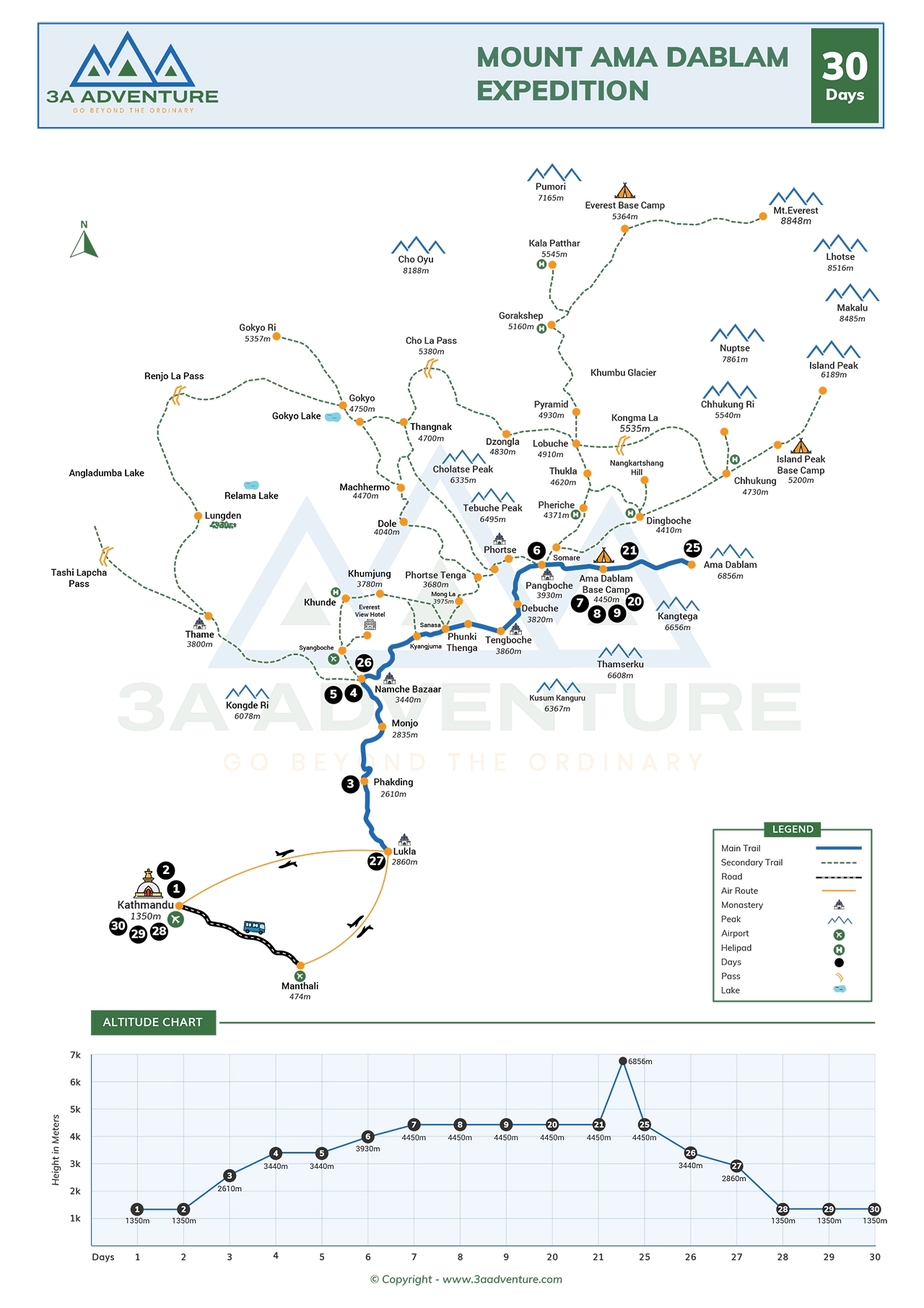
One of the key aspects of the Mount Ama Dablam Expedition is transportation. The adventure starts at Kathmandu, and the climbers organize the adventure and then head to the Everest region. Based on the itinerary, the trip will consist of a flight between Kathmandu and Lukla and the trek to Ama Dablam Base Camp. Participants finish the expedition by flying back to Kathmandu at the end of the expedition.
These flights save much time which would otherwise be spent traveling and offer access to the starting point of the trekking route. Due to the weather conditions in the mountains, flexibility is a factor during the trip since it may interfere with the flight schedule. Climbers must also have some extra time in their travel plans in order to allow time in case of delays.
Once the expedition gets to Kathmandu, hotel transfers and airport transfers are usually included in the expedition services. Good transportation logistics facilitate a comfortable journey between arrival and departure to enable the climbers to concentrate on the objectives of their Ama Dablam Climbing Expedition.
Communication
The higher you go in a Mount Ama Dablam Expedition, the more restricted your communication facilities are. Kathmandu has a high level of internet access, mobile networks, and other communication services. Connection can be difficult at times, and at other times during the trek to Ama Dablam Base Camp, it is affected by the weather and the place.
Communication opportunities at Ama Dablam Base Camp (4,450 m / 14,600 ft) tend to be less abundant than at lower altitudes. Slow internet speeds and network drops are to be expected by climbers. It is advisable to educate the family and friends that they might not always be in touch with the climbing phase of the expedition.
Communication services at higher altitudes may not be as reliable as climbers should expect, although staying in touch can be helpful. It is also possible to avoid futile fears during the expedition and to plan and spread information about significant travel before entering the mountain area.
Permit
A valid climbing permit is required for a Mount Ama Dablam Climb. The expedition also includes permits like Ama Dablam Expedition Climbing Permit, Sagarmatha National Park Entry Permit and Khumbu Pasang Lhamu Rural Municipality Permit, which are required in order to legally engage in climbing practice in the mountain. Before setting out on an expedition, climbers are advised to make sure that all the necessary paperwork has been done.
The requirements of permits can be different, as there is a chance that they will change according to the existing regulations and expedition plans. The majority of climbers choose to join an organized Mount Ama Dablam Expedition, in which the services of obtaining permits are included in the expedition services. This is used to ease the process of administration, and participants concentrate on preparing to climb.
When travelling, one should always keep copies of the important documents and personal identification. Always use approved channels when handling permit procedures to make sure that the local regulations are followed. Having the right permit arrangements is one of the major components of an effective and well-organized expedition.
Visa
The majority of foreigners visiting Nepal need a visa to travel there and participate in a Mount Ama Dablam Expedition. Most nationalities are offered a tourist visa, and travelers are advised to verify the current visa requirements before making their travel plans.
One is usually required to have a valid passport that has enough validity beyond the time of travel. Visa laws are dynamic, so climbers are advised to confirm the prevailing needs using official governmental platforms before traveling. It is always good to have all the travel documents ready beforehand to prevent any delays and complications when arriving.
The participants are advised to make sure that their visa period is sufficient to accommodate the entire expedition period (with arrival and departure days). The expedition takes several weeks and therefore, the right visa period is to be chosen. Visa preparation is a good way to make the journey jump off on the right foot and enable climbers to concentrate on the adventure.
Travel Insurance
Anyone participating in a Mount Ama Dablam Expedition should have travel insurance. The characteristics of high-altitude mountaineering require climbers to take out a policy that directly addresses trekking, climbing, emergency medical care, and evacuation services in case of need.
The expedition ascends to the high altitudes above Ama Dablam Base Camp (4,450 m / 14,600 ft) and extends to much higher camps in the summit phase. Due to such circumstances, regular travel insurance is not necessarily the one that is going to offer sufficient coverage. Before buying insurance, one should carefully look at the details of the policies.
All-inclusive coverage may cover financial risks in case of unforeseen circumstances like travel delays, illnesses, lost luggage, and evacuation costs. Being properly insured gives you a sense of relief and is viewed as a considerable aspect of responsible planning of expeditions.
Extra Expenses
Although most services are covered in a Mount Ama Dablam Expedition, the climbers are to provide personal costs that may be involved in the expedition. These extras are subject to change according to individual tastes and traveling needs.
Some typical additional costs can be personal snacks, beverages, laundry, recharging of electronic devices, communication, personal equipment, support staff tips, and any other pre-expedition and post-expedition travel costs. International flights and visa fees can also be differentiated depending on the package chosen.
It is a good idea to have a extra budget since there may be some unforeseen costs in any long expedition. Budgeting personal expenditure is a way of avoiding financial shocks and will enable the climbers to have an enjoyable adventure. Knowing the additional expenses that may arise is a significant aspect when preparing a successful Ama Dablam Climbing Expedition.
Private and Group Expedition
The Mount Ama Dablam Expedition may be planned as a solo trip or a mixed trip. The two alternatives have their own benefits, and the most suitable option depends on the preferences, climbing experience, and traveling intentions.
A personal trip will be a more flexible one and will also give the climbers a more personal experience. It may be adapted to the needs of an individual person, friends, or small groups of people who like personalized planning and a special plan.
Group expeditions unite like-minded climbers and, in many cases, give rise to a good team spirit. The participants are able to share the experience of the expedition, enjoying the benefit of organized logistics and support. A large number of climbers are fond of getting to know other like-minded adventurers and sharing the experience of the quest to the summit.
Some operators, like 3A Adventure, provide both individual and group opportunities to choose the format of the expedition that suits them best, according to their level of experience and the objectives of climbing.