Based on 27 reviews
Trip Duration
10 DaysTrip Difficulty
ModerateMax Altitude:
5,545m. / 18,192ft.Group Size
2 to 25 personBest Season
Autumn, SpringMeals
Breakfast, Lunch and DinnerAccommodation
Teahouse/ HotelTransportation
Tourist BusThe Short Everest Base Camp Trek is an excellent choice for travelers who want to experience the beauty of the Everest region within a limited timeframe. The trip is a mix of spectacular mountain views, the Sherpas’ ancient culture and the adventure of reaching one of the world’s most renowned trekking sites. The trek offers most of the attractions of longer Everest trails, but in a shorter time.
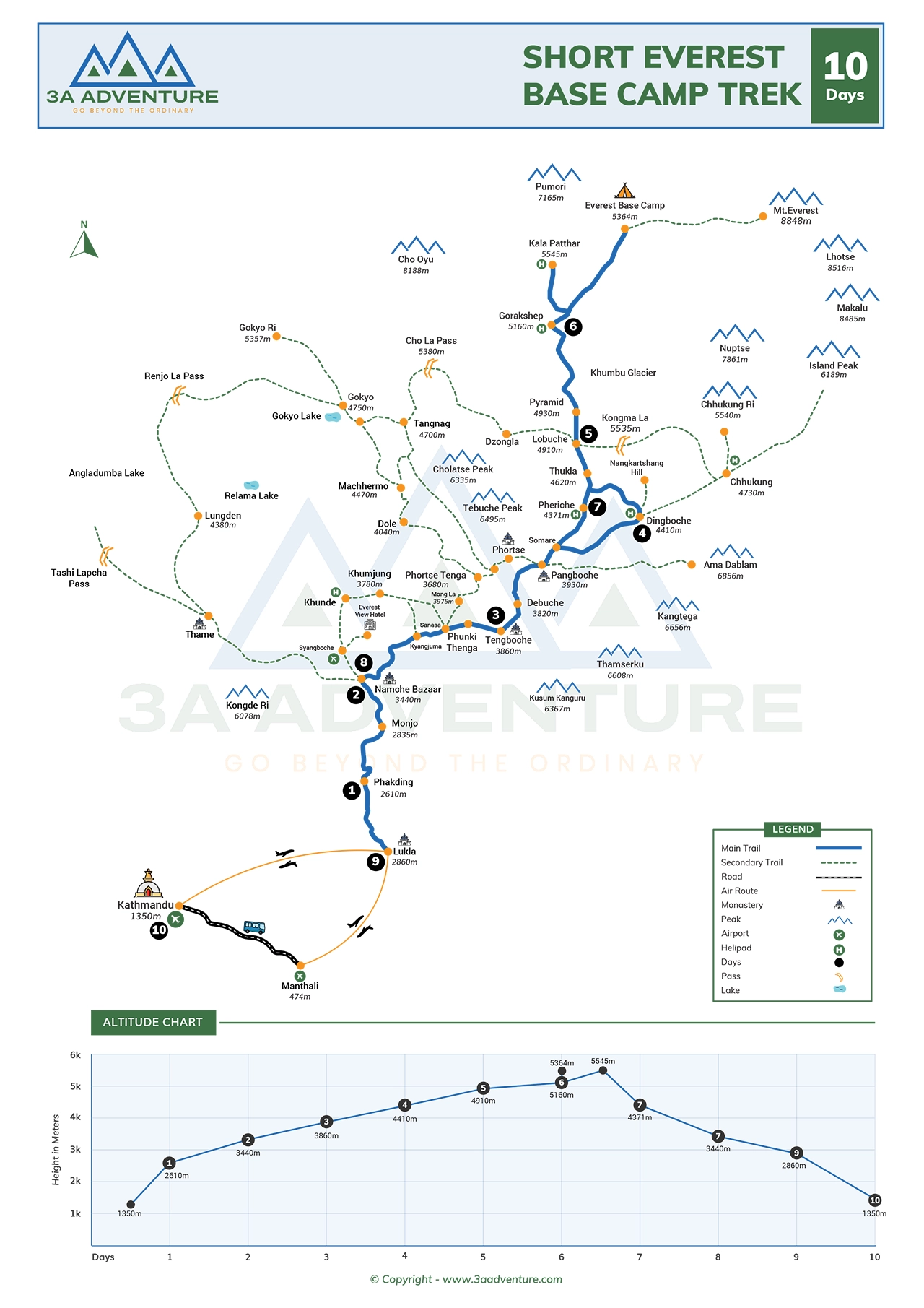
The adventure starts with a scenic flight to Lukla (2,860 m / 9,383 ft) and continues with a walk through scenic villages, suspension bridges and gorgeous river valleys. On the way, you will have to cross popular destinations like Phakding, Namche Bazaar, Tengboche, Dingboche, Lobuche and Gorakshep. The travel experience in each destination is different, making it enjoyable and unforgettable.
The possibility to visit the Everest Base Camp (5,364 m / 17,598 ft), which is the point of departure for those who want to climb Mount Everest, is one of the principal attractions of this 10-day Everest Base Camp Trek. The hike is also accompanied by a walk to Kala Patthar (5,545 m / 18,192 ft), which is among the most desirable points of view in the area. The trekkers are able to have spectacular panoramic views of Everest and many other Himalayan mountains that surround this place.
During the trip, the trekkers are exposed to diverse landscapes, which include forests and villages, as well as valleys and glaciers of the Alps. Comfortable teahouse accommodation and local hospitality add to the overall experience, making the route accessible to travelers with a reasonable level of fitness. Everest Base Camp Short Trek is not an easy trip because of the altitude and the number of hours one walks every day, yet the results are worth the effort many times over.
The Short Everest Base Camp Trek is a perfect program that suits those who want to have a shorter but complete Himalayan experience. It is a mix of natural beauty, cultural exploration, and personal accomplishment in one memorable trip. Whether it’s the mountain scenery, the adventure-seeking or the achievement of summiting the Everest Base Camp, this journey and this experience become one you would never forget. Through expert planning, time-tested local assistance and well-planned logistics, 3A Adventure can make this spectacular journey in the Himalayas easy, secure and unforgettable.
Your Short Everest Base Camp Trek starts with a thrilling flight to Kathmandu to Lukla. Flights can also be made during high trekking seasons at Manthali Airport in Ramechhap. The duration of the flight is approximately 45 minutes to one hour, and the scenery is breathtaking as the Himalayan range is seen. As the aircraft flies over green hills, deep valleys and snow-capped peaks, you will be able to taste the adventure that awaits you.
Once you have landed at Lukla (2,860 m / 9,383 ft), you will have a brief rest and begin your walk. The path slowly winds down with the gorgeous Dudh Koshi River and goes through tiny villages, suspension bridges, prayer flags, mani stones, and chortens. It is a nice and simple track, and the best place to start trekking in the Everest area.
About three hours into the walk, you will reach the small, tranquil village of Phakding (2,610 m / 8,562 ft). Spend the night resting and planning the days to come as you spend your first night in the mountains.
Activity: 3 hours trek
Max. Altitude: 2,860m/9,383ft. (Phakding)
Meal: Lunch, Dinner
Accommodation: Lodge, Teahouse
You will be trekking to Namche Bazaar after breakfast in Phakding. It leads along the Dudh Koshi River and crosses several suspension bridges, decorated with colored prayer flags. You will traverse through small settlements, forests, and scenic outlooks along the way as you take in the natural beauty of the Khumbu region.
The path gets steeper with the increase in altitude. It takes time to climb up, and one has to walk steadily, yet the scenery is constantly changing, and the walk is not unpleasant. The further up the mountain you go, the closer you will be to the local Sherpa communities and their culture and way of life.
About seven hours of walking will bring you to Namche Bazaar (3,440 m / 11,286 ft), the largest trading hub of the Everest region. This is a vibrant mountain town with beautiful mountain ranges surrounding it and has great facilities for trekkers. On a clear day, you can even have your first glimpse of Mount Everest and then retire into your teahouse at night.
Activity: 7 hours trek
Max. Altitude: 3,440m/11,286ft. (Namche Bazaar)
Meal: Breakfast, Lunch, Dinner
Accommodation: Lodge, Teahouse
You will trek from Namche Bazaar to Tengboche. The trail passes one of the most scenic mountains passes of the walk today. During your trip on the path, you will be able to see spectacular views of Ama Dablam, Lhotse, Nuptse, and other Himalayan mountains that dominate the sky.
The path goes through little villages and lovely rhododendron woods. In spring, these woods are also full of colored flowers, which provide an extra beauty to the landscape. The serene environment and the cool mountain air enhance the journey, although there are gradual uphill and downhill climbs along the path.
In about six hours of walking, you will arrive at Tengboche (3,867 m / 12,687 ft). One of the most significant Buddhist monasteries located in the Khumbu region is the historic Tengboche Monastery. The ancient building and breathtaking mountainous landscape make the monastery a place to remember. You will spend the night in a good teahouse after having explored the area.
Activity: 6 hours Trek
Max. Altitude: 3,867m/12,687ft. (Tengboche)
Meal: Breakfast, Lunch, Dinner
Accommodation: Lodge, Teahouse
Early breakfast will be followed by a continuation of your trip to Dingboche. The landscape starts to vary as the trek continues. The thick forests slowly give way to a valley, rocky terrain, and alpine landscape. The altitude is higher, which forms a more rugged environment, providing a real Himalayan experience.
On the way, you will cross the beautiful Khumbu Khola River, where many trekkers have a short rest. The path goes on through tiny villages and broad mountain valleys amidst high mountains. The landscape is more and more dramatic as you ascend above (4,000 m / 13,123 ft).
Then, after several hours of hiking, you will reach Dingboche (4,410 m / 14,468 ft). This is a beautiful village with splendid mountains and beautiful scenery of Ama Dablam, Cholatse, and Taboche. Dingboche is a great place to spend a night as you proceed to the Everest Base Camp because the environment and air in the area are so peaceful and so fresh.
Activity: 6 hours trek
Max. Altitude: 4,410m/14,469ft. (Dingboche)
Meal: Breakfast, Lunch, Dinner
Accommodation: Lodge, Teahouse
The trip today will lead you deeper into the high Himalayas as you make your way out of Dingboche into Lobuche. It begins with a gradual ascent in the open country, and extensive grazing grounds of the local yaks and cattle. The further up you go, the more rugged the landscape is, the fewer the plants, and the more spectacular the mountain views.
During the day you will have great views of Ama Dablam, Nuptse, Taboche and Kongma Tse. Another important sight on the way is Dughla, where some memorials and stupas commemorate the lives of climbers who died in the mountains. Most trekkers stop and leave tribute here and ponder the hardships of climbing at elevated altitudes.
Moving on, the path slowly climbs to Lobuche (4,910 m / 16,108 ft). The village is also an amazing location, surrounded by the impressive mountains and glacial scenery. After approximately six hours of hiking, you will reach your teahouse and relax before the thrilling trip to the Everest Base Camp.
Activity: 6 hours trek
Max. Altitude: 4,910m/16,109ft. (Lobuche)
Meal: Breakfast, Lunch, Dinner
Accommodation: Teahouse
Today is one of the most exciting and rewarding days of the trek as you finally reach Everest Base Camp. You will set out in the morning after breakfast in Lobuche, and commence a difficult approach to Gorakshep. The route is marked by rough terrain along the Khumbu Glacier with spectacular scenery of ice and rocky formations, and mountain peaks.
It is an estimated three-hour walk to Gorakshep (5,164 m / 16,942 ft), the last place to visit before the Everest Base Camp. Here you can have a little rest and have lunch, then proceed to the place where you are heading. The path is made more challenging as you go through rocky paths and glacial areas.
Another few hours of walking will take you to Everest Base Camp (5,364 m / 17,598 ft). It is an experience to stand on the summit of the tallest mountain in the world. Take breaks to enjoy the ambience, take pictures, and enjoy the Himalayan scenery, and come back to Gorakshep, where we will spend the night in a lodge.
Activity: 9 hours trek
Max. Altitude: 5,364m/17,598ft. (Everest Base Camp )
Meal: Breakfast, Lunch, Dinner
Accommodation: Teahouse
This will be a memorable day on the mountain as you begin the day earlier before sunrise to Kala Patthar, the highest point of the whole trip. The path leads gradually upwards, out of Gorakshep, and pays you back with some of the best panoramic views of the Everest region. By climbing Kala Patthar (5,545 m / 18,192 ft) early in the morning, you can see the sun rise above the Himalayan mountains.
In perspective, you will have great views of Mount Everest and numerous other mountains around. The sun is setting its golden rays, and the sight is really memorable and gives great possibilities to take photographs. You will rest and have breakfast at Gorakshep after a stay at the viewpoint.
Afterwards, you will go on with your back trip through Lobuche and down to Pheriche (4,210 m / 13,812 ft). It is also easier to breathe because of the low elevation, and the scenery varies to make the trip interesting. Arriving here, you will be put into your lodge and have a long rest.
Activity: 7 hours trek
Max. Altitude: 5,545m/18,192ft. (Pheriche)
Meal: Breakfast, Lunch, Dinner
Accommodation: Teahouse
You will be riding back to Namche Bazaar after breakfast at Pheriche. The current route goes through the beautiful scenery of the Khumbu region on the same trails as before. As you go down, there is more oxygen in the air, making the trek more comfortable than the high-altitude days.
The path goes through the classic Sherpa villages and provides great views of the nearby mountains. On the way, you are going to pass through regions that are linked with villages like Dingboche, Tengboche, and Dobuche. You will also go through a village of cultural significance, monasteries, and local culture, Khumjung.
As you proceed downhill, the forests start to be seen increasingly, which is a nice contrast to the rocky landscape of the higher levels. It will take approximately seven hours of hiking to get back to Namche Bazaar (3,440 m / 11,286 ft). Its vibrant environment, shopping, and dining establishments enable it to be a comfortable place to unwind and enjoy another successful day on the trail.
Activity: 7 hours trek
Max. Altitude: 3,440m/11,286ft. (Namche Bazaar)
Meal: Breakfast, Lunch, Dinner
Accommodation: Teahouse, Lodge
This is the last day of your trek on Everest. You will start a descent to Lukla after breakfast in Namche Bazaar. The route leads along the old tracks into woods and villages as well as along the valleys of the rivers that you have already seen on the way. It is a marvelous time to recount what has been experienced and accomplished in the last few days.
It will take approximately an hour and a half after Namche to reach Jorsale, at which point you can have a short rest and soak in the views around. Going on, you will come to Monjo, and turn onto the road to Phakding. As you go, you will pass over suspension bridges and go through some small settlements.
Lunch will be taken at Phakding before the last portion of the walk is done. After another hour of walking, you will arrive in Lukla (2,860 m / 9,383 ft). Spend your last night in the mountains and rejoice over a successful trekking part of your journey.
Activity: 7 hours trek
Max. Altitude: 3,440m/11,286ft. (Lukla)
Meal: Breakfast, Lunch, Dinner
Accommodation: Teahouse, Lodge
It is the last day of your Short Everest Base Camp Trek. Your scenic flight will then be from Lukla to Kathmandu after breakfast. Flights might be made to Manthali Airport in Ramechhap during peak trekking seasons as an alternative to Kathmandu. The mountain flight is a short flight and is the last chance to get a view of breathtaking aerial scenery of the Himalayas.
When the plane is flying over the mountains and valleys, you will be able to think about the amazing events of the last ten days. Since crossing the suspension bridges and visiting Sherpa villages to the Everest Base Camp and climbing to Kala Patthar, the trip has been full of memorable experiences and accomplishments.
When you reach Kathmandu or Manthali, it marks the end of your trekking adventure. You will be taken to your hotel and will experience the comfort of the city again. The friends, the memories, and the astonishing mountainous view you will have had during this trek will be with you even after you are out of the trek.
Activity: 35-minute flight
Max. Altitude: 1,350m/4,429ft. (Kathmandu )
Meal: Breakfast
Note:
If you have a private group and prefer a personalized experience, we can organize a custom trip tailored to your requirements and group size, running it any day you choose.
Transportation
Food and Accommodation
Guide and Support Staff
Permits and Expenses
Medical and Gear
Others
International Flights and Visa
Food and Accommodation
Travel and Medical Insurance
Other Expenses
Short Everest Base Camp Trek weather varies according to altitude and season. Lower areas tend to be warmer, but the temperatures get significantly colder as you rise in altitude. Conditions also change rapidly in the high areas of the Everest region.
The best time to do this trek is spring (March to May) and autumn (September to November). Skies in these months are usually clear, mountain views are good, and the trails are well maintained. Along part of the route, are also see the beautiful rhododendron blooms in the springtime.
The winters are more silent on trails, but colder around Everest Base Camp (5,364 m / 17,598 ft). The rainy season and clouds caused by the monsoon may impact visibility and flights to Lukla.
The 10-day Everest Base Camp Trek is the most favorable trip for most trekkers in spring and autumn when weather conditions are more favorable and scenic views of the area are at their best.
The Short Everest Base Camp Trek is a fairly challenging trek. It includes no technical climbing skills, although several days of mountain-trail walking at high altitudes are involved. The average number of hours spent trekking each day is 5-9 hours based on the program.
The difficulty lies in the altitude, rugged terrain, and the days of trekking. The closer you go to Everest Base Camp (5,364 m / 17,598 ft), the thinner the air will get, and any physical activity will be more intense.
Average fitness trekkers normally successfully complete the journey. Good attitude, gradual speed, and adequate acclimatization deserve mention as key elements to a comfortable experience.
Though the Everest Base Camp Short Trek is less demanding than most of the conventional tours, it also demands good stamina and willpower. The trek will be more enjoyable and rewarding with proper preparation prior to the trek.
One of the key issues in the Short Everest Base Camp Trek is altitude sickness due to the high altitudes reached by the route. As you climb above Namche Bazaar (3,440 m / 11,286 ft) oxygen concentrations decrease and your body must adapt.
Symptoms such as headaches, dizziness, nausea, loss of appetite and sleeping problems are common. These symptoms tend to be mild in the early stages. The risk can be mitigated by walking at a moderate pace, keeping hydrated, and adhering to the itinerary well.
In case the symptoms are critical, it is usually best to go down to a lower elevation. Well-trained guides keep a close eye on the trekkers and offer assistance where necessary.
The 10-day Everest Base Camp Trek involves a quick climb as opposed to the longer itineraries, and thus it is quite essential to be sensitive to the signals of your body. When trekking, proper acclimatization and responsible trekking practices can help achieve a safer and more enjoyable adventure.
The Short Everest Base Camp Trek can be significantly enhanced with good preparation. Although it is neither a difficult nor a technical climb, the trek will involve endurance and walking many hours a day.
Training should be started at least a couple of weeks prior to departure. Hiking, jogging, cycling, swimming, and going up the stairs can be included in the list of activities that can enhance cardiovascular fitness and endurance. Your legs and core muscles can be strengthened as well to make trekking easier.
Mental preparation is also very crucial. Weather conditions on the mountain, variable trail conditions, and lengthy days of walking may be burdensome. Having a positive attitude aids the process.
Everest Base Camp Short Trek can be much better when one comes in good physical shape. To ensure that trekkers get the best out of their Himalayan experience, 3A Adventure suggests they exercise prior to their departure to gain confidence and enjoy themselves.
The Short Everest Base Camp Trek includes food and accommodation in local teahouses and lodges along the way. These places have basic yet comfortable amenities, which target trekkers in the Everest area.
The meals typically have items like rice, noodles, soups, potatoes, vegetables, eggs, bread, and Nepali cuisine. There is also a wide availability of hot drinks such as tea and coffee. Elevation can result in a restricted menu at higher elevations because of difficulties in transportation.
Twin-sharing rooms with a simple bed, blankets, and pillows are normally part of the accommodation. Eating places are usually cozy and quite warm, and trekkers meet there after a day on the trail.
Facilities are not elaborate like in city hotels; however, they offer all that one would require to stay in a comfortable place. The Sherpa hospitality and mountain culture can also be experienced during the 10 days stay in local teahouses during the Everest Base Camp Trek.
Transportation is an important part of the Short Everest Base Camp Trek. The trek begins with a flight from Kathmandu to Lukla (2,860 m / 9,383 ft), the starting point to the Everest region. Flights can also be offered from Manthali Airport, Ramechhap during peak trekking seasons.
The mountain flight in itself is a highlight of the trip, which has breathtaking views of hills, valleys, and snow-covered peaks. Once in Lukla, all the travelling is done on foot along the trekking trail.
A round flight is then offered at the end of the trek to get the trekkers back to Kathmandu or Manthali. The weather conditions sometimes change flight schedules, as is typical in mountainous areas.
3A Adventure assists in organizing the transportation logistics and guides in the process. The Everest Base Camp Short Trek is a well-planned adventure that will have a smooth beginning and end.
Most of the Short Everest Base Camp Trek has communication facilities, with the quality of the services being affected by location and weather conditions. Big villages tend to be better connected compared to high remote locations.
The route has good mobile network coverage in most areas, through which trekkers can make calls and send messages. Internet is also available in some lodges and teahouses at an extra charge. But the speeds of the connection can be lower than what the travelers are used to in urban areas.
Most of the villages have the ability to charge electronic devices, with an additional fee possible at the higher altitudes. It is advisable to have a power bank with you.
Although it is possible to be in touch, most trekkers find it easy to use the trek as a disconnection opportunity and to get the most out of the mountain experience. The 10 days Everest Base Camp Trek is an ideal mix of adventure and contemporary comfort.
The Short Everest Base Camp Trek needs several permits. The permits are used to regulate the tourism industry, facilitate conservation, and sustain the trek infrastructure within the Everest area.
The Khumbu Pasang Lhamu Rural Municipality Permit and the Sagarmatha National Park Entry Permit are usually required by Trekkers. These are papers that have to be scrutinized at different stages along the path and have to be carried throughout the walk.
Permit fees are used in protecting the environment, local development projects, and maintaining trails. The important thing is to get the right permits prior to the trek to prevent disruptions in traveling.
The majority of trekkers would like to book permits with a trekking firm. In the case of 3A Adventure, the permit procedure is done effectively, and travelers do not need to worry about it but rather concentrate on what to pack to go on the trip.
The typical tourist visiting Nepal to undertake a Short Everest Base Camp Trek will need a tourist visa. Visas on arrival are available in Nepal to citizens of most countries at Tribhuvan International Airport in Kathmandu and specified border crossings.
Visitors should have a valid passport that has adequate validity and might require a passport-sized photo and visa fees, which can be paid using accepted currencies. The visa period and charge differ with the number of days to stay.
A tourist visa is normally easy to get, travellers are always advised to verify the up-to-date immigration rules prior to travelling. Rules are subject to modification, and case-specific situations can differ.
It is common practice among many trekkers to spend more time in Nepal prior to, or even after, the 10 days Everest Base Camp Trek in order to visit cultural locations and other attractions. The proper choice of visa period guarantees sufficient time to simply explore the whole experience of traveling without spending time on needless stress.
Anyone attending the Short Everest Base Camp Trek is strongly advised to get travel insurance. Certain risks are involved in the process of trekking in the remote mountain areas, and extensive coverage offers good protection during the process.
An appropriate policy must also cover trekking, emergency medical services, interruption of trips, and helicopter evacuation. Such evacuation during emergencies may be highly significant in the case of deadly illness, injury, or conditions that are critical due to altitude.
Travelers need to examine coverage limits before buying a policy and make sure that they can trek at the Everest Base Camp (5,364 m / 17,598 ft) to be covered. Other typical travel insurance policies do not cover high-altitude activities.
The right insurance will give trekkers the confidence and peace of mind to travel on. Everest Base Camp Short Trek is an enriching experience, and adequate insurance will save unwanted circumstances that might occur during the trek.
Although a lot of services are part of trekking packages, personal expenses should be budgeted when taking the Short Everest Base Camp Trek. The size may differ according to personal preferences and expenditures.
Some typical additional costs are hot showers, charging electrical gadgets, internet, bottled beverages, snacks, laundry services, and personal purchases. The prices are usually higher in the elevated areas since the supplies have to be carried into the remote mountainous regions that are remote.
Numerous trekkers also bring along extra money to tip the guides and porters to appreciate their efforts and help during the trek. Other items that are common purchases are souvenirs and local handicrafts.
It is advisable to bring sufficient cash as there are few ATM machines along the road. Having these extra expenses in place will assist in making sure that there are more comfortable and enjoyable 10 days Everest Base Camp Trek without any financial surprises.
The Short Everest Base Camp Trek is done in either a private or a group trek. Both choices have their distinct benefits based on your style of traveling, preferences, and financial capability.
A private trek provides greater flexibility. Trekkers have the ability to have their own time and pace, tailor-made arrangements, and have a more intimate experience with family or friends. The choice is best suited to individuals who would like to have additional comfort and autonomy.
Solo travelers and other people who like to interact with others of diverse backgrounds are the ones fond of group treks. By exchanging experiences with other trekkers, it is likely to make a lifetime friendship and a great experience on the trail.
The 3A Adventure has both individual and group departures to meet various travel demands. Be it a solo adventure or a shared experience, the Everest Base Camp Short Trek offers amazing mountain views, cultural experiences, and the thrill of achieving one of the most recognizable trekking sites in the world.
General
The number of people in a group is dependent on the date of departure. Treks may be conducted with few people or bigger groups based on the bookings.
Yes, there are usually numerous customisations of private departures to fit in your schedule, preferences and travel needs.
Yes, individual tourists are also welcome and can participate in group tours or reserve a personal trek.
Minimum age is not fixed, but the participants must be physically fit to undertake a few days of mountain trekking.
Preparation & Fitness
It is advisable to start routine fitness training at least four to six weeks prior to the trek.
Past trekking experience is not necessary but a good idea to have among physically fit and willing trekkers.
Excellent exercises that can prepare one for the trek include hiking, stair climbing, joggin and cycling.
All you need is a daypack with personal necessities and the porter carries the larger trekking bag.
Permits
It is advisable to arrive at least an hour or two before the departure time.
Yes, the weather in the mountains may at times lead to delays or cancellations of flights.
There are baggage restrictions in domestic mountain flights, and any extra baggage can charge on another fee.
Alternate plans are to be considered depending on the weather and the means of transport available, depending on the trip information and itinerary.
Insurance & Visa
Yes, most of the nationalities will be provided with a tourist visa at Kathmandu Airport.
Generally required are a valid passport, a passport-sized photo and the relevant visa fee.
Even though not obligatory in all cases, detailed travel insurance is highly encouraged for all trekkers.
Yes, your insurance is supposed to cover emergency helicopter evacuation of high-altitude trekking.
Guides & Support Staff
Trekking guides are all licensed, trained and experienced in guiding Himalayan treks.
The trek is guided by an English-speaking guide to communicate effectively during the journey.
Each porter carries up to 20 kg which is shared between two trekkers.
Yes, extra porter services are normally available at an extra cost.
Accommodation and Facilities
Some locations may offer single rooms at an additional fee and depending on availability.
Yes, the majority of teahouses will offer blankets, but it is better to bring a sleeping bag.
Yes, there are simple toilets at the lodges along the trekking path.
The majority of lodges are able to accommodate typical dietary needs with prior notice.
Weather & Seasons
The weather conditions in October and November are normally characterized by good visibility and consistent weather.
Yes, winter trekking is possible and it is colder and the snow can cover the trails.
It rains regularly during the monsoon months at the low altitudes, but the weather can change.
No, the visibility of the mountains is subject to weather conditions on a daily basis, and it cannot be assured.
Health & Safety
Guides evaluate the circumstances and organize suitable help, such as evacuation where necessary.
There are lodges and tea houses all through the trek that provide drinking water.
Yes, it is always advisable to have a small personal first-aid kit.
In certain villages, there are basic health posts but not much in the way of advanced medical care.
Booking & Payment
It should be booked a few weeks in advance during high seasons in trekking.
Yes, there is a deposit that is usually paid in order to be sure of your booking and to make your arrangements.
It is possible to do last minute booking depending on the flight availability and logistics.
The majority of operators accept bank transfers and other popular ways of payment.