

Need Help?
+977 9860666075

Based on 27 reviews

Trip Duration
13 Days
Trip Difficulty
Challenging
Max Altitude:
6,476m. / 21,247ft.
Group Size
2-16 People
Meals
Breakfast, Lunch & Dinner
Accommodation
Camp, Lodge
Transportation
FlightThe Mera Peak Climbing is one of the best trekking experiences that you can go to in Nepal. While the standard itinerary stretches from 17 to 20 days, our well-drafted short itinerary takes us 12 days to complete. This is a great deal for people who do not have 17 whole days to spend on a trek. This shortened trek is also great for intermediate and well-experienced trekkers as they can get a bit of extra thrill, trekking to a short and quick destination.
This trek takes you on a stunning Himalayan adventure to the highest trekking peak in Nepal, reaching 6476 meters above sea level. This trek may sound like a technical hell, but in reality, most people with prior high-altitude trekking experience can join the trek and complete it. Over 85% of trek journeys have been successful, while the rest were unable to make it to the top because of altitude sickness and other reasons. This number says a lot about the non-technical and manageable trails of the trek.
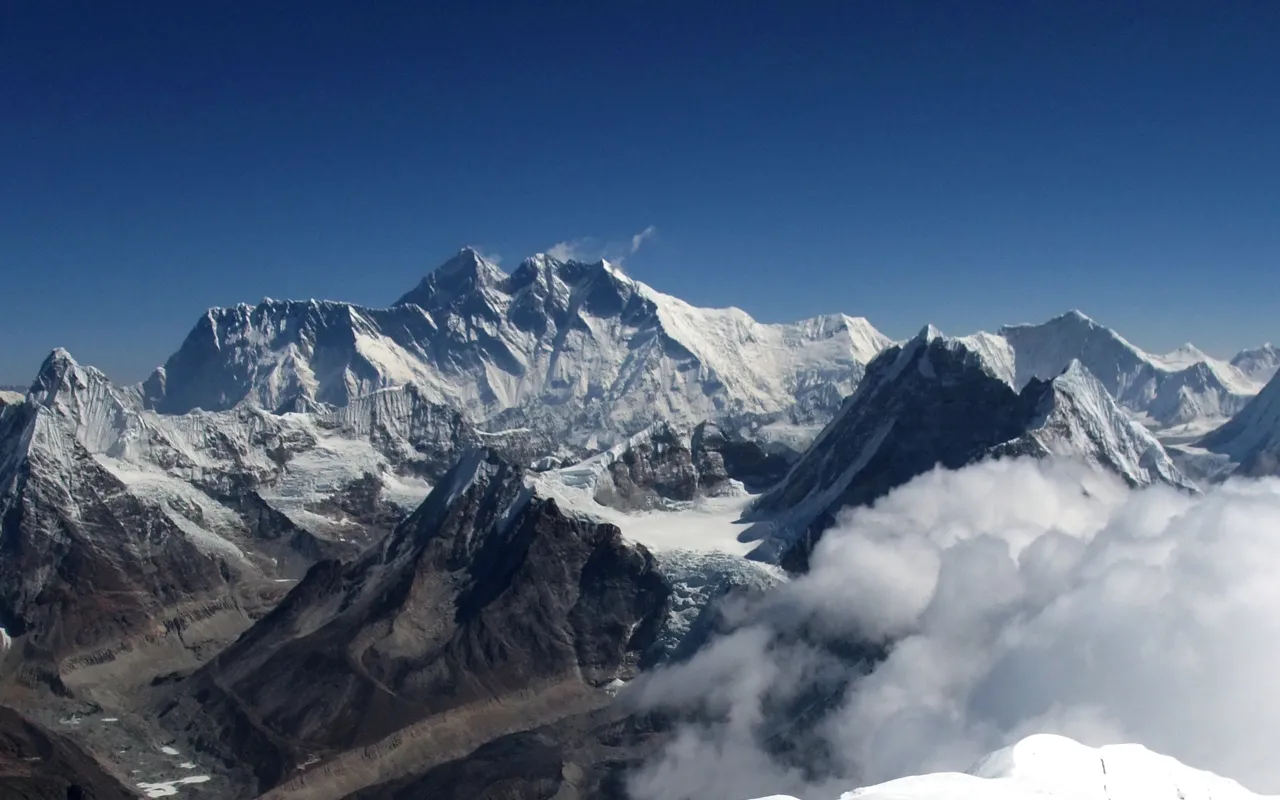
The climb to the top of the peak is obviously exhausting and long, but once your eyes are blessed with a stunning scene of Everest, Lhotse, Makalu, Cho Oyu, Kanchenjunga, and other peaks in the distance. You will soon forget all the huffing and puffing and strains in your leg. You will get to see 5 of the top 10 highest peaks in the world. Moreover, a 360-degree view of the entire Khumbu region is something you are not likely to forget anytime soon.
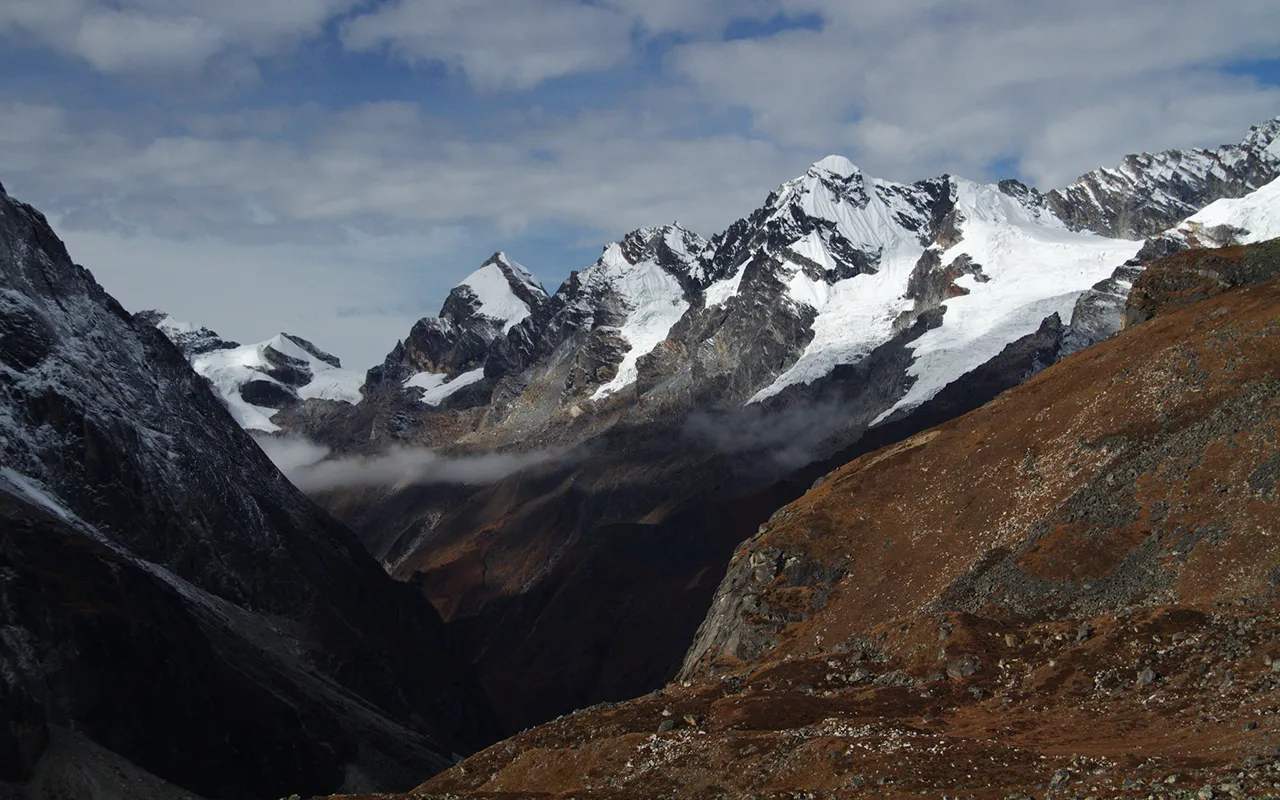
The trail leads us into the lush Makalu Barun National Park and the pristine Hinku Valley, both of which offer secluded trails. The dense forested sections full of rhododendron and pine forests lead us to glacial terrains up in the mountains. You also get to visit a couple of monasteries en route, offering a glimpse into the religious practices of the local people.

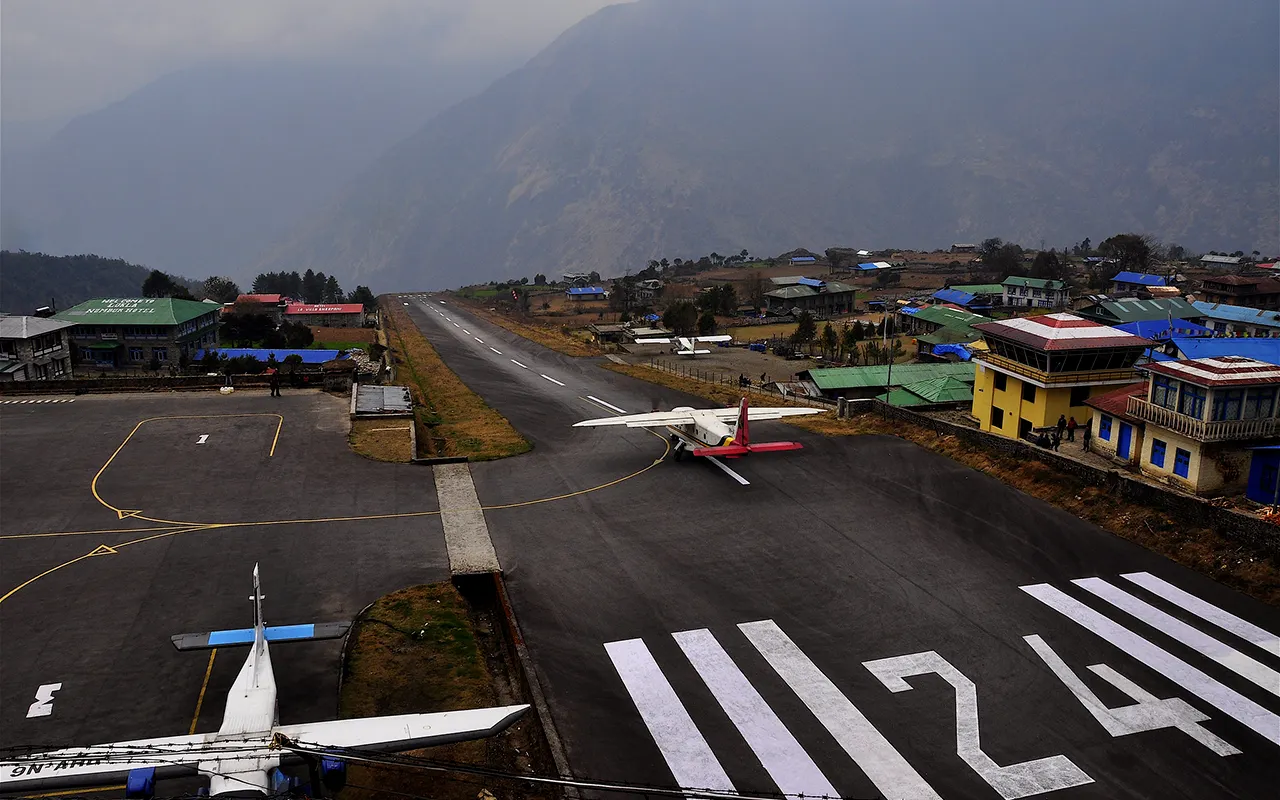
Officially starting the Mera Peak Climbing trek, we will first meet up at an agreed location or pick you up from the hotel, and take you to the domestic terminal of the Tribhuvan International Airport. From there, we will take a 35-minute flight to Lukla, reaching the starting point of the trek. We will ride a small aircraft to get there, since big planes can not land at the small and thrilling airstrip of Lukla.
The runway is only half a kilometer long, making it suitable only for small planes. It is often said to be the most dramatic airport in the world because of the high altitude and short runway surrounded by hills. The flight will be scenic as we fly above hills and valleys towered by giant peaks in the north. After reaching Lukla, you need to get ready with your daypack, while the porter will carry your luggage.
From the Tenzing-Hillary Airport, we will diverge from the standard Everest Base Camp trail and traverse a secluded trail to Chhutanga. The trek starts over a dirt path, crossing Lukla and ascending over a mixed terrain. Crossing small streams, the trail is quite scenic and silent, with the sounds of birds filling the air. After trekking for about 4 hours, we will reach our destination of the day. The total trek distance is 8 km with an altitude gain of 640 meters, reaching 3500 meters.

Activity: 35 mins flight

Max. Altitude: 2,860m/9,383ft. (Lukla)

Meal: Breakfast, Lunch & Dinner

Accommodation: Lodge
The next day, on the Mera Peak Climbing itinerary, we have to be on the trail for about 7 hours, making it one of the longest trekking days. The terrain of the day features steep climbs over rocky trails and grassy patches. You will also descend a lot, covering a total of 10 km of distance, which gains us 670 meters of elevation. The day starts at 3500 meters, and reaches 4170 meters above sea level by the end of the trek.
Starting off, the trail follows a winding path through a forest, ascending gradually towards the Zatrawala Pass. This part of the trek is a strenuous climb that demands an average physical fitness and above-average endurance. Proceeding ahead carefully, we steadily gain elevation and reach the summit of the pass. A wide and grand scene of the Hinku Valley, Dudh Kosi Valley, and peaks like Karyolung, Kongdi Ri, Lumding Himal, Numbur Himal, and more.
It can get a little windy there, making the prayer flags flutter rapidly. After a relaxing and scenic break at the top, we have to continue the trek and descend to Thuli Kharka. The path is well-defined but demands careful footing as loose rocks can make you fall.
Activity: 7 hrs trek
Max. Altitude: 4,170m/13,681ft. (Thuli Kharka)
Meal: Breakfast, Lunch & Dinner
Accommodation: Lodge
Today’s Mera Peak Climbing itinerary features a 9 km journey that passes through dirt trails, forests, and rocky terrain. Our day starts with breakfast at 4170 meters and reaches a final elevation of 3600 meters above sea level, losing 570 meters of altitude. The estimated trek duration is 6 hours, starting with a descent from Thuli Kharka, passing through the grazing lands of the Yaks.
After about an hour of trekking, we will reach the Hinku River and follow it downstream for most of today’s trek. The river is undulating at times, just like the trail alongside it; however, it is all gentle, with no steep inclines. Crossing many small streams, tributaries of the river besides, the terrain widens as we get our first glimpse of the Mera Peak. The trail follows a relatively plain path, passing by Sherpa settlements.
Soon enough, we will make it to Kothe village and check into our accommodation for the night. Before dinner is served, you can roam around the village and interact with the locals or just explore things.
Activity: 6 hrs trek
Max. Altitude: 3,600m/11,811ft. (Kothe)
Meal: Breakfast, Lunch & Dinner
Accommodation: Lodge
Day 4 of the Mera Peak Climbing trek is a relatively short trekking day, as we have to be out and about for 5 hours only. The total trek distance of the day is 8 km with an elevation gain of 750 meters. Our breakfast will be served at 3600 meters, before we start the trek, reaching 4350 meters above sea level by the end of the day. Leaving Kothe, the trail follows the Hinku River over rocky trails and traverses through forests of rhododendron and pine. There are occasional clearings with clear views of the valley.
After about 2 hours on the trail, we will reach Gondishung village. From there, we can go on a short detour to visit the Lungsumgba Gompa. This 300-year-old Buddhist monastery is a significant place in the region, serving as one of the main religious sites. There are paintings, murals, statues, ancient scrolls, and other interesting things in the Gompa, and the exterior design is a great example of the Tibetan Buddhism style.
Leaving the monastery, the trail goes uphill for a bit, still going alongside the Hinku River. As we get closer to Thangnak, the path turns wider with vast meadows and open scenes of Mera Peak and Kusum Kanguru. The final part of today’s trek is a gentle climb all the way to Thangnak village.
Activity: 5 hrs trek
Max. Altitude: 4,350m/14,272ft. (Thangnak)
Meal: Breakfast, Lunch & Dinner
Accommodation: Lodge
The 5th day of the Mera Peak Climbing trek is yet another short trekking day featuring a trail that can be covered in just 4 hours. The elevation gain of the day is 550 meters with a total trek distance of 6 km. The trail starts at 4350 meters and reaches 4900 meters by the end of the day. Departing from Thangnak, we will follow an ascending trail over rough terrain. We can clearly see the Shar Glacier and the Hinku Nup Glacier nearby.
Steadily climbing out of the village of Thangnak, we transition to an arid, rocky landscape from meadows and grassy patches. Trekking alongside the Hinku Nup Glacier, the trail gradually steepens and gets strenuous. The rocky terrain has some icy patches scattered everywhere, requiring careful footing. We are now above 4500 meters, at this substantial altitude, the air gets thinner, cutting down the oxygen percentage by 9.
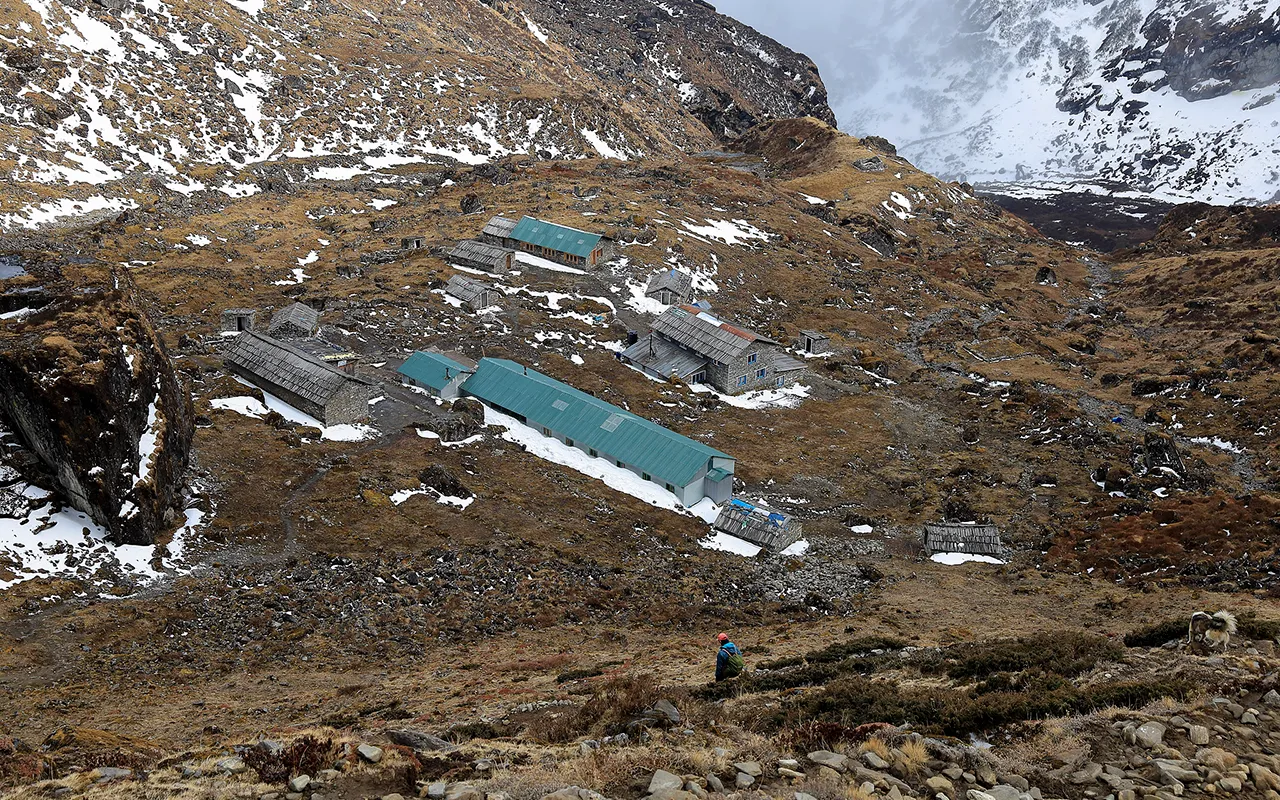
Soon enough, we will reach Khare village, where a majestic close-up scene of the Mera Peak awaits us. The last leg of today’s trek passes through an arid trail with beautiful scenes of Kyashar Peak.
Activity: 4 hrs trek
Max. Altitude: 4,900m/16,076ft. (Khare)
Meal: Breakfast, Lunch & Dinner
Accommodation: Lodge
This is the one and only acclimatization day on the Mera Peak Climbing itinerary. We will spend the day hiking to a higher elevation and resting. For our acclimatization hike, we will ascend to a nearby viewpoint, gaining about 300 meters of elevation, which covers 2 km of distance. We will finish our acclimatization hike in about 3 hours and return to Khare. For the time being, you are free to explore other nearby sites, just do not get too far and tire yourself out; this day is supposed to be a restful one.
Activity: 3 hrs hike
Meal: Breakfast, Lunch & Dinner
Accommodation: Lodge
Today is going to be a long trekking day as we have to invest 7 whole hours to reach the high camp. This trek stretches out about 6 km with a net elevation gain of 900 meters. Today’s snowy trail starts at 4900 meters above sea level and reaches 5800 meters. Beginning the trek early in the morning, we will climb up a rocky terrain towards the Mera Glacier. Leaving Khare, the path is full of loose rocks and scattered snow patches as we head to the glacier.
Soon after, we will reach the Mera Peak Base Camp, sitting at 5350 meters above sea level. This is one of our resting points of the day. From there, the path to high camp is challenging. We have to use crampons and ropes to continue the climb. The final part of today’s trek involves steeply climbing up rocky and snow-covered trails with stunning scenes of Chamlang and Baruntse peaks in the distance.
Activity: 7 hrs trek
Max. Altitude: 5,350m/17,552ft. (Mera Peak Base Camp)
Meal: Breakfast, Lunch & Dinner
Accommodation: Camp
Day 8 of the Mera Peak Climbing trek is the main day and also the longest trekking day of the journey. The estimated trek duration is a whopping 12 hours, with a total trek distance of 10 km. We will gain about 670 meters reaching the 6470-meter-high Mera Peak, the highest point of the trek. We will lose over 1570 meters by the end of the day, as we will descend to Khare.
We have to start the climb at around 3 AM. The guide will lead everyone, making sure to fix ropes, crampons, and all the other gear as he goes along. It does not take long for the trail to get steep, featuring crevasses and slippery icy sections. As we traverse this all white, snow-covered trail, we get to the final part of the climb. We have to climb up a steep trail that tests our endurance. From the top, a serene view of Everest, Lhotse, Makalu, Cho-Oyu, Kangchenjunga, and more awaits us.
After taking in the beautiful scenes for a while, we have to descend from the peak, get back to the high camp, base camp, and eventually to Khare. This is going to be a long descent.
Activity: 12 hrs trek
Max. Altitude: 6,470m/21,227ft. (Mera Peak)
Meal: Breakfast, Lunch & Dinner
Accommodation: Camp
This day on the Mera Peak Climbing trek is reserved for any unforeseen circumstances that might keep us from climbing the peak. For instance, bad weather conditions can stop us from climbing, and there is nothing we can do except wait for the weather to clear.
Meal: Breakfast, Lunch & Dinner
Accommodation: Camp
Day 10 of the Mera Peak Climbing itinerary is a descending day, losing about 1300 meters of elevation, going from 4900 meters to 3600 meters above sea level. This trek covers over 8 km of total distance with an estimated trek duration of 5 hours. Leaving Khare, we will descend through the Hinku Valley and reach Thangnak village. Our lunch will be served there before continuing the rest of the trek. After that, we will follow the Hinku River and descend gently all the way to Kothe.
Activity: 5 hrs trek
Max. Altitude: 3,600m/11,811ft. (Kothe)
Meal: Breakfast, Lunch & Dinner
Accommodation: Camp
The following day of the Mera Peak Climbing trek features a 6-hour-long trail with an elevation gain of 570 meters. The trek distance of the day is 9 km, starting with an ascent along the Hinku River. There are many streams that we have to cross along the way. As we keep going up, the terrain turns into pasture lands for the cattle. Soon after, we will reach Thuli Kharka village and check into a local tea house to spend the night.
Activity: 6 hrs trek
Max. Altitude: 4,300m/14,108ft. (Thuli Kharka)
Meal: Breakfast, Lunch & Dinner
Accommodation: Teahouse
Day 12 of the Mera Peak Climbing itinerary gains us 440 meters of elevation but also loses 1750 meters by the end of the day, taking us to 2860 meters above sea level. This trek is 10 km long with an estimated duration of 7 hours. Starting off, we will ascend the steep trail to Zatrawala Pass and reach its top. From there, we will descend all the way to Lukla, which is definitely going to be a long and tiring walk.
Activity: 7 hrs trek
Max. Altitude: 2,860m/9,383ft. (Lukla)
Meal: Breakfast, Lunch & Dinner
Accommodation: Lodge
The next day, we will have the last breakfast on this Mera Peak Climbing trek and get on a flight back to Kathmandu. This is the last day of the journey, and you get to see an overhead view of the Khumbu region one last time before the plane lands at Kathmandu.
Max. Altitude: 1,400m/4,593ft. (Kathmandu)

Note:
If you have a private group and prefer a personalized experience, we can organize a custom trip tailored to your requirements and group size, running it any day you choose.
Transportation
Food and Accommodation
Guide and Support Staff
Permit and Expenses
Medical and Gear
Others
International Flights and Visa
Food and Accommodations
Travel and Medical Insurance
Other Expenses
The best season for the Mera Peak Climbing trek is autumn, as this season offers the best trail conditions. The temperature is very mild, with daytime temperatures ranging from 10°C to 15°C in the higher elevation ranges. The trails remain dry as it is the season of fall, and the best thing about this season is the minimal chances of rainfall, keeping us safe from getting wet. The autumn season is also the festive period in Nepal, offering you the chance to witness various celebrations.
The Mera Peak Climbing trek is definitely a difficult trekking experience. Although the Mera Peak has been graded as a trekking peak, it is not a walk in the park. You have to have adequate endurance and above-average physical fitness to complete this trek fully. This trek is a mix of long trekking hours and steep ascents and descents that will surely test your stamina and overall physicality. On a scale of 10, our trek experts and guides have given it an 8.
This trek reaches a maximum altitude of 6470 meters above sea level, which is a considerable elevation that can definitely induce altitude sickness in trekkers and climbers. To keep you safe from the harms of the illness, the trek guide will make sure that you know all the preventive measures. He will also check your oxygen levels throughout the trek to make sure that he can take the necessary actions if there are early signs of altitude sickness.
The best way to prepare for this Mera Peak Climbing trek is to draft a 16 to 20-week-long physical preparation plan that involves working out your leg muscles and lower half body. Strengthening your lower body prepares you for the strain that the trails will give you after a long day of trekking. In addition to that, we also need you to have ample endurance capacity so that you can make it to your daily destinations on time. Without stamina, you will have to take many breaks, which will extend the trek duration.
Food options during the camping nights at the high camps will be packaged food and dehydrated food that you can just add hot water to. Resources are very valuable in the remote campsites, so every resource we have will be used to its full extent with no wastage. During your stay in tea houses, you can get a range of delicious dishes, including various local and traditional meals, along with some Western options.
The Mera Peak Climbing itinerary requires a flight to Lukla and some ground transportation. You also have to take a flight back to Kathmandu. All of the aforementioned transportation will be covered by the trek package, along with free airport pickup and drop-off.
Unfortunately, you will not get any cellular reception on this trek since it is a remote and secluded trekking experience. However, you have the option of getting an Everest internet card, which should work at most of the nightly stops except at camping sites. 3A Adventure’s guide will carry a satellite phone to call for help in case of medical emergencies.
For this trek, you just need to have the Mera Peak climbing permit and the Makalu Barun National Park permit. Since this itinerary avoids the main EBC trail, you do not have to get the Khumbu Pasang Lhamu Rural Municipality permit. Both permits are a part of the trek package.
After your arrival at the Kathmandu airport, the airport officials will guide you to towards the immigration section. That is where you get a visa application, which you must fill out and submit to the immigration officer. But, before that, you need to make sure that you pay your visa fees at the adjacent counter and get a receipt. You have to submit the application and receipt along with your passport, return tickets, two passport-sized photos, and proof of accommodation. The visa fees are not a part of the trek package.
Travel insurance is one of the mandatory things for this trek; we can not take you on this trek if you do not have travel insurance. This trek can be heavy on your health since we will be reaching over 6400 meters above sea level. In case of medical emergencies, your travel insurance will cover all the rescue operations costs, which is why it is necessary to be insured.
Your extra expenses include international flights to and from Nepal, extra nights and meals, visa fees, travel insurance fees, extra nights in Kathmandu, personal trekking gear, tips for the crew members, etc.
If you want to experience this trek with a trek group consisting of you and your friends, family, or loved ones, you need to get a private trek package. Unlike a group trek, there are no random people in the group in a private trek. However, a group trek is the most budget-friendly option out of the two.
General
Trekkers are supposed to hold on to their waste and garbage and dispose of it only at allocated sites. The entire region must be kept clean for future trekkers and travelers to enjoy. If you are found littering anywhere within the trek, you might be fined as per the local rules; generally, the local community charges about USD 45.
The Mera Peak Climbing trek is a peak climbing trek, whereas the EBC trek’s main climax is reaching the base camp. The Mera Peak is definitely the difficult one out of the two, and the scenes on both the treks are equally good.
No, it is definitely not suitable for beginners with no trekking experience. Every tekkers who wants to join must have prior trekking experience to climb Mera Peak
The key highlights of both sites are the scenes.
Yes, you can combine this trek with other nearby destinations, but our trek experts have to make sure that the modification is viable and doable at the given time.
Preparation & Fitness
You need to be a bit more fit than an average individual. Since this is a 12-hour trekking day, we expect trekkers to be very well-prepared.
While preparing for the trek, you can go on similar hikes with similar steep trails. Or you can simply use the treadmill on an incline.
No, trekking peaks such as Mera Peak do not require high technical knowledge. The climbing leader will teach you the basics at the camp.
Any cardio exercise works well, for instance, swimming, cycling, running, hiking, etc.
 Insurance & Visa
Yes, travel insurance is mandatory for this trek.
Your insurance package must cover high-altitude rescue operations costs up to an altitude of 7000 meters.
While it does include access to the permit, you still need to get a Makalu Barun National Park permit.
Yes, a visa-on-arrival is offered by the Government of Nepal.
You can apply for a visa online by visiting the Government’s official website.
 Guides & Support Staff
No, regardless of your experience level, you need to hire a licensed guide if you want to join this trek.
Typically, every two trekkers in the group will share a single porter.
Every trekker’s personal luggage must not weigh more than 12 kg.
Yes, 3A Adventure’s guides are trained in high-altitude first aid and crevasse rescue.
Yes, you can hire a personal porter for this Mera Peak Climbing trek; however, the expense related to it will not be covered by the trek package.
Yes, the climbing leader will make sure that you know how trekking gear is used effectively and the right way.
 Accommodation and Facilities
At the high camp, there are no tea houses or lodges; we will have to spend the night in a camp. The tea houses in the lower regions are definitely more comfortable.
 Food and Drinks
During your stay at high-altitude camps like Mera High Camp, we will provide dehydrated and easy-to-prepare food that has all the necessary nutrients.
Yes, you will find plenty of vegetarian options, but vegan options are not available everywhere.
While the locals easily survive on the water from the local spring source, you need to make sure to use a water purification tablet before you drink from any local source.
Meals at Mera Base Camp are prepared using a camping stove. The dehydrated food just needs hot water to cook.
 Weather & Seasons
For stable weather conditions, you can do this trek in the months of September, October, and November.
If the weather conditions are bad at the high camp, we will not be able to summit the peak and have to wait for the storm to pass.
The typical temperature at the Mera Peak summit during the peak trekking seasons range from -10°C to -5°C during the daytime.
Flight delays are not that common during the peak trekking seasons since the weather usually stays clear.
No, there are no weather forecasting services available at High Camp. Forecasting weather at high altitude is really unreliable.
 Health & Safety
Altitude sickness is induced when you climb high and spend the night without following the preventive measures. Visiting high elevations during the day is safe as long as we descend back down or practice the preventive measures.
Yes, the high camp has oxygen cylinders and emergency medical kits that can be used in case of emergencies.
The climb leader will be the one who heads first to check for any possible risk factors. If everything seems fine, he will ask the trekkers to follow one by one.
There is not much risk while descending from the base camp to Khare. However, you might slide on loose rocks and hurt yourself. To avoid this, just use a trekking pole and follow the footsteps of the guide.
Wearing warm gloves and avoiding any direct contact with cold ice and snow is the way to keep yourself safe. However, you are very unlikely to get frostbite on this trek.
 Booking & Payment
First, we want you to go through the trek package and really understand what you are getting into. After that, you can contact us via any given medium to book the trek with us.
Yes, there are flexible cancellation policies for the Mera Peak trek due to unpredictable weather conditions. However, you will not get the full deposit back; a certain portion of it will be charged as service fees.
To secure your spot for the Mera Peak climb in 2025, you need to deposit at least 50% of the total cost of the trek package.
Yes, we will refund your deposit if the trek has to be cancelled, but you will not be compensated fully. Our services begin the moment you successfully book the trek. A lot of logistics are required to have a successful trek, so a certain percentage of he initial deposit will be withheld.
Yes, single accommodations in teahouses or tents can be arranged at a price. The tea houses and lodges generally do not encourage single rooms, so getting one can be difficult.
If the Lukla flight is delayed for many days, we will have to postpone the trek to a later date.
No, our standard trekking package does not include any kind of gear rental for climbing equipment.
 Transportation & Flight
Yes, you can charter a helicopter for the return from Lukla to Kathmandu, at a price. This is not a part of the standard Mera Peak Climbing package.
No, you do not have to worry about that. We will have you transported to the airport at the start of the trek and drop you at the airport on the last day.
Yes, there is an alternative flight option. This flight takes you from Lukla to Ramechhap, a town 5 hours away from Kathmandu.
From the hotel, we will have you transported in a car or a minivan to the Tribhuvan International Airport.
You just have to carry your day backpack while the porters will carry your baggage for the entire trek. The trek guide will manage the accommodation arrangements along the way.