

Need Help?
+977 9860666075

Based on 27 reviews

Trip Duration
16 Days
Trip Difficulty
Moderate
Max Altitude:
6,119m. / 20,075ft.
Group Size
2-16 pax
Best Season
Spring, Autumn
Meals
Breakfast, Lunch & Dinner
Accommodation
Hotel, Lodge, Tea House
Transportation
Bus , FlightThe Everest Base Camp with Lobuche Peak Climbing is a combination of the standard EBC trek and the dramatic climb of the Lobuche Peak. To be precise, you will climb the Lobuche East Peak, reaching 6119 meters above sea level, the highest point of this journey to the remote Himalayas. Offering a mixture of an amazing highland trek to Everest and a challenging climb to a peak, this experience will be one that you will remember for decades. You will explore the nature of the Khumbu region and experience the culture of the locals as well.
Starting from the tiny town of Lukla, this trek features a visit to Tengboche Monastery, Pangboche Monastery, Namche Monastery, Phakding Monastery, and more. Visiting many religious sites along the route makes us feel a sense of spirituality. It also speaks of the culture of the local communities. Sherpa communities dominate the Khumbu region, and they practice the teachings of Tibetan Buddhism, making their culture and customs a bit unique in comparison to others who follow traditional Buddhism.
The Sherpa people are popular for being the natives of the mountains. Their natural ability to adapt to the highlands’ extreme environmental conditions has made them the best guides you can go with. Ever since the early summit attempts to scale the Everest peak, Sherpas have been the guides of each and every attempt. At present, people still want Sherpa guides as they are seen as the most reliable option. On this trek, you will spend many nights at Sherpa villages, with plenty of opportunities to interact with them.
The climax of this Everest Base Camp with Lobuche Peak Climbing would be reaching the Everest Base Camp and climbing the Lobuche Peak. First ascended by Ang Gyalzen Sherpa and Laurence Neilson in the year 1984, this peak is labelled as a trekking peak, which means that climbing it is not as difficult as other peaks. However, it is not a piece of cake either.

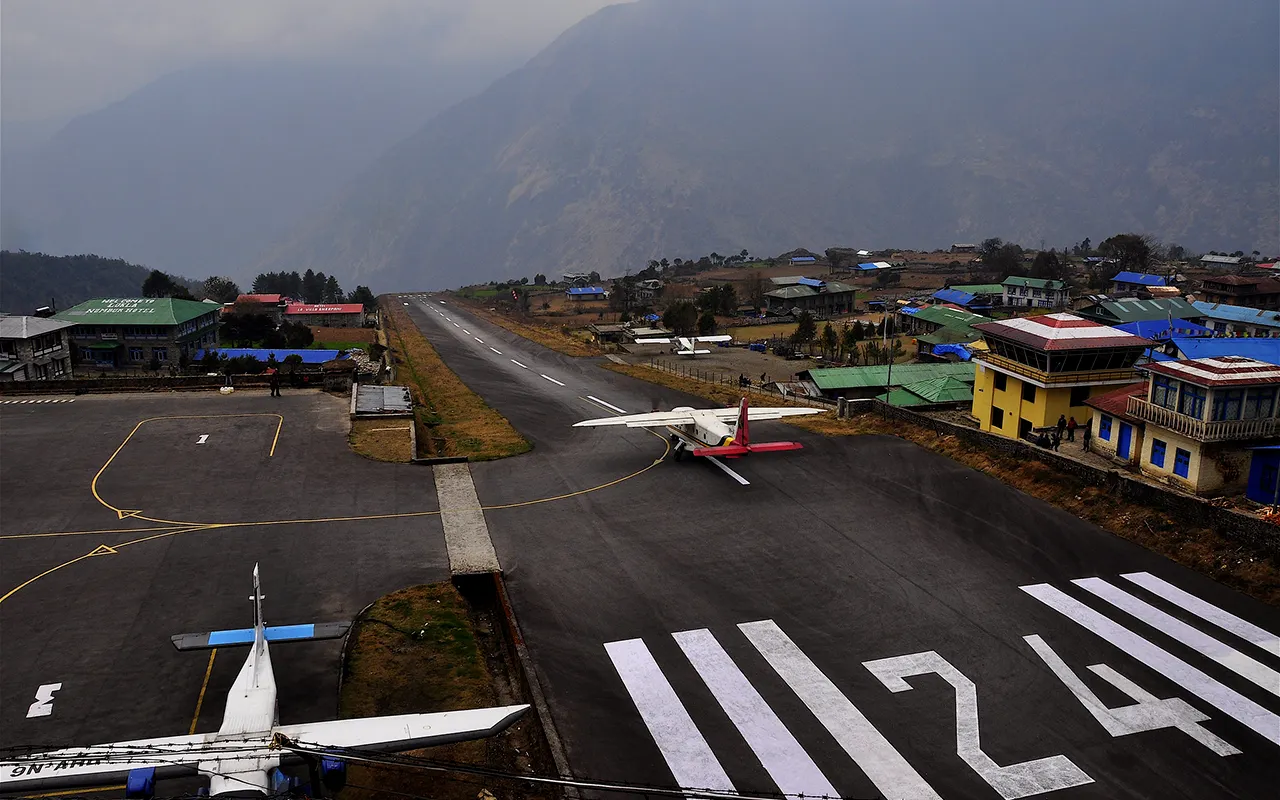
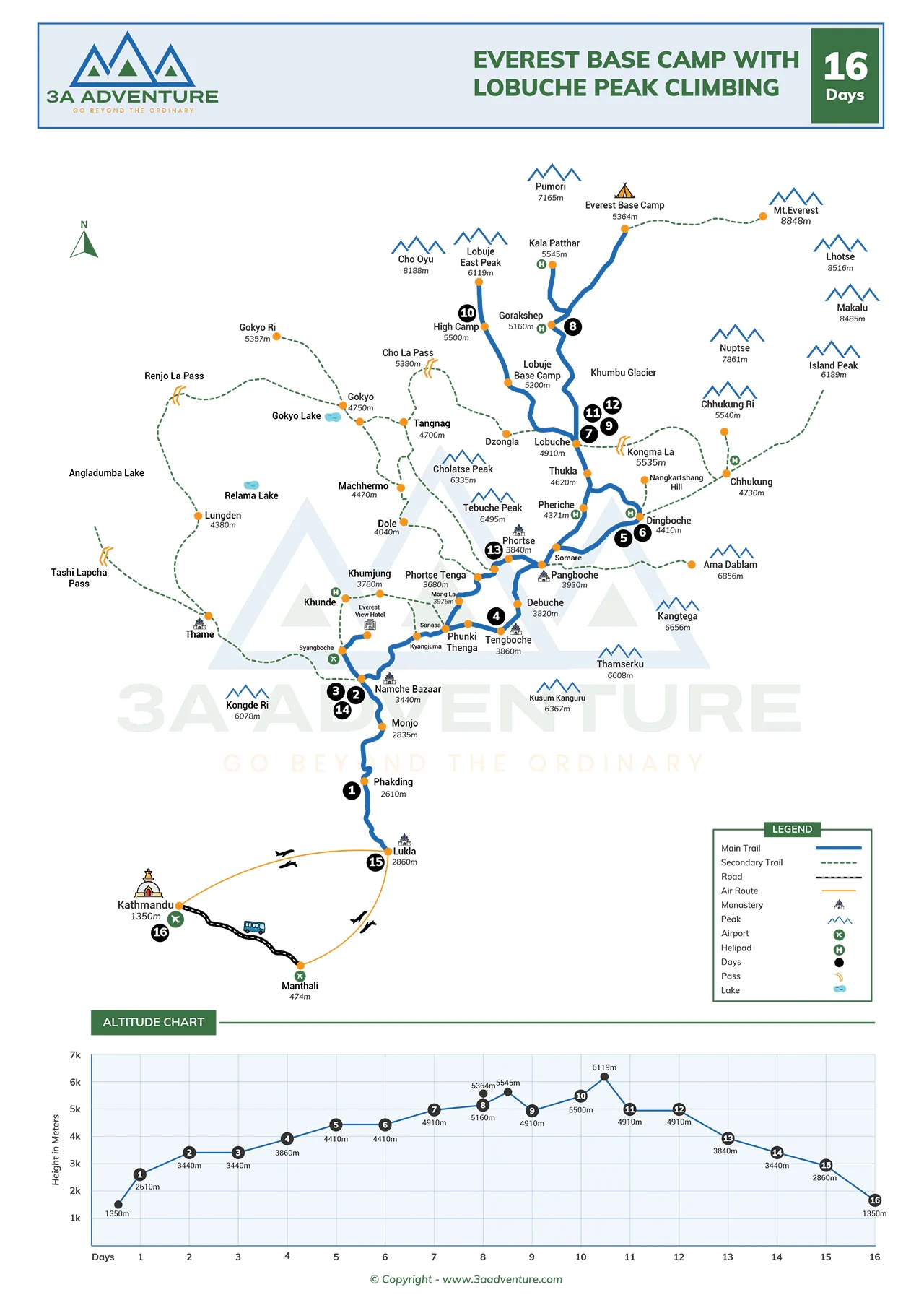
The first day of the Everest Base Camp with Lobuche Peak Climbing is here. Catching a flight, we will reach Lukla in about 35 minutes from Kathmandu. After touchdown at the Tenzing Hillary Airport, we will begin our trekking days with a short trek to Phakding.
The total distance of the day is around 8 km with an estimated trek duration of 3 to 4 hours. Leaving Lukla, we will pass by gear shops and cafes to reach the main gate and continue the trek over a slightly descending trail to Chheplung. From there, we will cross the Dudh Koshi river and end up at Ghat. Eventually, we will reach Phakding and call it a day.

Max. Altitude: 2,610m/8,563ft. (Phakding)

Accommodation: Lodge
The 2nd day of the Everest Base Camp with Lobuche Peak Climbing requires trekkers to cover 11 km of distance, which can be done within 6 to 7 hours of trekking. The day starts at 2610 meters, and by the end of the trek, we will reach 3440 meters above sea level. This gains us 830 meters of elevation.
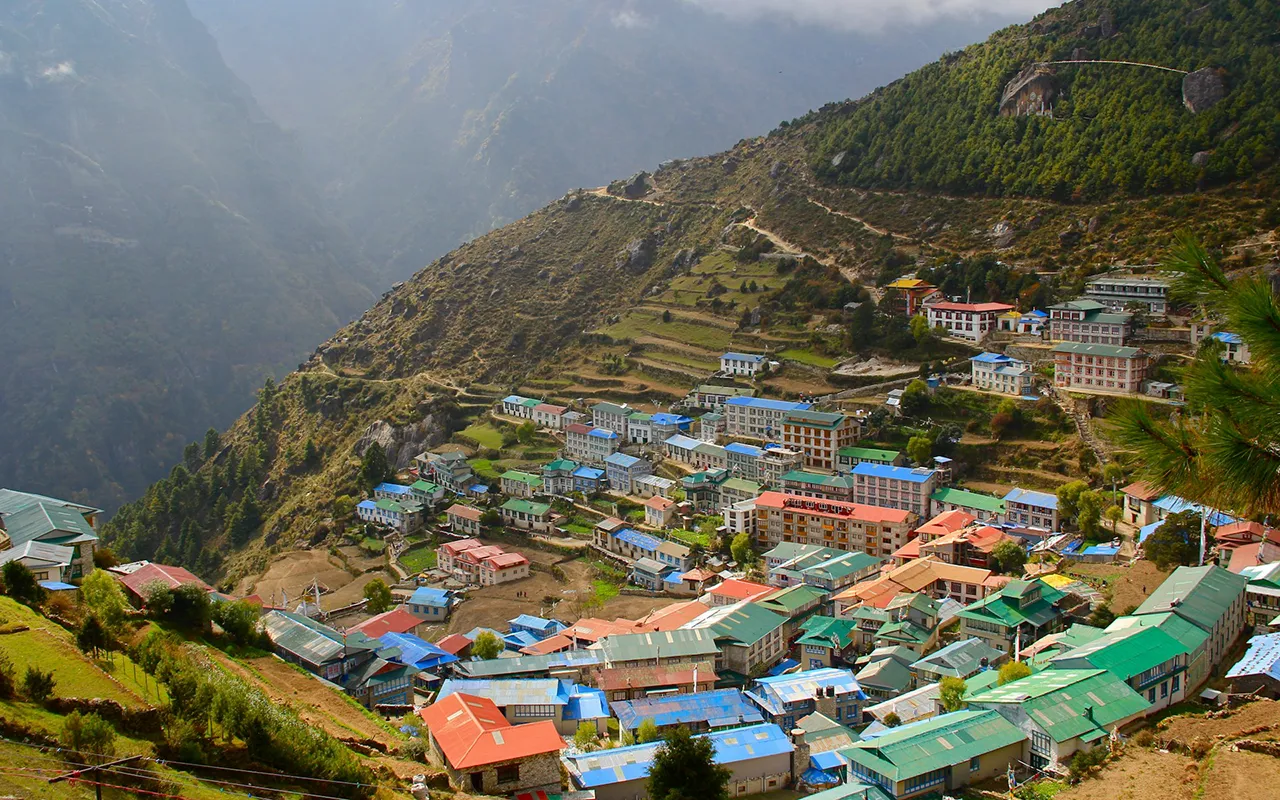
Leaving Phakding, the trail follows the Dudh Koshi River and turns north across many suspension bridges. After a while, we will pass TokTok, Benkar, and Monjo villages to reach Jorsale. From there, we will climb the Namche Hill and reach our destination.
Max. Altitude: 3,440m/11,286ft. (Namche Bazaar)
Accommodation: Lodge
Day 3 of the Everest Base Camp with Lobuche Peak Climbing is a rest day or an acclimatization day; very crucial for letting our bodies adapt well. Our day starts at the amazing Namche Bazaar, a haven in the middle of remote hills. After breakfast, we will head towards the Everest View Hotel for a short hike that will help us acclimate better.
Gaining about 400 meters of elevation, we will reach the Everest View Hotel and enjoy a picturesque scene of Thamserku, Ama Dablam, Lhotse, and Everest peak. On the way down to Namche, we will also visit the Syangboche airstrip, formerly operational, one of the highest airstrips in the world.
Max. Altitude: 3,440m/11,286ft. (Namche Bazaar)
Accommodation: Lodge
After a restful day at Namche, today’s Everest Base Camp with Lobuche Peak Climbing itinerary leads us on a 5 to 6-hour journey to Tengboche. The elevation gain of the day is 440 meters, reaching 3880 meters above sea level. The day begins at 3440 meters with a total trekking distance of 10 km.
From Namche, we will gradually descend to Phunki Tenga village, at 3250 meters. After a short tea break there, we will cross the Dudh Koshi river and ascend for about 2 hours to reach Tengboche.
Max. Altitude: 3,860m/12,664ft. (Tengboche)
Accommodation: Lodge
Reaching 4410 meters, today’s Everest Base Camp with Lobuche Peak Climbing trek has us on the trail for about 6 hours. We have to cover about 10 km, starting from 3880 meters above sea level, and gaining a net elevation of 530 meters.
Starting off, we have to descend through a forested section to reach Deboche village. From there, we cross the Imja River over a suspension bridge and reach Pangboche village, at 3985 meters. Following a short break, we will head towards Shomare village, stop there for a reenergizing lunch, and hit the last part of today’s trek to reach Dingboche.
Max. Altitude: 4,410m/14,469ft. (Dingboche)
Accommodation: Lodge
Day 6 is the 2nd acclimatization day on the Everest Base Camp with the Lobuche Peak Climbing itinerary. Today’s acclimatization hike includes climbing Nagarjun Hill, reaching 5083 meters above sea level. This is a great hike as it helps us practice the “climb high, sleep low” approach.
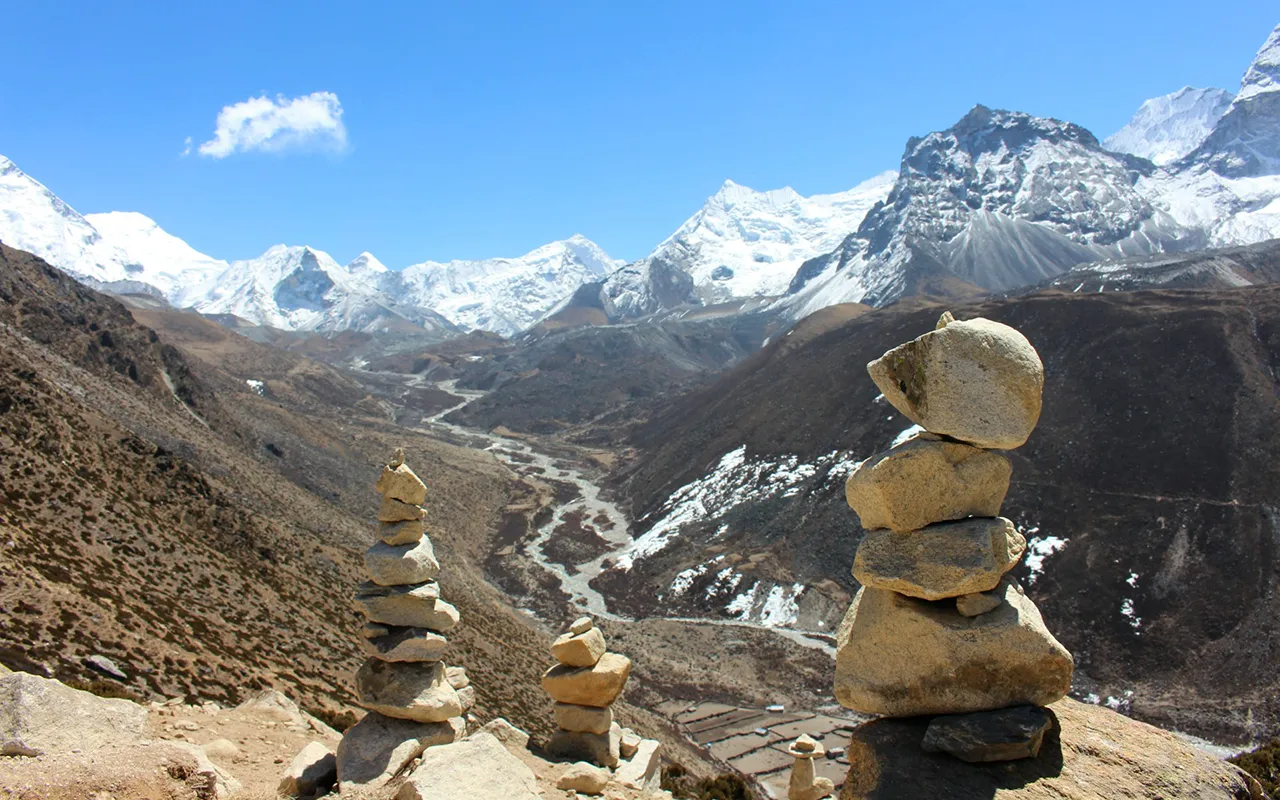
Reaching the top of the hill, you get to witness a grand scene of many nearby peaks, including the Island Peak, Ama Dablam, Lhotse, Makalu, and more. This hike will take us about 3 to 4 hours to complete round-trip, with an elevation gain of over 600 meters.
Max. Altitude: 4,410m/14,469ft. (Dingboche)
Accommodation: Lodge
On the 7th day of the Everest Base Camp with Lobuche Peak Climbing, we have a 9 km trek distance to cover. The estimated duration is 5 to 6 hours with a net elevation gain of 500 meters. The trail starts with a gentle ascent towards Thukla or Dughla village.
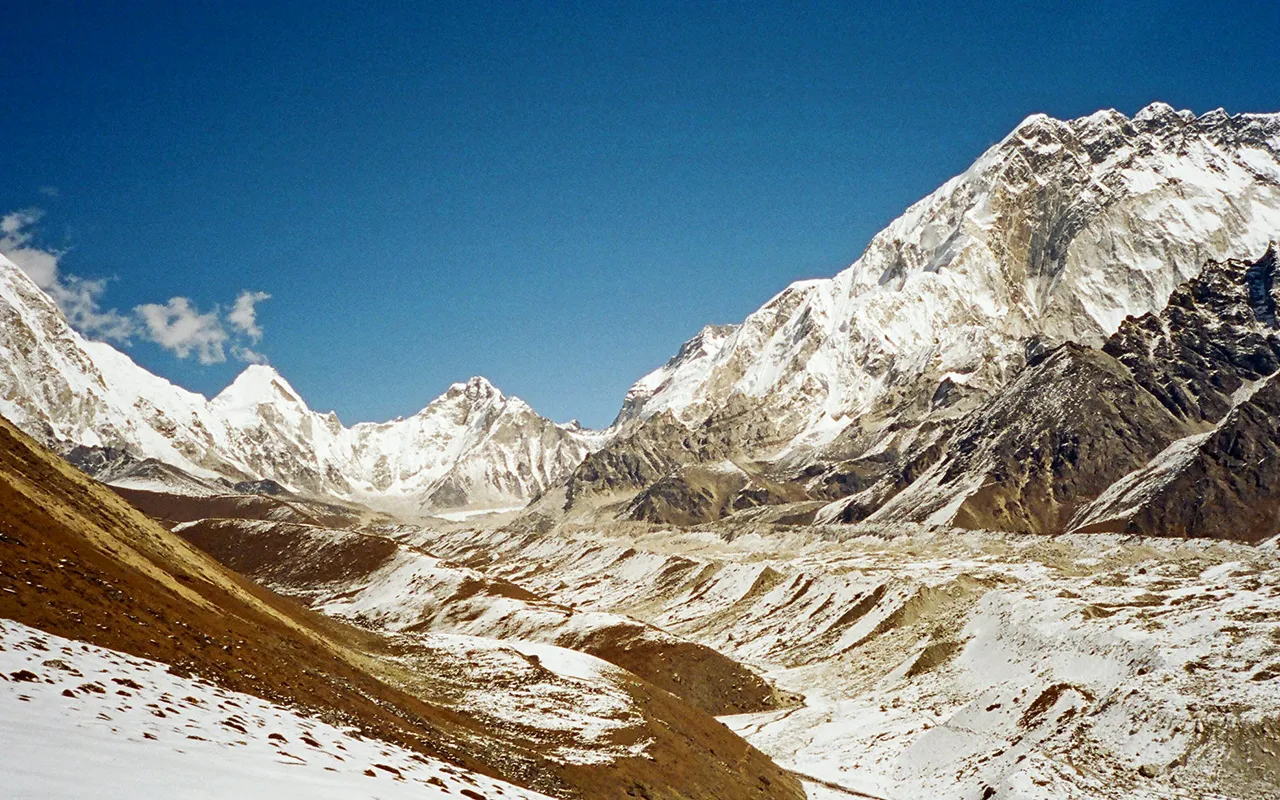
Passing through alpine pasture lands, we will cross a couple of streams to reach Dughla, enjoying the views of Cholatse and Taboche peaks. From the village, we have to climb a steep trail to reach the summit of Thukla Pass. After taking in the views of Nuptse, Pumori, and other peaks, we will descend all the way to Lobuche.
Max. Altitude: 4,940m/16,207ft. (Lobuche)
Accommodation: Lodge
Today is one of the main days of the Everest Base Camp with Lobuche Peak Climbing. Reaching the Everest Base Camp, we will gain about 450 meters of elevation. The total trek distance of the day is 12 km, which will take about 7 to 8 hours to complete.
Starting off, the trail goes alongside the Khumbu Glacier and leads us to Gorak Shep. We have to check into a lodge there, leave our heavy bags, and trek to the base camp. With views of Pumori and Nuptse, the rugged trail to the base camp is very exciting. After reaching the Everest Base Camp, we will take tons of pictures and take in the serene views, before heading back to Gorak Shep.
Max. Altitude: 5,164m/16,942ft. (Gorakhshep)
Accommodation: Lodge
Day 9 is yet another long trekking day on the Everest Base Camp with Lobuche Peak Climbing itinerary. With a total trail distance of 11 km, today’s trail takes about 7 to 8 hours to complete, losing about 635 meters of net elevation. Today, we have to wake up and hike to Kala Patthar before dawn to experience the amazing sunrise scene.
Reaching the viewpoint takes about 2 hours, and the grand sunrise view featuring Pumori, Ama Dablam, Lhotse, Nuptse, Everest, and more is just out of this world. After a while, we will get back down to Goark Shep, have our breakfast, and head towards Lobuche village.
Max. Altitude: 4,940m/16,207ft. (Lobuche)
Accommodation: Lodge
The next day, on the Everest Base Camp with Lobuche Peak Climbing, we will trek about 5 km of distance. This should take us about 5 to 6 hours to cover since the trail is rugged, steep, and rocky. The elevation gain today is 290 meters, reaching 5200 meters above sea level.
Starting at 4910 meters, the trail follows a steep and rocky ascent heading towards the high camp. First, we will reach the base camp of the eastern Lobuch peak. From there, you get to see a wide view of the Khumbu Glacier, Pokalde, Cholatse, and Ama Dablam peak. Continuing the ascent, the air gets thinner as we make our way to the high camp. The guide and porters will set up the camp and also cook hot meals for dinner.
Max. Altitude: 5,200m/17,060ft. (Lobuche High Camp)
Accommodation: Camp
After a restful night at the high camp, we have the longest day of the entire journey. With a duration of 11 to 12 hours, the trek distance is 8 km, gaining us over 900 meters of elevation at the top of the peak. Our net elevation change is a loss of 1200 meters, reaching Lobuche.
The day starts very early, as we have to avoid the afternoon winds. You will need some basic mountaineering techniques for this climb, which the guide will brief you about. Climbing the peak will definitely be a difficult process, but with the guidance of a professional, you will make it to the top eventually.
From the top, a majestic panoramic view of Nuptse, Lhotse, Ama Dablam, and Everest can be seen. After some time at the top, we will descend back to the high camp, have our lunch, and get on the trail to Lobuche.
Max. Altitude: 4,940m/16,207ft. (Lobuche)
Accommodation: Lodge
This day is reserved for unforeseen circumstances that might keep us from climbing the Lobuche peak. Sometimes, bad weather conditions make it impossible and impractical to climb the peak.
Max. Altitude: 4,940m/16,207ft. (Lobuche)
Accommodation: Lodge
Day 13 of the Everest Base Camp with Lobuche Peak Climbing is the start of the descending days. Today’s trail features a long 6 to 7-hour trail that covers about 12 km of distance. This trek takes us down to 3930 meters above sea level, losing 980 meters of elevation.
Leaving Lobuche village, we have to descend towards the Imja Khola Valley following the lateral moraine of a nearby glacier. The trail features a rugged terrain and crosses a couple of suspension bridges as well. Soon after, we will arrive at the village of Phortse, a Sherpa community where you will find many traditional stone houses.
Max. Altitude: 3,840m/12,598ft. (Phortse Village)
Accommodation: Lodge
The following day, on the Everest Base Camp with Lobuche Peak Climbing, we have to be on the trails for about 6 hours. Covering over 11 km of distance, today’s trek brings us down 490 meters of elevation, reaching 3440 meters at Namche. The starting point of the day is 3930 meters above sea level, beginning with a descent through a lush forest.
Heading towards the Dudh Koshi River Valley, we have to cross many suspension bridges over the Imja River and the Dudh Koshi River to reach our lunch spot of the day. Post-meal, we have an uphill climb that leads us to Namche Bazaar. This climb can be a bit exhausting, but the scenes along the way will divert your brain.
Max. Altitude: 3,440m/11,286ft. (Namche)
Accommodation: Lodge
Today is the longest trekking distance on the Everest Base Camp with Lobuche Peak Climbing itinerary, spanning over 19 km in total. The net elevation loss is 580 meters, taking us to 2860 meters above sea level. This trek starts off with a forested trail leading us down the Namche Hill. The descent is steep and long.
After getting down from the hill, we reach the village of Jorsale. From there, we trek our way to Monjo, crossing many suspension bridges and exiting the Sagarmatha National Park. Continuing the descent, we will reach Lukla at around 3 pm and rest for the time being.
Max. Altitude: 2,860m/9,383ft. (Lukla)
Accommodation: Lodge
Depending on the availability and weather conditions, we will either take a morning flight to Kathmandu or Manthali. After a relaxing breakfast at Lukla, the day begins with a flight. Taking off from the Tenzing Hillary airport, it will be an exciting moment as the runway is short and faces a hill. Enjoying an aerial view of Lhotse, Ama Dablam, Everest, and more, you will reach Kathmandu in just 35 minutes or so.
Max. Altitude: 1,400m/4,593ft. (Kathmandu)
Accommodation: Hotel

Note:
If you have a private group and prefer a personalized experience, we can organize a custom trip tailored to your requirements and group size, running it any day you choose.
Transportation
Food and Accommodation
Guide and Support Staff
Permit and Expenses
Medical and Gear
Others
International Flights and Visa
Food and Accommodations
Travel and Medical Insurance
Other Expenses
The spring season offers a lush experience trekking through the forested parts of the Sagarmatha National Park and the overall Khumbu region. You can witness the vibrant Rhododendron flowers, wild flowers, and wild berries en route to the daily destinations. Spring is also great for mild daytime temperatures; you will have a consistent 10°C to 15°C average temperature during your trekking days. At the same time, the nighttime temperature can reach single digits.
Another best season for this trek is the autumn season. The average daytime temperature ranges from 12°C to 16°C during this time of the year. In addition to that, the visibility in the air is the best, out of all the other seasons. Most of the major festivals of the Nepalese people are celebrated during this season, giving you ample opportunities to witness cultural celebrations throughout your journey in Nepal. Since this season features very minimal chances of rain, it is often chosen by trekkers instead of spring.
The most difficult aspect of the Everest Base Camp with Lobuche Peak Climbing is the altitude. The trail to Everest Base Camp is moderately difficult, and so is the climb up Lobuche Peak. It is graded as a trekking peak, which means that climbing the peak is not as difficult as others. However, it is still not a walk in the park. There are a couple of ascents on the way to EBC, and the snow-covered, steep path to the summit of Lobuche is a bit difficult as well.
The increasing altitude makes it a bit difficult for trekkers to be as active and mobile as they are at low altitude. This is because of the decreased amount of oxygen in the atmosphere, making us short of breath. This makes us physically tired easily, as we have to breathe more to make up for the lower oxygen content in the air. Overall, on a scale of 10, this Everest Base Camp with Lobuche Peak Climbing deserves a rating of 8.
Altitude Sickness could be an issue on this trek, especially if you are not following the preventive measures. However, since 3A Adventure’s guides are trained to make sure that you follow and understand how to avoid altitude sickness, you are less likely to contract the illness easily. One of the things about altitude sickness that people misunderstand is its ability to affect any person. Regardless of age, sex, or trekking experience, anyone can get altitude sickness if they do not follow the preventive measures carefully.
To stay clear of altitude sickness, as much as possible, you must stay well-hydrated throughout the trek. This means drinking at least 2 to 3 liters of water per day and avoiding eating or drinking things that dehydrate your body. Moreover, you must always follow the pace of the Everest Base Camp with Lobuche Peak Climbing guide. If you rush to higher elevations, the chances of getting altitude sickness increase.
The Everest Base Camp with Lobuche Peak Climbing demands a slightly better physique than the average, as you will literally have to climb a mountain. This requires the tekkers to train their stamina and legs. You also have to do some strength training since you have to ascend steep mountain slopes with a backpack. You can do exercises like running, cycling, swimming, etc., for endurance building, and a weighted hike up small hills to train your lower half of the body.
During the days on the trail, you will be provided with 3 meals per day, breakfast, lunch, and dinner, with whatever drinks the tea house offers on the side. These are the only meals covered by the Everest Base Camp with Lobuche Peak Climbing package, along with breakfasts during the stay in Kathmandu. Your meal options on the trails are Thukpa, Dal Bhat, different types of noodles, pasta, pancakes, stir-fried veggies, meat curry, seasonal veg curry, and more. You are free to choose any meal from the menu provided by the tea houses.
When it comes to accommodation, the Everest Base Camp with Lobuche Peak Climbing package covers all of it, from day 1 till the end of the trek. However, amenities such as hot showers, Wi-FI, laundry, bar bills, extra meals, etc., are not a part of the package in any way. Those are your extra expenses that you should cover separately.
Our proposed Everest Base Camp with Lobuche Peak Climbing itinerary requires traveling from Kathmandu to Lukla to start the trek. At the end of the trek, we will fly back to Kathmandu from Lukla. These are the only transportation options the trek package covers, along with a ride to and from the airport.
The Everest region is the most well-infrastructured trekking region of Nepal. You will get mobile networks for the most part, but not all the way through. However, if you buy an Everest Link Internet card, you can stay connected to the internet for the entire trekking days. These internet cards are your personal Wi-Fi in the remote Himalayas, your only reliable source of internet connection. The Everest Base Camp with Lobuche Peak Climbing guide will have a satellite phone to contact emergency services in case someone needs it.
The Everest Base Camp with Lobuche Peak Climbing requires trekkers to obtain the Sagarmatha National Park Entry Permit and the Khumbu Pasang Lhamu Rural Municipality Permit. The fees for these permits will be covered by the trek package, and the guide will help you obtain them easily.
The visa fee that you have to pay after you arrive at the Tribhuvan International Airport is not a part of the Everest Base Camp with Lobuche Peak Climbing package. After you fill out your visa application form at the immigration section, you are required to pay your visa fees in order to obtain your tourist visa.
Travel insurance is a must for this trek; without it, we can not take you on this journey to the Himalayas. You can get any insurance of your choice, but make sure that it covers emergency rescue expenses in case you ever need to be evacuated immediately from the remote highlands via a rescue helicopter.
Although the Everest Base Camp with Lobuche Peak Climbing package covers most of your major and daily expenses, there are some things that are not practical for us to cover. Including but not limited to, your extra expenses are emergency rescue services, visa fees, tips for the crew members, travel insurance fees, extra meals, upgraded accommodation arrangements, lunch and dinner in Kathmandu, etc.
We also offer a private trek package where you do not have to share the experience with random people in a group. Instead, you can form a group of your friends and close ones only. Experiencing this amazing Himalayan journey with the ones that are close to you might just be one of the highlights of your life. Meanwhile, our standard group package is best for those who are traveling solo or on a budget.
General
Excluding all the acclimatization hikes, this trek spans about 78 km round-trip, including the trek to EBC and climbing the Lobuche peak.
In total, you will have to spend 7 nights at elevations higher than 4000 meters above sea level. This elevation can induce altitude sickness if we are not careful enough. You must follow proper acclimatization techniques to keep yourself away from it.
Yes, beginner mountaineers can attempt the climb to Lobuche East Peak, but they must have prior high-altitude trekking experience. You can have zero mountaineering experience and do this climb, but prior trekking experience is a must. The climbing guide will make sure that beginners know all the safety precautions and proper usage of climbing gear.
The hike to Kala Patthar takes about 1.5 to 2 hours to complete round-trip, which is not a strenuous hike at all. The trail is very easy going with gradual ascents all the way to the top of the viewpoint.
No, there are no optional side trips along the route as we simply do not have time to waste. If you really want to, we can arrange side hikes to other destinations as well, but this will come at a price.
Preparation & Fitness
On average, we recommend training for at least 10 to 12 weeks before climbing the peak.
Yes, practicing with a weighted backpack to prepare is one of the best exercises you can do to prepare for the trek.
Yes, it is possible for beginners to acclimate well. They just have to follow the given instructions.
While crampons are necessary for the climb, ice axes are mandatory.
Yes, the Everest Base Camp portion is very safe.
 Insurance & Visa
The tourist visa you get after arriving in Nepal is just an entry ticket to access the country. The visa has nothing to do with the trek. Trekkers are required to have the Sagarmatha National Park Entry Permit and the Khumbu Pasang Lhamu Rural Municipality Permit in order to do this trek legally. There are checkpoints along the route where our permits will be validated.
Any travel insurance package should be okay as long as it covers high-altitude rescue expenses. Our standard trek package has nothing to do with emergency rescue expenses. The travel insurance provider should cover such expenses fully or partially, depending on the type of coverage.
Yes, the Sagarmatha National Park Entry Permit and the Khumbu Pasang Lhamu Rural Municipality Permit are included in the package. You do not have to pay extra to obtain these permits for the trek.
Yes, foreign nationals can obtain the required permits without the presence of a local guide at the Tourism Board Office in Kathmandu or Pokhara.
Yes, an e-visa is a great alternative to a visa-on-arrival since it saves you from waiting for your tourist visa approval at the Tribhuvan International Airport. You can get an e-visa by visiting the official immigration website.
 Guides & Support Staff
No, trekkers are required to have a licensed guide with them; it is mandatory to hire a guide for this trek. In addition to that, people must also be accompanied by a climbing guide while attempting to climb the Lobuche peak.
The maximum weight a porter can safely carry to Lobuche High Camp is around 24 kg. A porter is to be shared by two trekkers in the group, meaning that your luggage should not be more than 12 kg. Extra weight will be accounted separately.
Our climbing guides know the ascents very well, with a great vision of locating potentially risky paths. You are highly unlikely to get into a crevasse, but our guides are trained to rescue, just in the rare case someone needs help.
Climbing equipment is generally carried by the trekkers themselves; things such as trekking poles, crampons, microspikes, etc., are supposed to be carried by the user. Other loads, such as clothes and small sturdy items, can be given to the porters to carry.
Yes, although tipping culture is not a thing in Nepal, the guides and porters are accustomed to getting tipped. So, tips at the end of the trek are expected.
 Accommodation and Facilities
Yes, hot showers are available at higher camps like Lobuche High Camp or Gorak Shep. However, hot water is prepared on demand, and it is readily available as the cold weather conditions can cool it down in an instant.
Electricity availability is not predictable in the high mountains, as frequent power outages can be very disruptive. You can also charge your devices from the solar energy reserve, but this will cost you a buck or two per hour of charge.
Lodges are available at Lobuche East Base and High Camp; there is no need for camping, unless you want to. However, we would suggest sleeping inside a tea house, instead of the cold and wet snow-covered grounds of the high camp.
 Food and Drinks
Bringing extra food is not required at all; you can have unlimited Dal Bhat at the tea houses. Other meals and dishes are also very filling and energizing.
Yes, there are many options for vegans and vegetarians, but the dietary restrictions, such as gluten-free, might not be met.
 Weather & Seasons
During spring and autumn, the weather is generally clear and there is no heavy rainfall or snow. However, exceptions can be made in rare cases. Usually, flight cancellations are pretty common during the seasons of rainfall and winter.
On a typical day, you can expect a daytime temperature of 0 to 5 degrees Celsius, whereas the nighttime temperature can reach well below zero, reaching -5 to -10 degrees Celsius on average.
No, snowstorms are not common at all during the peak trekking season, but it does not mean that you are not going to experience one. The weather patterns in the Himalayas can be very unpredictable.
To avoid the afternoon winds, we need to start the climb at around 3 or 4 in the morning.
Yes, it is feasible, but the weather conditions are not optimal for trekking.
 Health & Safety
Lightheadedness, nausea, shortness of breath, etc., are the signs of AMS.
Yes, oxygen cylinders are available for emergencies at many high-altitude sites.
Medical facilities are usually found in major villages, but they are not very accessible.
Yes, the trek guide will use a satellite phone to contact the emergency services.
You just need to make sure to keep yourself warm and not expose your skin to ice and snow.
 Booking & Payment
You can book this trek during the winter season and wait for spring to come around and start the trek.
There is a contingency day for these types of cases.
Yes, you can customize the itinerary, but it must be approved by our trek experts.
No, there are no such discounts.
As per our cancellation policy, you will be 0% of the initial deposit.
 Transportation & Flight
We will book your flight to Lukla; you don’t have to handle any transportation arrangements.
In case of flight cancellations, we can try taking a flight from Manthali instead.
Yes, you can charter a helicopter for emergencies and basic travel as well.
Including the airport waits, it takes about 2.5 hours to get to Lukla.
No, Lukla is not accessible by ground vehicles. However, you can trek from Lukla to Kathmandu.