

Need Help?
+977 9860666075

Based on 27 reviews

Trip Duration
14 Days
Trip Difficulty
Difficult
Max Altitude:
5,416m. / 17,769ft.
Group Size
2-16 People
Meals
Breakfast, Lunch & Dinner
Accommodation
Hotel, Lodge
Transportation
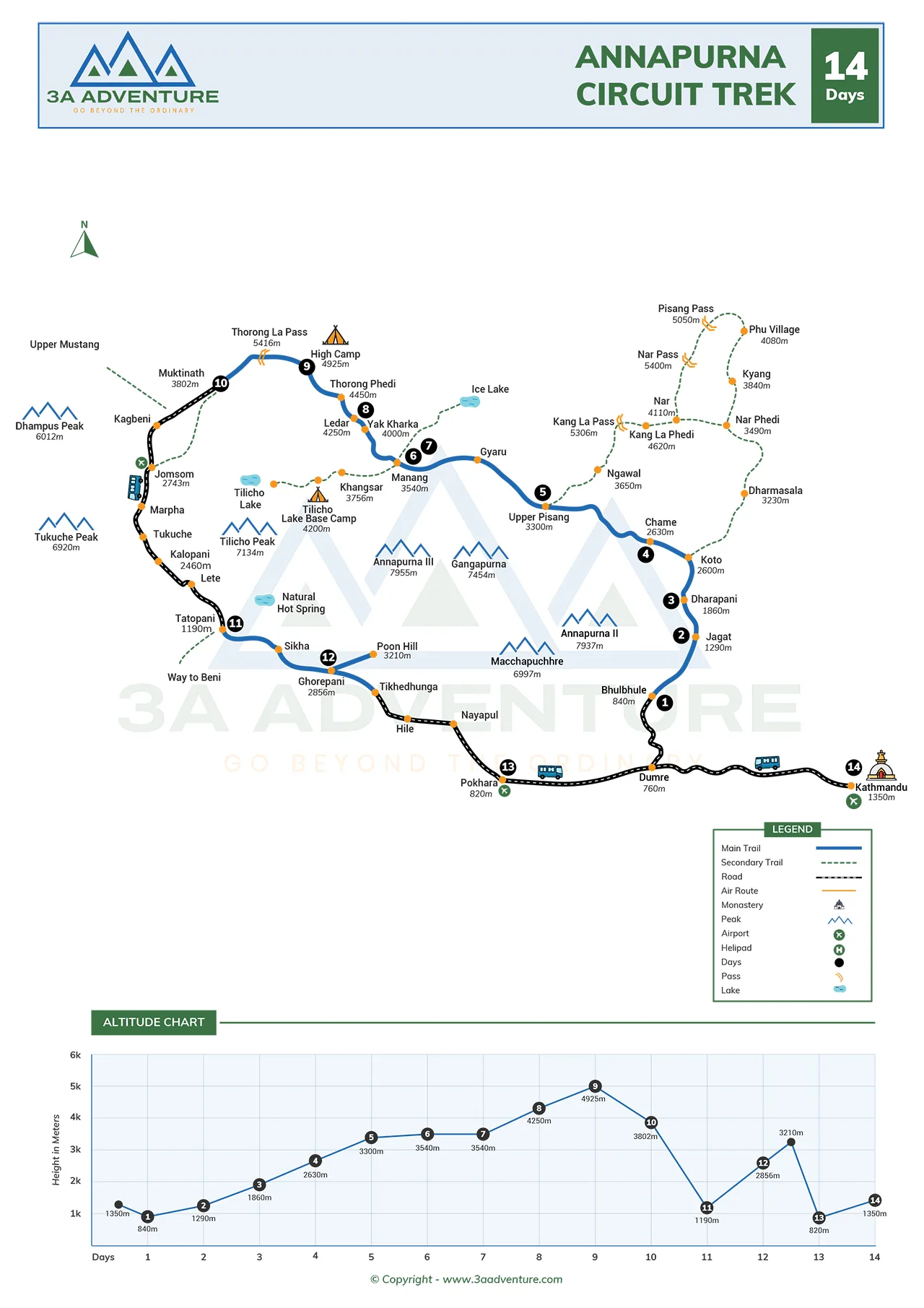
Tourist BusAfter the Everest Base Camp trip, the Annapurna Circuit trek is arguably Nepal’s most well-known highland trekking adventure. Over the course of 11 trekking days, our Annapurna Circuit Trek itinerary covers around 85 km. Despite being called the 14-day Annapurna Circuit journey, there are really 11 trekking days since three days are set out for transit to and from the initial location and the finish of the journey.
Since this is a standard itinerary with no extras, it is completely suitable for novices. The extended Annapurna Circuit Trek lasts 16 to 22 days. We will begin the Annapurna Circuit Trek from Bhulbhule rather than Besisahar, which is the usual starting place, although it still follows the same itinerary. To ensure a good acclimatization, we shall approach the Itinerary from a counter-clockwise direction.
You will see a variety of sceneries on your 14-day Annapurna Circuit Trek, beginning with the lower hills’ Chame vegetation, followed by the alpine Yak Kharka vegetation, and finally ending with the desert theme of Manang. Additionally, you should anticipate walking 7–10 kilometers on average while wearing a light daypack.
October and November are the ideal months for the Annapurna Circuit Trek because of the generally dry weather and an average daily temperature of 15°C. Summer is another ideal season for the Annapurna Circuit Trek. Although it might become a little hot in the cities and lower areas, the vistas are the greatest you will find and are quite clear.
For this walk, we advise you to bring light gear and warm clothes, but make sure they can withstand the bitter cold. Additionally, you may rent hiking gear from a nearby Kathmandu store or carry your own. The Annapurna Circuit Trek package does not include any of these items. Read till the end to find out every aspect of the trek, starting with its highlights.

To start the Annapurna Circuit Trek, we have to drive to Bhulbhule on a tourist bus. This starting point is about 175 km from the city of Kathmandu. It should take us about 6 to 7 hours to reach Besisahar, from where we will get on a jeep to Bhubhule village. Heading west from Kathmandu, we will drive over the Prithvi Highway, pass by Malekhu to reach Dumre and head north from there, leaving the highway. After reaching the starting point of the trek, we will head to a local tea house and spend our first night on the trek.

Activity: 6-7 hrs drive

Max. Altitude: 840m/2,756ft. (Bhulbhule)

Meal: Breakfast, Lunch & Dinner

Accommodation: Hotel
Starting the trekking days of the Annapurna Circuit Trek, we have a 16 km trail ahead of us, which has an estimated trek duration of 5 hours. The total elevation gain of the day is 455 meters, starting from 845 meters and reaching 1300 meters above sea level. The day begins with a lovely breakfast at Bhulbhule, followed by a trek alongside the Marsyangdi River. This is a well-marked path going through jungles and terraced farmlands.
Passing by many remote settlements, we will have our lunch en route and continue the ascent to Jagat. We have to cross a couple of streams over suspension bridges to reach our destination for the day.
Activity: 5 hrs trek
Max. Altitude: 1,300m/4,265ft. (Jagat)
Meal: Breakfast, Lunch & Dinner
Accommodation: Lodge
After a restful sleep at the Gurung village of Jagat, the 3rd day of the Annapurna Circuit Trek starts with a slight ascent alongside the Marsyangdi River. The initial part of the trek passes through stone-paved paths, leading us to Chamje village. Leaving Chamje, we will cross a suspension bridge and hit the climb up to the Tal village, entering the Manang region. This village offers great views of waterfalls and mani walls. From there, we will head to Kodo village, have a filling lunch there, and cross yet another suspension bridge to reach Dharapani.
Max. Altitude: 3,900m/12,795ft. (Dharapani)
Meal: Breakfast, Lunch & Dinner
Accommodation: Lodge
On the 4th day of the Annapurna Circuit Trek, the total trekking distance is 15.5 km, which we can cover in about 6 hours. The elevation gain of the day is 750 meters, reaching 2610 meters above sea level, starting from 1860 meters. Starting off, we will go over a forested trail and reach the village of Timang. A gorgeous view of the Manaslu peak can be seen from the village.
After a while, we will reach Koto village with a memorable view of Annapurna II, Annapurna IV, and Lamjung Himal. Continuing the trek, we will shortly reach Chame village and check into our accommodation for the night.
Activity: 6 hrs trek
Max. Altitude: 1,860m/6,102ft. (Chame)
Meal: Breakfast, Lunch & Dinner
Accommodation: Lodge
The hike from Chame to Pisang takes about six hours. The trip begins with a relaxing walk up to the suspension bridge across the Marsyangdi River. After that, the path enters a pine forest and continues until it reaches Bhartang. The elevation gain of the day is 690 meters, reaching 3300 meters above sea level, with an estimated duration of 5 to 6 hours.
The trail next ascends steeply to Dhikur Pokhari, which provides a stunning vista of the Annapurna range and Pisang Peak. We may need three to four hours to travel the entire upward route from here, depending on the influence of attitude. You can enjoy the stunning scenery of undulating hills and lush forests once we get there.
Activity: 5-6 hrs
Max. Altitude: 3,300m/10,827ft. (Upper Pisang)
Meal: Breakfast, Lunch & Dinner
Accommodation: Lodge
The following day on the Annapurna Circuit Trek, we will have to cover over 17 km of distance, which takes around 5 to 6 hours. Starting from 3300 meters above sea level, we will end the day at 3540 meters, gaining 240 meters of elevation. After breakfast at Upper Pisang, we will trek all the way to Ghyaru Ngawal village. The ascent to Ghyaru is steep, but the scene of the village is worth it all.
From Ngawal, we will head towards Barge Monastery. You might notice the air is getting colder and thinner as we move up the valley. Soon enough, we will reach the Manang Bazaar, sitting on the valley floor.
Activity: 5-6 hrs trek
Max. Altitude: 3,540m/11,614ft. (Manang)
Meal: Breakfast, Lunch & Dinner
Accommodation: Lodge
This is the one and only acclimatization day on the Annapurna Circuit Trek itinerary. To best utilize our time in the highlands, we will head on a hike to Ice Lake, also known as Kicho Tal. This acclimatization hike is around 10 km long, round-trip, with an estimated duration of 6 to 7 hours. This can be a long hike for most, which is why we have a short alternative hike to the Gangapurna Lake viewpoint.
Although the hike to the Ice Lake is strenuous, gaining us about 1100 meters of elevation, it is one of the most scenic parts of the region. With a stunning panoramic view of the Annapurna Himalayan range, the Tilicho peak, and the Gangapurna Glacier, this hike will keep us busy for the whole day.
Activity: 6-7 hrs
Meal: Breakfast, Lunch & Dinner
Accommodation: Lodge
Day 8 of the Annapurna Circuit Trek starts at 3540 meters above sea level and ends at 4250 meters. This gains us 710 meters of elevation within 4 to 5 hours of trekking. The total trek distance of the day is 9 km. The initial portion of the trek features a steady ascent to the village of Tenki, leaving the treeline behind. Heading northwest from Manang, we traverse the Jarsang Khola valley. From Tenki village, we continue the trek and reach Gunsan village, where traditional houses made of mud, clay, and stones can be seen.
After a while, we will reach Yak Kharka and spend a little time resting. From there, we will shortly get to Ledar and call it a day.
Activity: 4-5 hrs trek
Max. Altitude: 4,250m/13,944ft. (Ledar)
Meal: Breakfast, Lunch & Dinner
Accommodation: Lodge
On the 9th day of the Annapurna Circuit Trek, we will cover about 7.3 km of distance with an estimated duration of 4 to 5 hours. By the end of the trek, we will have gained 675 meters of elevation, reaching 4925 meters above sea level. The trek starts with a gentle climb towards Thorong Phedi. Crossing many streams and traversing an arid alpine terrain, we will get to the base of the Thorong La Pass, Thorong High Camp.
Activity: 4-5 hrs trek
Max. Altitude: 4,925m/16,158ft. (Thorong Phedi)
Meal: Breakfast, Lunch & Dinner
Accommodation: Lodge
Day 10 of the Annapurna Circuit Trek is the most physically demanding day and also the longest trekking day, with an estimated duration of 9 hours. The total trekking distance of the day is 15.6 km with an elevation gain of 491 meters at the top of the pass. Our net elevation change is a descent of 1656 meters, reaching Muktinath.
Starting the day, we have to ascend a rocky trail all the way up the Thorong La Pass. It is one of the highest passes in the world, which is also physically demanding. Reaching 5416 meters above sea level, you can see the Tibetan Plateau from the pass, along with views of the Annapurna Himalayan range. After spending some time at the top, we will descend to Muktinath and stay at a local inn for the night.
Activity: 9 hrs trek
Meal: Breakfast, Lunch & Dinner
Accommodation: Lodge
You can rest your tired muscles today, as we will be riding a jeep for 3 to 4 hours to reach Tatopani. The elevation loss of the day is 2560 meters above sea level, covering about 113 km of distance. After a morning visit to the Muktinath temple, we will get on a 4WD Jeep and head down the Kali Gandaki Valley. Winding through the hilly slopes, we will soon reach Jomsom and follow the Kali Gandaki River to reach Tatopani.
Activity: 3-4 hrs drive
Max. Altitude: 2,743m/8,999ft. (Jomsom)
Meal: Breakfast, Lunch & Dinner
Accommodation: Lodge
The next day on the Annapurna Circuit Trek itinerary, we have to cover about 17 km of trek distance, the longest of the journey. The estimated duration is 6 to 7 hours with a net elevation gain of 1660 meters. The day starts at 1200 meters above sea level, and takes us to 2860 meters. Today’s trek passes through Shikha and Chitre villages, which are popular Thakali villages. Crossing forests of magnolia, rhododendron, and oak, we will eventually reach Ghorepani and check into a local tea house.
Activity: 6-7 hrs trek
Max. Altitude: 2,860m/9,383ft. (Ghorepani)
Meal: Breakfast, Lunch & Dinner
Accommodation: Teahouse
Day 13 of the Annapurna Circuit Trek features a 12.5 km trail with an elevation gain of 350 meters at Poon Hill. The net elevation loss is 1070 meters. The estimated trek duration is 4 to 5 hours with an additional 2 hours of driving. The highest point of the day is 3210 meters above sea level, at the viewpoint of Poon Hill.
We will begin the day around 4 in the morning and hike to Poon Hill to experience a beautiful sunrise view. The view from the top features the Dhaulagiri and Annapurna Himalayan range. After a while, we will descend back to Ghorepani and head towards Tikhedhunga. From there, we will get on a jeep and reach Pokhara in about 2 hours.
Activity: 4-5 hrs hike / 2 hrs drive
Max. Altitude: 3,210m/10,531ft. (Poon Hill)
Meal: Breakfast, Lunch & Dinner
Accommodation: Hotel
The following day is the last day of the Annapurna Circuit Trek. Starting the day with a beautiful view of the hills and the entire Annapurna range, we will soon head to catch our ride to Kathmandu. From Pokhara, we have to cover about 200 km of distance to reach Kathmandu, which takes about 8 hours.
Max. Altitude: 1,400m/4,593ft. (Kathmandu)

Note:
If you have a private group and prefer a personalized experience, we can organize a custom trip tailored to your requirements and group size, running it any day you choose.
Transportation
Food and Accommodation
Guide and Support Staff
Permit and Expenses
Medical and Gear
Others
International Flights and Visa
Food and Accommodations
Travel and Medical Insurance
Other Expenses
The seasons of fall, summer, and spring are the best times to trek the Annapurna Circuit. In the lower hills area, summer may feel a little too hot, but it’s also the finest time to visit the area. The region’s brightly lit, lush landscape in the summer, along with the distant snowy peaks, creates a sight you won’t soon forget. Furthermore, spring and autumn are also excellent times of year; however, they are typically picked because of their “less rainfall” characteristics. Overall, summer is the best season to trek the Annapurna Circuit, next to spring and fall.
The Annapurna Circuit Trek’s challenging terrain, rough, inclining pathways, and cold air all make up for its high elevation (it reaches a maximum of 5416 m at Thorong La Pass). Because there is less oxygen in the air at high altitudes, people experience shortness of breath to compensate for the oxygen shortage. Since we will be walking on dirt grounds rather than well-paved roads, some of the incline routes are really challenging. Our Annapurna guides give this hike an overall rating of 7.5 out of 10.
Since we seldom spend any time at elevations over 5000 meters, which is where severe altitude sickness turns up, you are unlikely to catch it on our journey. We won’t be spending much time at the Thorong La Pass, which is the highest point of the Annapurna Circuit Trek at an incredible 5416 meters above sea level. When someone spends a whole night at high elevation without being properly acclimated, altitude sickness usually results. We have incorporated an acclimatization day into our Annapurna Circuit Trek itinerary for just this purpose.
It is not at all simple to prepare for the Annapurna Circuit Trek. It is crucial that you adequately prepare yourself, both mentally and physically. We advise taking a 21-day vacation if you choose to undertake this journey. To account for unanticipated circumstances, you should leave enough room before and after the journey. You can take the additional days to recuperate completely if all goes according to plan.
Cardio exercises and lengthy walks are recommended by our experienced guides as physical preparation. Going on short treks up hills is the finest thing to do while you’re getting ready. It’s perfectly OK to only exercise for endurance and cardio if you don’t live near hills.
A variety of traditional highland foods that are unique to the Annapurna area will be sampled on our Annapurna Circuit Short Trek. The Gurung, Magar, and Thakali tribes—all of whom have unique dietary habits—are the primary inhabitants of the Annapurna region’s highlands. Throughout the Annapurna Circuit Trek, the lodging is rather cozy and offers just the most basic conveniences. There are a few more conveniences available; however, some may be just showy.
Even if supplies are few in hardly accessible communities, the facilities in the Annapurna highlands are generally regarded positively since they make every effort to ensure that trekkers are comfortable.
At the start of the Annapurna Circuit Trek, we will have you get on a drive from Kathmandu to Bhulbhule. On day 11, you will take a ride from Muktinath to Jomson. Then, you will get on a ride to Pokhara from Tikhedhunga at the end of the trek, followed by a bus ride to Kathmandu. All of these transport expenses are covered by the trek package.
The Annapurna area is made up of both isolated communities that can only be reached on foot and well-maintained villages. Even the most isolated highland communities now have some level of network connectivity, which is excellent since it means you will be able to communicate during the Annapurna Circuit Trek. The majority of the hotels and restaurants along the trekking route offer WiFi, while some may charge an additional fee.
An Annapurna Conservation Area (ACA) permit and a Trekker’s Information Management System (TIMS) card are required for this Annapurna Circuit Trek. The ACAP office in Pokhara charges NRs. 3000 for the ACA permit, whereas the Kathmandu Nepal Tourism Board in Kathmandu charges NRs. 2000 for a TIMS card. These permits may be obtained with the assistance of our guide, and the trek package will cover the fees.
Visa fees are considered personal expenses, and so they are not a part of the Annapurna Circuit Trek package. After you arrive at the Tribhuvan International Airport, you need to pay your visa fees to obtain a tourist visa.
Travel insurance fees are also considered expenses of a personal nature. Every trekker in the group must have insurance to join our Annapurna Circuit Trek.
Things like additional meals, international flights, extra nights, emergency rescue services, visa fees, travel insurance fees, hot showers, WiFi, tips for the crew members, and more are not a part of the trek package.
Private treks are the best option for those who do not prefer to share the journey with strangers. You can go on this amazing Annapurna Circuit Trek with only your loved ones. On the other side, a standard group trek will have a bunch of individuals whom you are likely not to know.
General
Most of the trekkers spend only a single day in Manang before continuing the trek and heading towards the Thorong La Pass.
The highland sections of the trek, such as Manang, Ghyaru, Ngawal, Ice Lake, etc., offer the best scenes of Tilicho and Annapurna II.
Yes, you can visit the Ice Lake during the acclimatization day, and you can also visit other alternative sites without missing key parts of the route.
Most of the highland villages are heavily influenced by Tibetan Buddhism and architectural style; some of the most notable ones are Braga, Ghyaru, and Ngawal.
Yes, trails in between villages like Ledar and Thorong Phedi, Yak Kharka and Tengi, etc., can feel very remote as they are sparsely populated.
Before reaching Thorong High Camp, the most challenging but rewarding climb is the hike to Ice Lake during the acclimatization day in Manang.
Yes, the trek can be combined with nearby destinations, but some of them can add the number of days to the standard itinerary, which also increases the cost.
Preparation & Fitness
When hiking to the top of the Thorong La Pass, you will be on the trails for 4 to 5 hours. There are no alternative routes to take.
While it is not mandatory, having previous high-altitude trekking experience is always a plus. Beginners can also join the hike to Ice Lake, but it can be a bit too difficult for them.
The early morning ascent to Poon Hill from Ghorepani is not strenuous at all. It is one of the easiest ascents of the entire Annapurna Circuit Trek.
You can simply follow the pace of our trek guide and walk slowly; do not climb the ascents aggressively.
Yes, there are many short acclimatization hikes around Manang, including the Ice Lake hike, Gangapurna Lake hike, Chongkor viewpoint hike, and Praken Gompa hike.
You should at least drink 3 to 4 liters of water throughout the trek, regardless of the altitude you are staying at.
Trekkers do not have to carry their own oxygen supplies; however, they need to carry their own altitude sickness pills.
 Insurance & Visa
Yes, there are many checkpoints along the way, particularly in villages like Besisahar, Chame, Pisang, Manang, and Jomsom.
Yes, you can get travel insurance that covers emergency medical rescue from Thorong La. The trek package does not cover such expenses.
Solo trekking is not allowed in the region; trekkers are supposed to be accompanied by a licensed guide.
You can simply ask the insurance provider for the specific clauses in the insurance contract. However, most insurance providers do not cover such expenses; you have to choose an insurance that covers weather-related expenses.
Yes, if trekking gets delayed due to bad weather, you can simply visit the official immigration website and extend your visa without having to visit any offices physically.
You do not need any multiple-entry visas, just the simple tourist visa is enough to explore different sites within he country. Multiple-entry visas are for those who re-enter Nepal under the same visa period.
No, travel insurance policies do not cover such expenses; the Annapurna Circuit Trek package covers all your transportation expenses.
 Guides & Support Staff
Hiring a guide is not just about being on the right path; they also act as translators between you and the locals, and they are also responsible for contacting emergency services.
3A Adventure’s porters are capable of carrying around 24 kg of load throughout the Annapurna Circuit Trek.
Yes, our knowledgeable and experienced guides are familiar with the culture and history of the locals.
Yes, porters and guides will set up the tents and also prepare meals if you decide to stay in tents at high camps.
Our guides will measure your blood oxygen levels every day and night to look out for early signs of altitude sickness.
Yes, our local guides are bilingual; however, most of them are well-versed in Nepali and English rather than Tibetan.
No, such arrangements are not possible, as it is just not practical to do that.
 Accommodation and Facilities
Yes, you will get apple pies in most of the cafes in Manang. Although the fresh ones are mostly available in the autumn season.
Yes, hot water is readily available at lodges and tea houses near Thorong Phedi since it is usually cold.
Lower region villages, including Bhulbhule, Jagat, Pisang, offer attached bathrooms, while the higher region villages are highly to offer shared bathrooms.
Yes, there are many sites where you can camp instead of sleeping in tea houses, but this arrangement must be made in advance; you can not request camps on the go.
 Food and Drinks
Yes, there are villages like Marpha and Manang where you can try many different local cuisines instead of Western or standard food options.
Kitchens are usually closed by 7 to 8 PM in high-altitude tea houses since it can get really cold at night. Also, most tea houses open really early in the morning to prepare breakfast.
Yes, we can arrange food as per your restrictions, but you have to mention special requests at the booking phase.
 Weather & Seasons
The clearest sunrise view can be experienced during the months of August, September, and October. However, the summer months are also great for sunrise views.
Yes, landslides might occur within the Kali Gandaki Valley in the monsoon season. You will also pass by landslide zones during the trek.
In alpine zones, the weather can change in an instant as swift winds tend to bring clouds. However, the weather is somewhat stable during the peak trekking seasons.
Yes, snowfall is a possibility during the late spring season at Thorong La Pass.
Wide open areas like Yak Kharka, Thorong Phedi, and others experience winds mostly. However, you do not require extra layers of clothes.
In case the high passes are not available for trekking, we can continue the trek via lower trails as well.
 Health & Safety
Most of the major villages, including Chame, Pisang, Manang, and Jomsom have small medical posts or oxygen readily available for emergencies.
Yes, there are many safe resting spots along the Thorong La Pass. However, in case of altitude sickness, the trek guide will bring you down a couple of hundred meters.
Yes, the natural hot springs are generally safe for most skin conditions, but make sure to consult a doctor before doing so.
Although the suspension bridges seem scary because of the swaying, it is actually very safe to cross. You can additionally hold the rails if you need support.
No, most of the highland animals are usually very chill. Blue sheep are harmless; they do not interact with humans that much, but Yaks might charge at you if you provoke them.
 Booking & Payment
Yes, we can arrange flexible start dates for you at a price.
Yes, the trek package will include all your permit fees and tea house accommodations, along with your stay in Pokhara.
If you fall ill in the middle of the trek, you will be escorted to the nearest hospital. Your initial deposit will be refunded partially, as per our policy.
Yes, you can upgrade to private rooms, but they are usually reserved for months.
No, there are no discounts for groups or families on the trek.
Yes, changes to the itinerary can be accommodated after booking, but only minor changes. Bigger changes to the itinerary might cost you extra.
 Transportation & Flight
It is definitely easier to start the trek from Bhulbhule since it reduces the total trek distance.
From Tatopani, we have to drive over rough patches of dirt trail, which can be bumpy at times. On a scale of roughness, the road to Taopani is a 7 out of 10.
While there are no particular “luggage transfer” services, we can arrange sending your bags on a jeep or bus.
Yes, you are able to skip a few villages en route. Every year, drivable roads reach further into the valley. But that would require a completely different itinerary and pricing.
Typically, from Pokhara, we will be on the road for 8 hours and reach Kathmandu by evening.
No, the winter season can be very cloudy in Pokhara, which can delay flights as the visibility is not good enough. However, the Jomsom region is not really cloudy in winter.
Yes, although private taxis are not in high demand, we can manage them from Tatopani or Nayapul.